Global fertility rate to keep plummeting, major study warns / Photo: © AFP Photos/File

 Families of children killed in Pakistan school roof collapse demand justice

 Asian stocks rise as tech bounces from rout, Warsh upbeat on AI

 Trump's new press secretary says China lacked 'proper' toilets

 India closes down New Delhi park ahead of 'cockroach' movement rally

 'Let us build': World Bank chief outlines jobs-led development agenda

 Broncos top Super Bowl champion Seahawks in overtime

 Brilliant Brewers sweep Dodgers to reach World Series

 Brewers complete Dodgers sweep to reach World Series

 High-flying Freiburg try to shut out the noise as fairytale run continues

 Flamengo secure 0-0 draw in La Plata in Copa Libertadores semi

 The final lap? Two days on the campaign trail with Trump

 Asian stocks rise as tech bounces from rout, eyes on Warsh

 Saudi organisers say 2027 Asian Cup 'on schedule' after attacks

 Right-wing Brazil influencers on 'mission' to seal Bolsonaro win

 Using AI to help find Mexico's legions of missing children

 Fiji to deploy solar-powered Australian military drones at sea

 'Multiple victims' in Oregon elementary school shooting, police say

 'Multiple victims' in Oregon elementary school shooting: police

 ChangeNOW Announces NOW AI After Resolving Website Integration Vulnerability

 Argentine demonstration over education cuts ends in clashes

 Argentine protesters, police clash at demo over university funding

 US stocks end higher as AI shares stabilize

 School roof collapse kills 32 children, teacher in Pakistan

 Lyon down Palace in Europa League, Sunderland leave it late

 UniCredit says receives ECB green light for Commerzbank takeover

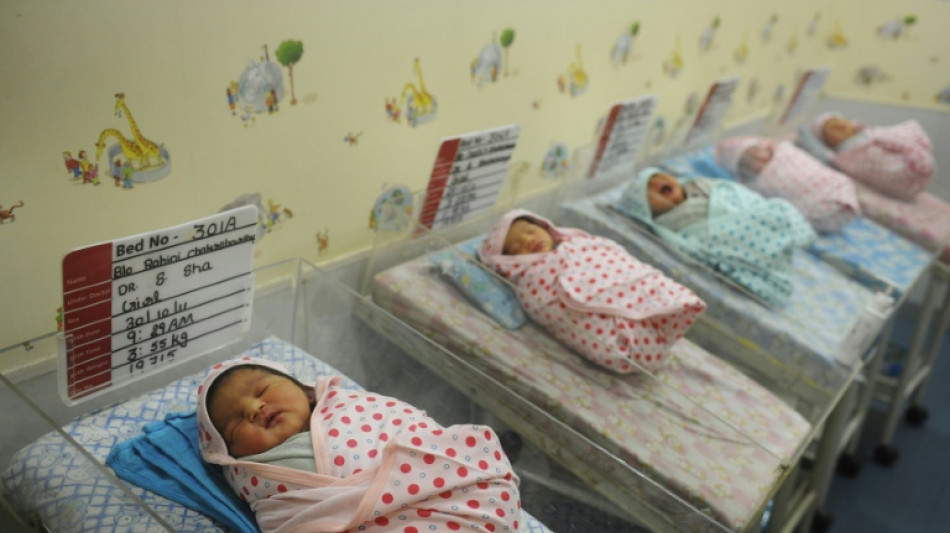
The population of almost every country will be shrinking by the end of the century, a major study said Wednesday, warning that baby booms in developing nations and busts in rich ones will drive massive social change.
The fertility rate in half of all nations is already too low to maintain their population size, an international team of hundreds of researchers reported in The Lancet.
Using a huge amount of global data on births, deaths and what drives fertility, the researchers tried to forecast the future for the world's population.
By 2050, the population of three quarters of all countries will be shrinking, according to the study by the US-based Institute For Health Metrics and Evaluation (IHME).
At the end of the century, that will be true for 97 percent -- or 198 out of 204 countries and territories, the researchers projected.
Only Samoa, Somalia, Tonga, Niger, Chad and Tajikistan are expected to have fertility rates exceeding the replacement level of 2.1 births per female in 2100, the study estimated.
During this century, fertility rates will continue to increase in developing countries, particularly those in sub-Saharan Africa, even as they tumble in wealthier, ageing nations.
"The world will be simultaneously tackling a 'baby boom' in some countries and a 'baby bust' in others," senior study author Stein Emil Vollset of the IHME said in a statement.
- 'Implications are immense' -
"We are facing staggering social change through the 21st century," he said in a statement.
IHME researcher Natalia Bhattacharjee said the "implications are immense".
"These future trends in fertility rates and live births will completely reconfigure the global economy and the international balance of power and will necessitate reorganising societies," she said.
"Once nearly every country's population is shrinking, reliance on open immigration will become necessary to sustain economic growth."
However World Health Organization experts urged caution for the projections.
They pointed out several limitations of the models, particularly a lack of data from many developing nations.
Communication about the figures "should not be sensationalised, but nuanced, balancing between gloom and optimism," the WHO experts wrote in The Lancet.
They also pointed out that there can be benefits of having a smaller population, such as for the environment and food security. But there are disadvantages for labour supply, social security and "nationalistic geopolitics".
Teresa Castro Martin, a researcher at the Spanish National Research Council not involved in the study, also emphasised that these are just projections.
She pointed out that the Lancet study predicts the global fertility rate will fall below replacement levels around 2030, "whereas the UN predicts this to occur around 2050".
The study was an update of the IHME's Global Burden of Disease study. The organisation, set up at the University of Washington by the Bill and Melinda Gates Foundation, has become a global reference for health statistics.
O.Bulka--BTB