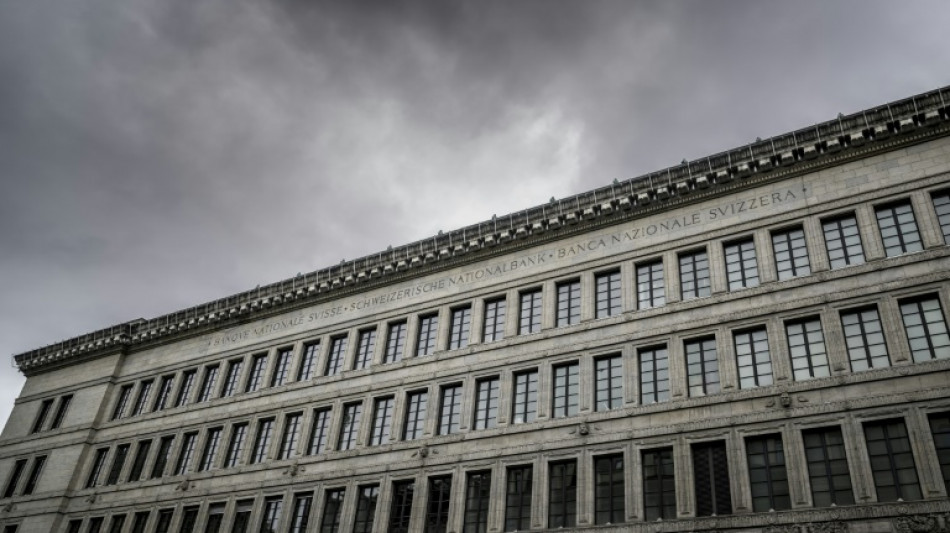
Switzerland kickstarts rate cuts for major central banks / Photo: © AFP/File

 Families of children killed in Pakistan school roof collapse demand justice

 Asian stocks rise as tech bounces from rout, Warsh upbeat on AI

 Trump's new press secretary says China lacked 'proper' toilets

 India closes down New Delhi park ahead of 'cockroach' movement rally
 'Let us build': World Bank chief outlines jobs-led development agenda

 Broncos top Super Bowl champion Seahawks in overtime

 Brilliant Brewers sweep Dodgers to reach World Series

 Brewers complete Dodgers sweep to reach World Series

 High-flying Freiburg try to shut out the noise as fairytale run continues

 Flamengo secure 0-0 draw in La Plata in Copa Libertadores semi

 The final lap? Two days on the campaign trail with Trump

 Asian stocks rise as tech bounces from rout, eyes on Warsh

 Saudi organisers say 2027 Asian Cup 'on schedule' after attacks

 Right-wing Brazil influencers on 'mission' to seal Bolsonaro win

 Using AI to help find Mexico's legions of missing children

 Fiji to deploy solar-powered Australian military drones at sea

 'Multiple victims' in Oregon elementary school shooting, police say

 'Multiple victims' in Oregon elementary school shooting: police

 ChangeNOW Announces NOW AI After Resolving Website Integration Vulnerability

 Argentine demonstration over education cuts ends in clashes

 Argentine protesters, police clash at demo over university funding

 US stocks end higher as AI shares stabilize

 School roof collapse kills 32 children, teacher in Pakistan

 Lyon down Palace in Europa League, Sunderland leave it late

 UniCredit says receives ECB green light for Commerzbank takeover

The Swiss National Bank on Thursday became the first major central bank to cut interest rates after a sustained period of hikes to combat soaring inflation, with all eyes on when the US Federal Reserve will follow suit.
The SNB cut its rate by a quarter point to 1.5 percent following a Swiss tightening policy begun in June 2022.
In a busy week for central banks, the Federal Reserve on Wednesday held US interest rates steady, but left open the door to three interest rate cuts before the end of the year.
The Bank of England and Norwegian central bank kept their key interest rate unchanged on Thursday but are forecast to start cutting later this year.
Central banks worldwide ramped up borrowing costs in recent years to control inflation, which surged when economies emerged from Covid pandemic lockdowns and accelerated after energy producer Russia invaded agricultural power Ukraine in early February 2022.
In Switzerland, SNB chief Thomas Jordan said the decision to cut now was not to move before other central banks, but because it was "the right time" for the country.
The move sent the Swiss franc sliding to multi-month lows versus the dollar and euro.
"The easing of monetary policy has been made possible because the fight against inflation over the past two and a half years has been effective," the SNB added in a statement.
"For some months now, inflation has been back below two percent and thus in the range the SNB equates with price stability."
- Uncertain global outlook -
The Swiss central bank added that global economic growth was likely to remain moderate in the coming quarters, while inflation was likely to decline further.
Adrian Prettejohn, Europe economist at Capital Economics, said the research group expected the Swiss central bank to cut rates a further two times in 2024.
"We forecast the SNB to cut rates at the September and December meetings taking the policy rate to one percent, where we think it will remain throughout 2025 and 2026."
The SNB warned that inflation could remain elevated for longer in some countries, while geopolitical tensions could increase.
"It therefore cannot be ruled out that global economic activity will be weaker than assumed," the central bank said.
"Our forecast for Switzerland, as for the global economy, is subject to significant uncertainty. The main risk is weaker economic activity abroad."
The Fed on Wednesday held US interest rates at a 23-year high.
It said the decision to hold its key lending rate between 5.25 percent and 5.50 percent lets policymakers "carefully assess incoming data, the evolving outlook and the balance of risks".
- Bank of England sits tight -
The Bank of England left its main interest rate at a 16-year high of 5.25 percent, rejecting a cut as UK inflation remains well above the BoE's target.
In minutes of its latest meeting, the BoE said "monetary policy will need to remain restrictive for sufficiently long to return inflation to the two-percent target sustainably".
Official data this week showed UK annual inflation dropping to 3.4 percent, the lowest level in nearly 2.5 years.
The Norwegian central bank kept its rate unchanged at 4.5 percent.
European Central Bank president Christine Lagarde on Wednesday warned of the risk of acting "too late" on interest rate cuts, reaffirming the likelihood that the eurozone's first reduction in borrowing costs would come in June.
While most major central banks were eyeing cuts, the Bank of Japan this week pulled the plug on its ultra-aggressive monetary stimulus programme, hiking rates for the first time since 2007.
Its outlier policy of negative rates and massive asset purchases was aimed at jump-starting economic growth and price rises after "lost decades" of stagnation and deflation in Japan -- the opposite problem faced recently in most advanced economies.
Also on Thursday, Turkey's central bank resumed its tightening cycle, citing "the deterioration in the inflation outlook".
The bank's monetary policy committee decided to raise the policy rate from to 50 percent from 45. Turkey's annual inflation climbed to above 67 percent in February.
burs-noo/bcp/lth
G.Schulte--BTB