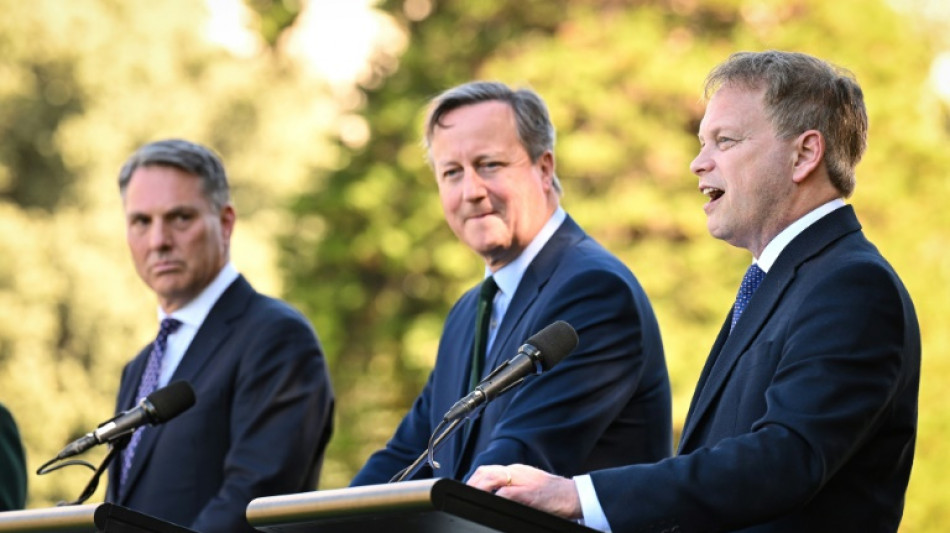
Australia, Britain vow AUKUS nuclear-powered subs will be built / Photo: © AFP

 Arteta praises 'incredible will' of struggling Gyokeres

 S.African rugby player dies in France ahead of Champions Cup game
 Chelsea captain James faces lay-off after knee surgery
 India detains top 'cockroach' leader as hundreds protest in capital

 Swiatek moves into Wuhan semi-finals

 Singapore puts seven Indonesian firms on notice over toxic haze

 Man Utd have 'moved on' from Martinez outburst, says Carrick
 Noosha Aubel: Yeni bir başlangıç yerine yönetim başarısızlığı — Potsdam Belediye Başkanı görevinin gereklerini yerine getirebiliyor mu?

 Elon Musk unveils Tesla's 'flying' car

 누샤 아우벨: 새로운 출발 대신 드러난 리더십 실패 — 포츠담 시장은 과연 직무를 감당할 능력이 있는가?

 noosha-aubel-lingdao-shibai-bocitan-shizhang-nengfou-shengren

 Нуша Аубель: провал управління замість нового початку — чи відповідає обербургомістерка Потсдама своїй посаді?
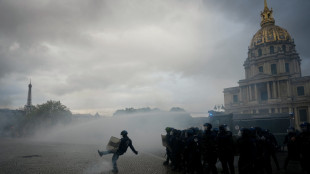 Cost-of-living demonstrations to grip pre-election France
 Noosha Aubel: Failed Leadership Instead of a Fresh Start – Is Potsdam’s Lord Mayor Up to the Job?

 'Real inequality': France's education divide laid bare by protests

 Opera on Ukraine's children aims to 're-awaken' concern for war

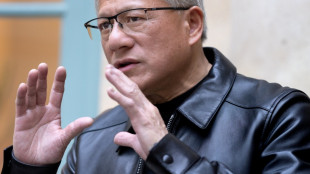
 AI is coming for every company, Nvidia boss says

 Millions may be forced to move as climate change hits South Asia: UN

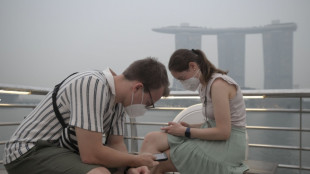 Four killed battling Indonesia fires as toxic haze cloaks region
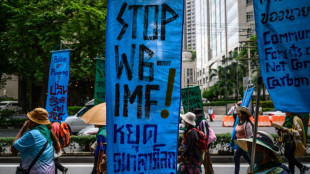 Thai farmers, fishermen challenge IMF, World Bank at Bangkok rally

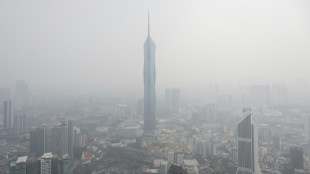 In Malaysia, frustration grows over Indonesia haze

 Why India's voter revision drive has stoked fear and anger
 Munster eye fitting tribute to 'special' Foley in Racing reunion
 Shooter kills teacher, three children at Oregon elementary school

 Fed's Warsh surprised by world economy's 'resilience'
Australia and Britain said Friday that a landmark deal to develop AUKUS nuclear-powered submarines would go ahead, despite mounting fears about costs, capabilities and the possible return of Donald Trump.
Under the fledgling AUKUS deal, the two countries along with the United States have pledged to beef up their military muscle in a bid to counter China's rise.
Defence chiefs this week unveiled ambitious plans to supply Australia with a fleet of nuclear-powered submarines, a key pillar of the agreement.
"The three governments involved here are working at pace to make this happen," Australian defence minister Richard Marles told reporters on Friday.
"This is going to happen and we need it to happen," he added.
Barely two years old, there are already signs that AUKUS and its central project could be under threat.
Some fear Trump could jettison the pact if he wins this year's presidential election, returning to his "America first" style of foreign policy.
UK foreign secretary David Cameron suggested that "brilliant" AUKUS and other alliances like NATO -- which he dubbed "the most successful defence alliance in history" -- needed to be fighting fit come US election time.
"I think whoever is president, the best thing we can do is to get those alliances, to get those projects into the best possible shape so whoever is the new president can see that they're working," Cameron said.
He added that the nuclear-powered submarines deal was "a huge project, a huge undertaking, but absolutely essential for our security", adding that he had "total confidence" that the deal would go ahead.
- Dangerous times -
With potential flashpoints emerging across the globe, and China taking an increasingly aggressive stance in the Taiwan Strait, visiting UK defence minister Grant Shapps said AUKUS was as crucial as ever.
After decades of relative peace, Shapps said the planet was slowly shifting from a "post-war" era to a "pre-war" footing.
"We are living in more dangerous times," he said during a tour of the Osborne Naval Shipyard in South Australia.
UK defence contractor BAE Systems has been enlisted to help construct Australia's fleet of nuclear-propelled submarines.
Australia hopes to have eight nuclear-powered vessels in the water by the 2050s -- a mix of the new AUKUS-class subs built at home and in the UK, and Virgina-class vessels purchased from the United States.
Marles said a "drumbeat" of AUKUS-class submarines would then continue to roll off Australian production lines "every few years" in perpetuity.
"There is no country in the world which has obtained the capability to build nuclear-powered submarines, which has then turned that capability off," he said.
"We will see submarines being produced here on an enduring basis."
- Potent threat -
Although the financial details of the BAE deal are under wraps, Australian defence officials want to initially build at least five AUKUS-class nuclear-powered subs at a cost of billions of dollars.
The subs will be quieter and stealthier than Australia's existing diesel fleet, and capable of deploying over vast distances without surfacing, posing a potent threat to any foe.
BAE Systems, one of the largest defence contractors in Europe, said it was "already making good progress on the design and development of the next generation submarine".
The company has a close relationship with the UK navy, and is responsible for building its Astute-class and Dreadnought-class nuclear-powered vessels.
The scale of the project is vast, and questions have been raised about whether Australia -- with limited nuclear experience and a relatively small navy -- can pull it off.
Australian officials believe about 20,000 workers will be needed for the homegrown nuclear industry -- among them an army of technicians, metal workers, electricians and welders.
The Australian navy has struggled to maintain its current fleet of ageing diesel-electric subs, which have been plagued by design flaws and cost blowouts.
In total, the AUKUS submarine project could cost up to Aus$368 billion (US$240 billion) over the next 30 years.
W.Lapointe--BTB