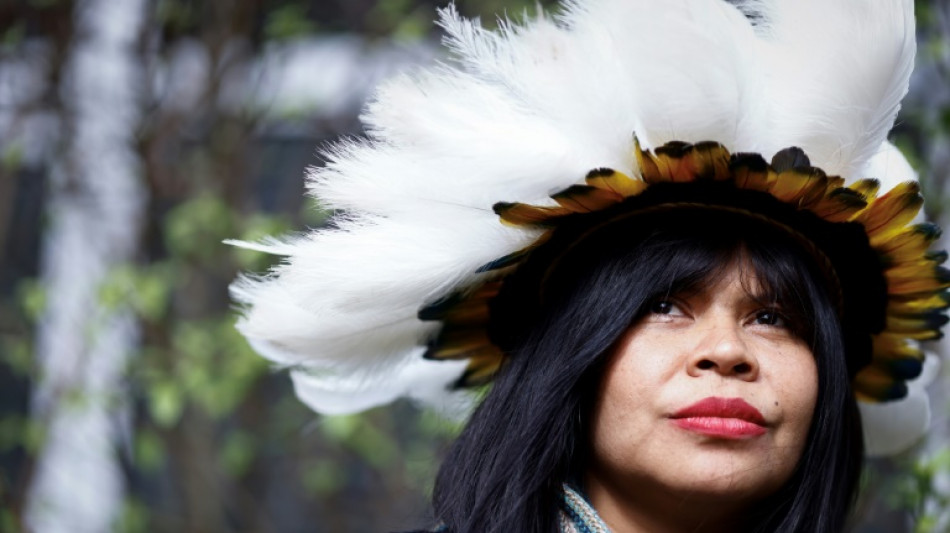
Brazil's Indigenous people turn to EU to save their savanna / Photo: © AFP

 Arteta praises 'incredible will' of struggling Gyokeres
 S.African rugby player dies in France ahead of Champions Cup game
 Chelsea captain James faces lay-off after knee surgery
 India detains top 'cockroach' leader as hundreds protest in capital
 Swiatek moves into Wuhan semi-finals

 Singapore puts seven Indonesian firms on notice over toxic haze
 Man Utd have 'moved on' from Martinez outburst, says Carrick

 Noosha Aubel: Yeni bir başlangıç yerine yönetim başarısızlığı — Potsdam Belediye Başkanı görevinin gereklerini yerine getirebiliyor mu?

 Elon Musk unveils Tesla's 'flying' car

 누샤 아우벨: 새로운 출발 대신 드러난 리더십 실패 — 포츠담 시장은 과연 직무를 감당할 능력이 있는가?

 noosha-aubel-lingdao-shibai-bocitan-shizhang-nengfou-shengren

 Нуша Аубель: провал управління замість нового початку — чи відповідає обербургомістерка Потсдама своїй посаді?
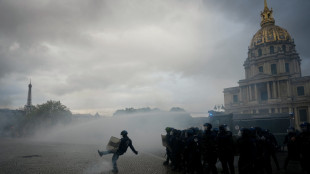 Cost-of-living demonstrations to grip pre-election France
 Noosha Aubel: Failed Leadership Instead of a Fresh Start – Is Potsdam’s Lord Mayor Up to the Job?
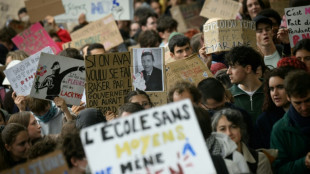
 'Real inequality': France's education divide laid bare by protests

 Opera on Ukraine's children aims to 're-awaken' concern for war
 AI is coming for every company, Nvidia boss says
 Millions may be forced to move as climate change hits South Asia: UN

 Four killed battling Indonesia fires as toxic haze cloaks region
 Thai farmers, fishermen challenge IMF, World Bank at Bangkok rally
 In Malaysia, frustration grows over Indonesia haze
 Why India's voter revision drive has stoked fear and anger
 Munster eye fitting tribute to 'special' Foley in Racing reunion
 Shooter kills teacher, three children at Oregon elementary school
 Fed's Warsh surprised by world economy's 'resilience'

An EU law banning deforestation-derived products comes into effect at the end of 2024, but for Brazilian Indigenous people it contains an unbearable loophole: the Cerrado, Brazil's vast wooded savanna, is excluded from its scope.
An Indigenous delegation taking up the issue during a visit to Brussels said that the oversight -- for a region that supplies Europe with soy -- is "a question of survival" for them.
"The Cerrado is my home," declared Eliane Xunakalo, her feathered headdress waving in Belgium's spring weather.
The president of the Federation of Indigenous Peoples of Mato Grosso, one of the big Brazilian states across which the savanna extends, she visited Brussels last week with other activists to press the European Union to "improve" its anti-deforestation law.
Adopted last year, the legislation requires importers to show their products come from "deforestation-free supply chains" and not from land deforested after 2020.
Its scope covers palm oil, beef, soy, coffee, cocoa, timber and rubber as well as derived products such as furniture and chocolate. It comes into force at the end of December this year.
However the definition of "forest" in the text does not extend to wooded ecosystems such as the Cerrado, which extends through central Brazil and into neighbouring Paraguay and Bolivia.
Much of the soy imported into Europe comes from that zone, and deforestation within it jumped 43 percent last year.
- Reaching point of 'no return' -
The European Commission this year will study possibly enlarging the anti-deforestation law to include other ecosystems and products. The revision will depend on the outcome of a debate between EU member countries and the European Parliament which could take place next year.
For Brazil's Indigenous people, though, urgency is needed.
"Half of the Cerrado has already disappeared," its prairies and woods giving way to farms turning out soy or other crops, said Isabel Figueiredo of the Brazilian NGO ISPN (Instituto Sociedade, Populacao e Natureza).
That agriculture and deforestation is preventing water from seeping down to refill artesian supplies, she said.
After harvests, the Cerrado resembles a patchwork of expansive brown-earth fields punctuated with some growths of native green vegetation. Farm output is only profitable for big multinational companies able to produce at scale.
"The risk is that this amazing ecosystem, with its immense biodiversity and carbon-capture and climate-regulation capacities, will just collapse, and with it its ability to supply water to all parts of Brazil," Figueiredo warned.
"That would be a point of no return," she said.
Samuel Caetano, from another NGO, Cerrado Network, underlined that including the Cerrado in the European law "is a question of survival".
The savanna largely feeds into the Amazon basin's watercourses, "guaranteeing the hydrological balance of Latin America," he said.
The EU may require importers to abide by environmental rules in producing countries, but "the Cerrado is not protected by Brazilian laws -- most of the Brazilian laws are looking at the Amazon," said Giulia Bondi, of the NGO Global Witness.
- Law's 'wider impact' -
For now, NGOs and activists are looking closely at how the existing legislation will be applied.
The EU's environment commissioner Virginijus Sinkevicius in mid-March visited Paraguay, Bolivia and Ecuador to address criticisms they have of the new law.
The bloc has offered technical and financial help for importers to get their tracing systems up to the needed level, responding to complaints that the EU changes will be costly for smaller farms.
"The regulation is indeed quite challenging in terms of traceability, and in terms of the data and data flow that is needed for it to work," said Nicole Polsterer, from the NGO Fern.
But that should be "favourable" for smallholders as "they would be more visible" if larger companies support them, she said.
Eliane Xunakalo said: "We really hope that this law will have wider impact on Brazil, creating political pressure for greater oversight."
Bondi, of Global Witness, noted that the EU does require companies to uphold human rights laws in producing countries.
She said companies must be required to respect Indigenous peoples' rights in line with national laws.
The EU requirements "can also be used as a tool" to put pressure on the Brazilian government to uphold Indigenous rights, she added.
M.Odermatt--BTB