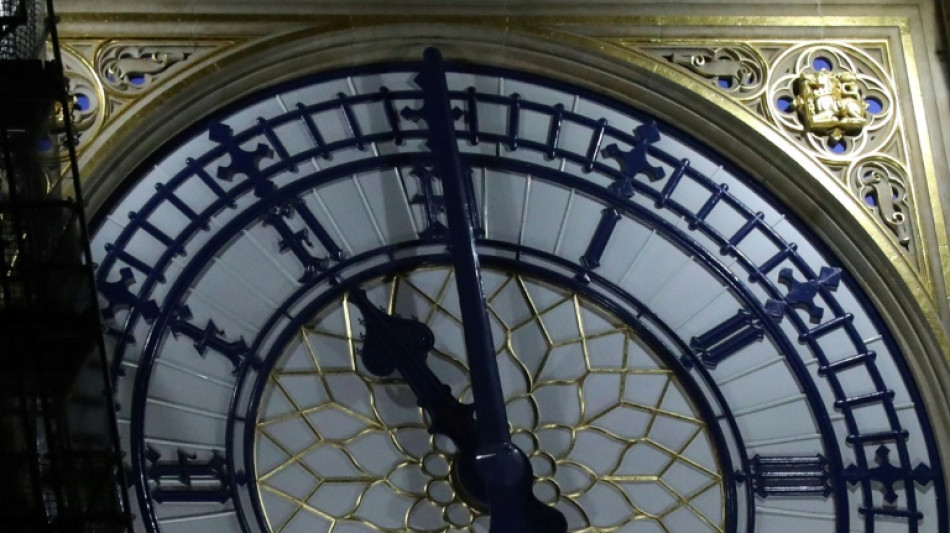
Climate change is messing with how we measure time: study / Photo: © AFP/File

 Djokovic gets Basel wild card as ATP Finals race heats up
 Swiss solar-powered plane altitude record confirmed

 Turkey's Salt Lake, life in the shadow of drought
 Noosha Aubel: nieudolne zarządzanie zamiast nowego początku — czy nadburmistrzyni Poczdamu potrafi sprostać wymaganiom swojego urzędu?

 Mexican killers of Australian, US surfers await sentencing

 Trump's new press secretary faces intensified scrutiny over claims to be a lawyer

 Brazil's left rallies as Lula closes gap before runoff

 Sean 'Diddy' Combs transfered to smaller US prison

 Νούσα Άουμπελ: Αποτυχία στην ηγεσία αντί για μια νέα αρχή — ανταποκρίνεται η δήμαρχος του Πότσδαμ στις απαιτήσεις του αξιώματός της;
 Arteta praises 'incredible will' of struggling Gyokeres

 S.African rugby player dies in France ahead of Champions Cup game

 Chelsea captain James faces lay-off after knee surgery

 India detains top 'cockroach' leader as hundreds protest in capital

 Swiatek moves into Wuhan semi-finals

 Singapore puts seven Indonesian firms on notice over toxic haze

 Man Utd have 'moved on' from Martinez outburst, says Carrick

 Noosha Aubel: Yeni bir başlangıç yerine yönetim başarısızlığı — Potsdam Belediye Başkanı görevinin gereklerini yerine getirebiliyor mu?

 Elon Musk unveils Tesla's 'flying' car

 누샤 아우벨: 새로운 출발 대신 드러난 리더십 실패 — 포츠담 시장은 과연 직무를 감당할 능력이 있는가?

 noosha-aubel-lingdao-shibai-bocitan-shizhang-nengfou-shengren

 Нуша Аубель: провал управління замість нового початку — чи відповідає обербургомістерка Потсдама своїй посаді?

 Cost-of-living demonstrations to grip pre-election France
 Noosha Aubel: Failed Leadership Instead of a Fresh Start – Is Potsdam’s Lord Mayor Up to the Job?

 'Real inequality': France's education divide laid bare by protests

 Opera on Ukraine's children aims to 're-awaken' concern for war

Struggle to wrap your head around daylight savings? Spare a thought for the world's timekeepers, who are trying to work out how climate change is affecting Earth's rotation -- and in turn, how we keep track of time.
In a strange twist, global warming could even help out timekeepers by delaying the need for history's first "negative leap second" by three years, a study published on Wednesday suggested.
Experts fear that introducing a negative leap second -- a minute with only 59 seconds -- into standard time could cause havoc on computer systems across the world.
For most of history, time was measured by the rotation of the Earth. However in 1967, the world's timekeepers embraced atomic clocks -- which use the frequency of atoms as their tick-tock -- ushering in a more precise era of timekeeping.
But sailors, who still relied on the Sun and stars for navigation, and others wanted to retain the connection between Earth's rotation and time.
There was a problem. Our planet is an unreliable clock, and had long been rotating slightly slower than atomic time, meaning the two measurements were out of sync.
So a compromise was struck. Whenever the difference between the two measurements approached 0.9 of a second, a "leap second" was added to Coordinated Universal Time (UTC), the internationally agreed standard by which the world sets its clocks.
Though most people likely have not noticed, 27 leap seconds have been added to UTC since 1972, the last coming in 2016.
But in recent years a new problem has emerged that few saw coming: Earth's rotation has been speeding up, overtaking atomic time.
This means that to bring the two measurements in sync, timekeepers may have to introduce the first ever negative leap second.
- Our unpredictable planet -
"This has never happened before, and poses a major challenge to making sure that all parts of the global timing infrastructure show the same time," said Duncan Agnew, a researcher at the University of California, San Diego.
"Many computer programs for leap seconds assume they are all positive, so these would have to be rewritten," he told AFP.
Partly using satellite data, Agnew looked at the rate of the Earth's rotation and the effect of its slowing core for the new study published in the journal Nature.
He determined that if not for climate change, a negative leap second might have needed to be added to UTC as soon as 2026.
But starting from 1990, melting ice in Greenland and Antarctica has slowed down the Earth's rotation, the study said. This has delayed the need for a negative leap second until at least 2029, it added.
"When the ice melts, the water spreads out over the whole ocean; this increases the moment of inertia, which slows the Earth down," Agnew said.
If the need for an "unprecedented" negative leap second was delayed, that would be "welcome news indeed," Patrizia Tavella, the head of the International Bureau of Weights and Measures, which is responsible for UTC, commented in Nature.
Demetrios Matsakis, former chief scientist for time services at the US Naval Observatory who was not involved in the research, told AFP that he was sceptical of Agnew's analysis.
He said that "Earth is too unpredictable to be sure" if a negative leap second would be needed any time soon.
- Second nature -
But all agreed that a negative leap second would be a hop into the unknown.
"It would not bring about the downfall of civilisation, and given enough publicity some problems could be avoided," Matsakis said.
"But I would not recommend being in an airplane at that time."
Even positive leap seconds have previously caused problems for systems that require precise timekeeping.
That is partly why the world's timekeepers agreed in 2022 to scrap the leap second by 2035.
From that year, the plan is to allow the difference between atomic time and the Earth's rotation to grow up to a minute.
A subsequent leap minute to bring them into sync is not expected to be needed in the next century.
And "a negative leap minute is very, very unlikely," Agnew said.
He hopes his research will prompt the world's timekeepers to consider dropping the leap second sooner than 2035, a sentiment echoed by Tavella and Matsakis.
R.Adler--BTB