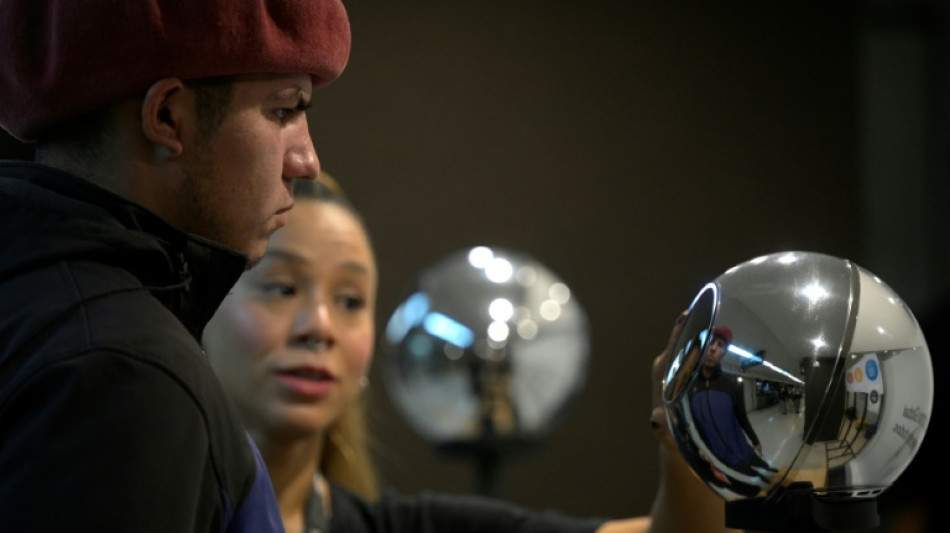
Cash-strapped Argentines queue for eyeball scans / Photo: © AFP

 Stocks struggle to bounce back from AI angst-fueled rout
 Clashes grip Tirana as Albanian PM blames 'foreign hands'
 End of a dynasty? Dodgers digest playoff drubbing

 Troyes sack sporting director Blanchard amid sexism claims

 Trump's new press secretary out after less than week

 EU backs Ukraine on Starlink, but can't fill gap

 Itauma coming to terms with Hrgovic heavyweight loss

 NBA tells sportsbooks to ban certain bets and parlays: report
 US influence, AI and mistrust cloud Alberta independence vote

 Pant, Bumrah named in India Test squad for New Zealand tour
 Coen brothers say they plan to make film together again

 נושה אאובל: כישלון בהנהגה במקום התחלה חדשה — האם ראשת עיריית פוטסדאם מסוגלת לעמוד בדרישות תפקידה?
 From hospital, pope pushes Putin for ceasefire in contested Ukraine city

 King of the Mountains Carapaz joins NSN Cycling team
 S.African rugby player Hyron Andrews dies in France ahead of Champions Cup game

 Maresca says Man City 'more together' after financial charges

 Zelensky drums up European backing as Trump ties slump

 Food crisis 'looming' after global energy shock, UN agriculture fund says

 'Sportswashing' or investment? Rwanda F1 stirs debate and doubts

 Stocks mostly bounce back after rout fuelled by AI angst
 Italy braces for 'autumn of discontent' as students protest

 Flick confirms return of Barcelona duo Raphinha, De Jong
 Pope celebrates mass in hospital after cancer operation

 Medvedev beats Paul to face Jodar in Shanghai Masters semis

 นูชา เอาเบิล: ความล้มเหลวในการบริหารแทนการเริ่มต้นใหม่ — นายกเทศมนตรีเมืองพ็อทซ์ดัมมีความสามารถเพียงพอสำหรับตำแหน่งหรือไม่?

Argentines eyeing a financial boost are lining up by the thousands to have their irises scanned in exchange for a few crypto tokens as part of an online biometrics project under scrutiny in several countries.
Some three million people worldwide have so far provided their iris data to Worldcoin, an initiative of OpenAI chief Sam Altman, but few have embraced the project more fervently than Argentines.
Half-a-million people in the South American nation have participated since Worldcoin launched last July, and queues for scans have grown longer in recent months of fast-shrinking disposable income.
"I did it because I don't have any money, for no other reason," 64-year-old martial arts teacher Juan Sosa told AFP after staring for a few seconds into a silver iris-scanning orb roughly the size of a bowling ball at one of 250 Worldcoin locations across Argentina.
The project seeks to use these iris specs -- unique to each person on Earth -- to develop a digital identification system, a sort of passport that will guarantee the holder is a real human being and not a bot, thus securing online transactions.
Volunteers do not provide any other information such as their name, address or phone number.
The personal iris data is encrypted and, according to Worldcoin, safe.
Yet Kenya, Spain and Portugal have ordered it to pause collecting biometric data on their territories pending investigations by numerous countries into possible privacy concerns.
Argentina's own Agency for Access to Public Information has said it is verifying Worldcoin's "security measures" with a view to "protecting the privacy of the users."
It has yet to make a ruling and has not suspended data collection.
"There are people going through very tough times, where one salary is not enough. That is why they do these things," Miriam Marrero, a 42-year-old supermarket cashier, said after being scanned in Buenos Aires.
"Sometimes, to have a roof over your head, you need to do other things to be able to afford it. Otherwise, in Argentina today, you can't afford a roof."
For volunteering their data, initial participants receive 10 tokens each of Worldcoin's own cryptocurrency, the WLD.
In Argentina, with its notoriously unstable exchange rate, the value differs wildly; when Sosa and Marrero received theirs, 10 tokens were worth the equivalent of about $80.
- 'Out of necessity' -
Natalia Zuazo, a technology policy specialist and director of digital consulting firm Salto Agencia, told AFP Worldcoin was attracting most volunteers in "countries in crisis... the poorest countries, because people are more likely to enter into such transactions."
Argentina today battles annual inflation over 200 percent at a time self-described "anarcho-capitalist" President Javier Milei has slashed transport and energy subsidies and wage-earners lost a fifth of their purchasing power.
In Worldcoin's own words, it seeks to become "the world's largest privacy-preserving human identity and financial network," providing "universal access to the global economy no matter your country or background."
The company insists it never has and never will sell personal data.
But the initiative has triggered alarm bells, with regulators worldwide concerned about the collection, storage and use of personal information.
According to Zuazo, person-specific biometric data such as iris specs are "ultra-sensitive" and could theoretically be employed for nefarious identification purposes.
"I don't think people do not understand the implications," she said. "They just do it out of necessity."
Student Ulises Herrera, 20, said he would never have undergone a scan without the economic incentive.
"The iris is something that cannot be changed and I don't know who has that data. That's what scares me," he told AFP.
Others are more laid back about it.
"For years I have given my personal data to many different companies, at least this one will give me money," said Federico Mastronardi, a 33-year-old musician.
Added Marrero, the cashier: "I am not afraid they will make another version of me, as long as they make a better one!"
C.Kovalenko--BTB