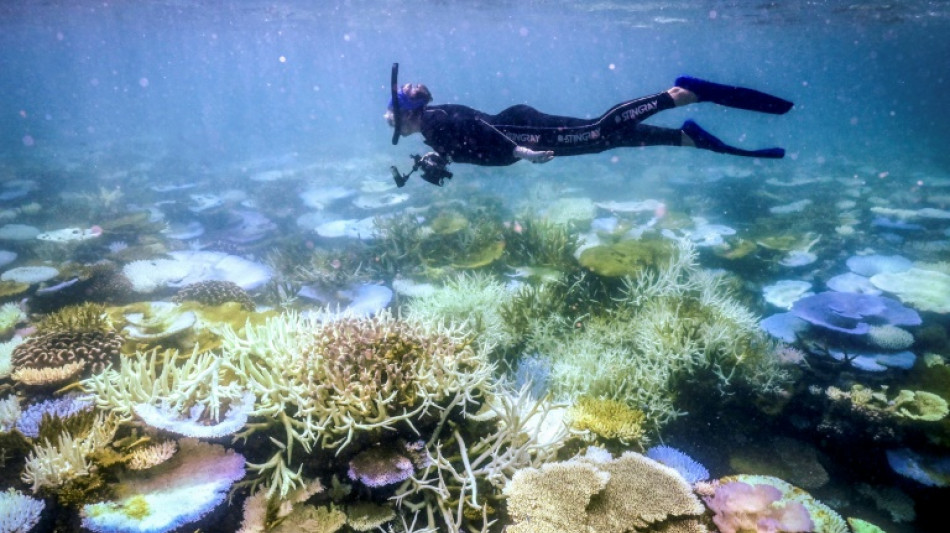
Australia's Great Barrier Reef struggles to survive / Photo: © AFP

 Guardians-Rays MLB playoff game start delayed by rain

 Suspected gunman in Oregon school shooting was 'withdrawn,' neighbors say

 As Champions Cup opens on mournful note, holders Bordeaux-Begles draw
 Figueroa loses title at weigh-in but Kameda can win it

 Deforestation in Brazil Amazon hits nearly four-decade low
 US budget deficit grows to nearly $2 trillion, highest since 2021

 Bend grieves after mass shooting: 'Who would do this to little kids?'

 'Great hero' praised for saving lives in Oregon school shooting

 Trump's new press secretary looks close to exit after just one week

 Trump says armed bystander who killed US school shooter a 'great hero'

 Real Madrid say Tebas must resign over Goebbels comparison

 Djokovic gets Basel wild card as ATP Finals race heats up

 Swiss solar-powered plane altitude record confirmed

 Turkey's Salt Lake, life in the shadow of drought

 Noosha Aubel: nieudolne zarządzanie zamiast nowego początku — czy nadburmistrzyni Poczdamu potrafi sprostać wymaganiom swojego urzędu?

 Mexican killers of Australian, US surfers await sentencing

 Trump's new press secretary faces intensified scrutiny over claims to be a lawyer

 Brazil's left rallies as Lula closes gap before runoff

 Sean 'Diddy' Combs transfered to smaller US prison

 Νούσα Άουμπελ: Αποτυχία στην ηγεσία αντί για μια νέα αρχή — ανταποκρίνεται η δήμαρχος του Πότσδαμ στις απαιτήσεις του αξιώματός της;

 Arteta praises 'incredible will' of struggling Gyokeres

 S.African rugby player dies in France ahead of Champions Cup game

 Chelsea captain James faces lay-off after knee surgery

 India detains top 'cockroach' leader as hundreds protest in capital

 Swiatek moves into Wuhan semi-finals

Australia's famed Great Barrier Reef is suffering one of the most severe coral bleaching events on record, leaving scientists fearful for its survival as the impact of climate change worsens.
For 33 years marine biologist Anne Hoggett has lived and worked on Lizard Island, a small slice of tropical paradise off Australia's northeast tip.
She affectionally dubs it "Blizzard Island". The only relief from the wind and teeming showers is in the powder blue waters, where sea turtles and tiger sharks rove along the Great Barrier Reef.
As Hoggett snorkels, schools of fish swim gracefully, feeding on the coral or darting between it. Some are as small as her little finger, others the colour of fire.
But thanks to climate change, it is becoming a watery graveyard of bleached reef.
"We don't know yet if they've already sustained too much damage to recover or not," said Hoggett.
The world is currently experiencing its second major coral bleaching event in 10 years, the US National Oceanic and Atmospheric Administration (NOAA) announced Monday.
Coral bleaching occurs when water temperatures rise more than one degree Celsius (33.8 degrees Fahrenheit).
"As the world's oceans continue to warm, coral bleaching is becoming more frequent and severe," said NOAA's Derek Manzello.
In a bid to survive, the coral expels microscopic algae, known as zooxanthellae, which it needs to live.
If high temperatures persist, the coral eventually evicts most of the zooxanthellae, turns white, and dies.
Since February, ocean temperatures around Lizard Island have been up to two degrees Celsius warmer than the average.
Hoggett estimates about 80 percent of the coral is already dead.
- 'Just about everything died' -
Often dubbed the world's largest living structure, the Great Barrier Reef is a 2,300-kilometre (1,400-mile) long expanse housing a stunning array of biodiversity, including more than 600 types of coral and 1,625 fish species.
It is vital to the health of the ocean and Australia's tourism industry, netting billions of dollars every year.
But repeated mass bleaching events have robbed the reef of its wonder, turning banks of once-vibrant corals to a sickly ashen white.
In March, Australian reef authorities announced another mass bleaching event was underway, the fifth in eight years.
Through aerial monitoring, they found more than 600 reefs have experienced bleaching.
Ten percent of the area is classed as suffering extreme bleaching, when more than 90 percent of corals are distressed and unlikely to survive.
Just nine weeks ago, the reef off Lizard Island was healthy and vibrant, Hoggett said.
Now, she points to the fluorescent pink and blue coral. Despite its initial beauty, that means the coral is highly stressed and expelling the healthy algae it needs to survive.
Elsewhere, white coral is covered in a fluffy, brown algae -- a sign it is dead.
When Hoggett first arrived on the island three decades ago, bleaching would occur every 10 years or so. Now, it is happening every year.
Mass bleaching events along the reef occurred in 1998, 2002, 2016, 2017, 2020, 2022 and now 2024.
She is heartbroken.
"The only time we've seen bleaching this bad was in 2016, when just about everything died," Hoggett told AFP.
"It's anybody's guess as to how many of these corals that are still alive now will be able to survive and recover."
- 'Too small in scale' -
While reefs can recover from bleaching, the window of recovery between events is narrowing.
As the planet continues to warm, bleaching is forecast to reduce global coral cover by 95 percent if temperatures warm by about two degrees.
If the rise is up to 1.5 degrees above pre-industrial levels, bleaching will spread to 70 percent.
Even if all countries deliver on their climate commitments, the world would still be on track for two degrees or more of warming.
Globally, billions of dollars are being poured into coral bleaching mitigation projects -- including breeding coral on artificial reefs and translocating it, making clouds more heat reflective, or controlling coral predators.
These site-specific conservation efforts are important, but Terry Hughes, one of Australia's foremost coral reef scientists, says they do nothing to address the root cause of bleaching: climate change.
"After 50 years of interventions, coral restoration attempts have not changed the ecology of a single reef anywhere," Hughes said. "They're just too small in scale."
For example, Hughes says breeding corals in aquariums has strict limitations.
"You would need 250 million large corals, each the size of a dinner plate, to increase coral cover in the Great Barrier Reef by just one percent -- and it would cost billions of dollars," he added.
"The solution is to reduce greenhouse gas emissions as quickly as possible."
- 'Not giving up' -
Australia has invested about Aus$5 billion ($3.2 billion) into improving water quality, reducing the effects of climate change, and protecting threatened species.
The country is one of the world's largest gas and coal exporters, and has only recently set loose targets to become carbon neutral.
Whether these efforts will be enough to see the reef keep its World Heritage Status will be examined by UNESCO later this year.
Great Barrier Reef Marine Park Authority chief scientist Roger Beeden says it will take some time before the full extent of this year's event are realised, but he is hopeful coral will recover.
"There's hundreds of species of corals, they have evolved in an environment that is incredibly dynamic. They are very adaptable," he said.
"We need to do all that we can. I'm always hopeful. I think like medical doctors -- I'm not giving up on this patient."
On Lizard Island, Hoggett worries for its future.
"Coral reefs are so beautiful, and I love them so much. They do so much good for the world," she said.
"It just makes me angry that it's within our power to stop this from happening and we are not doing anything quickly enough."
P.Anderson--BTB