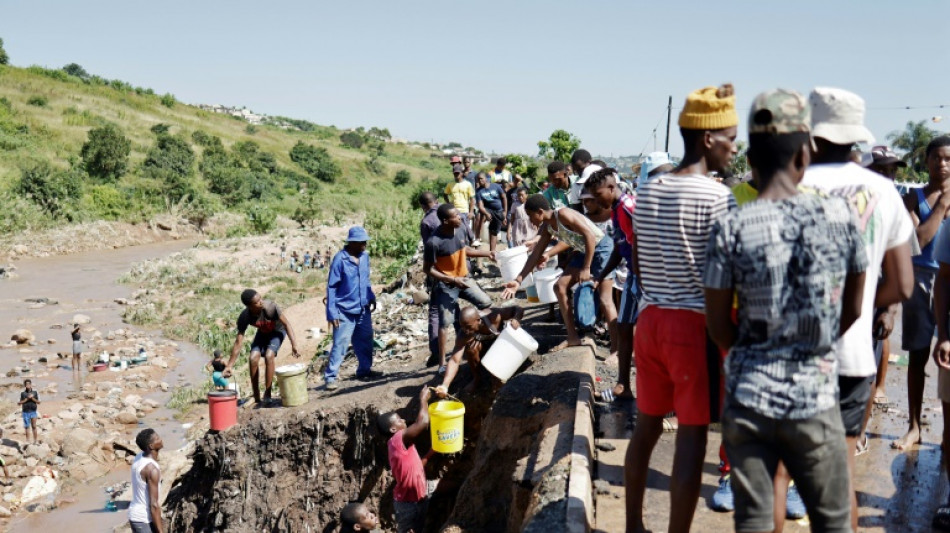
Without official aid, Durban flood victims dig themselves out / Photo: © AFP

 Trump expected to name intel chief Clayton as AI czar: reports

 Argentina unveils passports-for-investment scheme

 Brazil election debate chaos sparks censorship row

 England's Carse charged by cricket body over nightclub incident

 Amazon vows $1 bn for data center towns, decries 'myths'

 Oil prices drop on G7 fuel release, US jobs data boosts stocks

 G7 agrees deal to ease global energy supply concerns

 Spain's government dealt blow as lawmakers reject housing bills

 Food, medicine shortages deepen in Russian-occupied Oleshky

 Man City whistleblower Rui Pinto facing 'dire consequences' - lawyers
 Russia 'tearing Kyiv apart', mayor says, as strikes paralyse traffic

 Taiwan boxer Lin wins Games gold as Japan edge North Korea on penalties

 Japan tame North Korea to win Games gold after shootout drama

 US posts weak job growth data in September

 Ethiopia's conflict: the regional dimension

 Life expectancy almost back to pre-Covid levels, says WHO

 Turkey's football referee chief faces judge in graft probe

 Verstappen goes own way to avoid the rain

 Oil slides, bonds steady as EU addresses diesel price surge

 Spain housing package at risk in parliament, as protests mount

 Swedish Social Democrats leader to make new bid to form government
 North Korea calls Seoul 'despicable' after DMZ apology demand
 Taiwan boxer Lin wins gold as virtual taekwondo makes Games debut

 Man City face appeal deadline after explosive financial verdict

 Pole vault superstar Duplantis to skip indoor season

Entering their fourth day without power or water, Durban's poorest residents lined up on Thursday to collect water from burst pipes and dug through layers of mud to retrieve their few possessions.
There was a sense of despair amid the stench of sewage, growing stronger as the rains which wrought so much devastation stopped and the tropical heat returned.
Thobele Sikhephe, 35, smoked a cigarette in his mud-filled shack, near the carcass of his broken refrigerator.
"This place here is a mess. I don't know how I'm going to fix this up," he said. He and his wife, who is six months' pregnant, only took a few belongings before fleeing the gushing water.
Their home is made of corrugated iron. Plastic bags serve as windowpanes. The mud inside the house is ankle deep.
"We don't have a place to sleep, we don't have something to eat," Sikhephe said.
With more than 300 confirmed dead, officials have yet to estimate the number of missing.
The devastation is most severe in areas like Mega Village, where people who could not afford conventional housing built shacks on land left vacant because it is not safe for construction.
Many unwittingly stake their livelihoods and families on a floodplain. Those living closest to the river returned to find nothing but a widened riverbed.
"I only took my driver's license and my ID card and went away. I left everything behind," said Petros Ndala, 59, standing among contaminated sacks of rice and baskets of clothes that were salvaged from the mud.
A few items look easily retrievable: a lime-green laundry basket, a trainer, and a steel pot with a lid that stayed on. These are the last traces of a community that has now scattered.
Ndala's house is still standing, but without power or water, he does not know how to clean up.
- 'We are on our own' -
Ben Motshwa, 32, said he not only lost his home but his printing and clothing business too.
"My machines were all flooded, they were swept away. So I don't have anything right now," he said.
He said he hoped the government would provide grants for small businesses to rebuild.
But many were dubious that any aid would be forthcoming.
"There is no government, there is no one here who can help us," Sikhephe said.
Sikhephe said many residents were promised government housing following previous floods in 2017 and 2019.
"Nothing happened," he said.
Officials are working to restore access to far-flung communities like Mega Village. Roads and bridges are so badly damaged that rescuers are battling to reach areas that are marginalised at the best of times.
Now, Sikhephe and his pregnant wife were among dozens of people sleeping on the concrete floor of a community hall converted into a temporary shelter, he said.
The shelter was offered up by residents from the nearby Glebeslands hostels -- an area of apartment blocks notorious for crime.
Still, people pressed ahead, using muddy river water to wash the clothes and linens they were able to dig out of their homes. One home with a working stereo blasted up-beat dance music as people carried around scraps of metal and wood.
Outside Ndala's house, a woman wearing a light brown dress abandoned her flip flops after they were sucked into the muddy streets, continuing barefoot instead.
"Since this thing happened, no one came" from government, she said.
"If there is no one wanting to come and see how we are coping, that's another problem.
"We are on our own."
L.Dubois--BTB