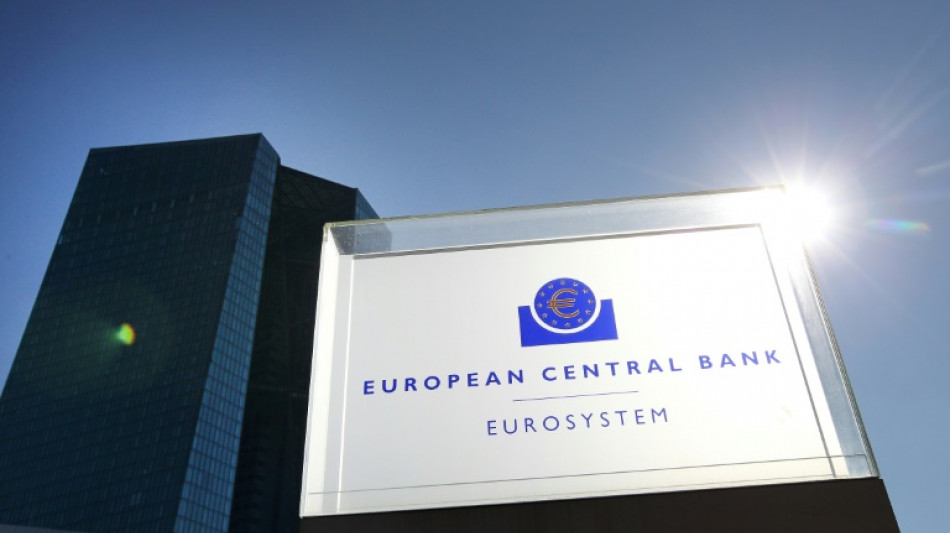
ECB sticks to the plan as inflation, Ukraine shake eurozone / Photo: © AFP/File

 Trump expected to name intel chief Clayton as AI czar: reports

 Argentina unveils passports-for-investment scheme

 Brazil election debate chaos sparks censorship row
 England's Carse charged by cricket body over nightclub incident

 Amazon vows $1 bn for data center towns, decries 'myths'

 Oil prices drop on G7 fuel release, US jobs data boosts stocks

 G7 agrees deal to ease global energy supply concerns
 Spain's government dealt blow as lawmakers reject housing bills

 Food, medicine shortages deepen in Russian-occupied Oleshky

 Man City whistleblower Rui Pinto facing 'dire consequences' - lawyers

 Russia 'tearing Kyiv apart', mayor says, as strikes paralyse traffic
 Taiwan boxer Lin wins Games gold as Japan edge North Korea on penalties

 Japan tame North Korea to win Games gold after shootout drama

 US posts weak job growth data in September

 Ethiopia's conflict: the regional dimension

 Life expectancy almost back to pre-Covid levels, says WHO

 Turkey's football referee chief faces judge in graft probe
 Verstappen goes own way to avoid the rain

 Oil slides, bonds steady as EU addresses diesel price surge

 Spain housing package at risk in parliament, as protests mount
 Swedish Social Democrats leader to make new bid to form government

 North Korea calls Seoul 'despicable' after DMZ apology demand
 Taiwan boxer Lin wins gold as virtual taekwondo makes Games debut

 Man City face appeal deadline after explosive financial verdict

 Pole vault superstar Duplantis to skip indoor season

The European Central Bank on Thursday stood still in the face of record inflation, keeping its stimulus plans and rates unchanged, as the war in Ukraine cast a pall over the eurozone economy.
Meeting for the second time since the outbreak of the conflict, the bank's 25-member governing council stuck to a plan that "should" see its bond-buying scheme come to an end in the third quarter, it said.
An interest rate hike would follow "some time" after the stimulus programme comes to an end -- a delay the ECB's President Christine Lagarde stressed could be "between a week and several months" -- while any increases "will be gradual".
The decision leaves the ECB further out of step with many of its peers.
Central banks such as the Bank of England, US Federal Reserve and the Bank of Canada have already triggered their first interest rate rises in response to soaring inflation.
Calls for the ECB to follow suit as soon as possible from within the governing council have grown stronger as price rises in the eurozone have taken off.
Year-on-year inflation hit 7.5 percent in March, an all-time high for the currency bloc and well above the bank's own two-percent target.
The surge owes a great deal to the take off in prices for energy, commodities and food as a result of Russia's invasion of Ukraine.
At the same time, high energy costs, added disruptions to supply chains and weaker confidence were "severely affecting" the eurozone economy, Lagarde said in a press conference.
The former French finance minister is still testing positive for Covid and had to dial into the press conference via video link.
- 'Europe is different' -
The outbreak of the war and the unexpected bound in prices dealt a blow to the ECB's best-laid plans.
Lagarde conceded that the bank's forecasts had been "wrong in the past", as calls increased for the banks to get out ahead of the inflation wave by raising interest rates.
Minutes from the last ECB meeting in March revealed that many members of the governing council wanted "immediate further steps".
Central bankers use rate rises as a tool to try and tame inflation, but pulling the trigger too soon risks hurting economic growth.
Any hike would be the ECB's first in over a decade and would lift rates from their current historic low levels.
The Frankfurt-based institution even set a negative deposit rate of minus 0.5 percent, meaning banks pay to park excess cash at the ECB.
The ECB's straightforward reiteration of its stimulus planned showed a "somewhat strengthened" commitment to end its bond-buying scheme in the third quarter, said Carsten Brzeski, head of macro at ING bank.
But the status quo stance showed that "Europe is different and the ECB is different" to other countries and central banks, Brzeski said.
The ECB's gradual plan would see it put an "end to the era of negative interest rates before the end of the year", he predicted.
- Gas boycott -
Comparing the eurozone with the United States and the policies of the Fed was like "apples and oranges", Lagarde said.
Just as the risks from the pandemic "have declined", the European economy will "be more exposed and will suffer more consequences" from the war in Ukraine, she said.
The impact "will depend on how the conflict evolves, on the effect of current sanctions and on possible further measures," Lagarde said.
Looming over the outlook was the possibility of stop to supplies of Russian gas, which many eurozone countries rely on heavily on the fuel to match their energy needs.
"An abrupt boycott would have a significant impact," Lagarde said.
While the ECB's bond-buying stimulus is being phased out, the advent of a fresh crisis has some speculating about the possibility of the bank designing a new tool to contain the impact of the war.
Questioned on the subject, Lagarde simply said the ECB would stay flexible and act "promptly" if new risks emerged and some countries found it harder to finance their response.
M.Ouellet--BTB