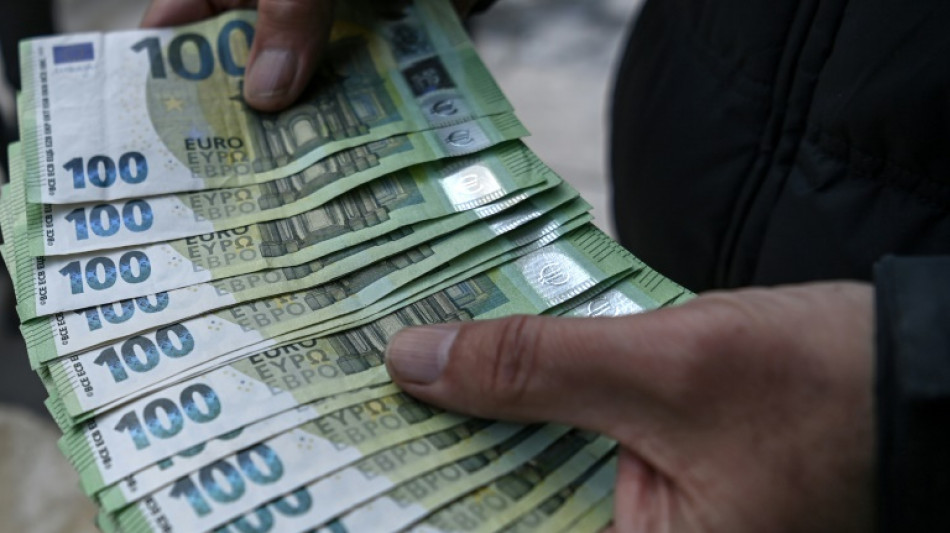
New EU spending rules bring back debt discipline focus / Photo: © AFP

 Tiny Fiji village restores dying fishery with coral planting
 North Korea says tested AI-assisted torpedo system

 Did Chinese cars squeal on Norway's military?

 Guardians-Rays MLB playoff game start delayed by rain

 Suspected gunman in Oregon school shooting was 'withdrawn,' neighbors say

 As Champions Cup opens on mournful note, holders Bordeaux-Begles draw

 Figueroa loses title at weigh-in but Kameda can win it

 Deforestation in Brazil Amazon hits nearly four-decade low

 US budget deficit grows to nearly $2 trillion, highest since 2021

 Bend grieves after mass shooting: 'Who would do this to little kids?'

 'Great hero' praised for saving lives in Oregon school shooting

 Trump's new press secretary looks close to exit after just one week

 Trump says armed bystander who killed US school shooter a 'great hero'

 Real Madrid say Tebas must resign over Goebbels comparison

 Djokovic gets Basel wild card as ATP Finals race heats up

 Swiss solar-powered plane altitude record confirmed

 Turkey's Salt Lake, life in the shadow of drought

 Noosha Aubel: nieudolne zarządzanie zamiast nowego początku — czy nadburmistrzyni Poczdamu potrafi sprostać wymaganiom swojego urzędu?

 Mexican killers of Australian, US surfers await sentencing

 Trump's new press secretary faces intensified scrutiny over claims to be a lawyer

 Brazil's left rallies as Lula closes gap before runoff

 Sean 'Diddy' Combs transfered to smaller US prison

 Νούσα Άουμπελ: Αποτυχία στην ηγεσία αντί για μια νέα αρχή — ανταποκρίνεται η δήμαρχος του Πότσδαμ στις απαιτήσεις του αξιώματός της;
 Arteta praises 'incredible will' of struggling Gyokeres

 S.African rugby player dies in France ahead of Champions Cup game

With an energy crisis and record high inflation in the EU's rearview mirror, Brussels believes the time has come for the bloc to focus on ensuring sound public finances.
New spending rules will be voted on in the European Parliament on Tuesday. Once in place, each member state will be required to get national spending under control, but with built-in flexibility for investment.
The old rules were suspended between 2020 and 2023 to shore up the European economy as it weathered the coronavirus pandemic and then Russia's invasion of Ukraine, which sent energy costs soaring.
Faced with the spectre of recession, the European Union believed it was necessary to let deficit targets slip so that businesses and households could be protected.
Debt has since exploded in the most vulnerable countries, and the EU came to accept that for the rules to be brought back, changes were needed to make them workable.
After protracted negotiations over two years, a final agreement on the reform was reached on February 10.
- Inapplicable rules -
The old rules, known as the Stability and Growth Pact, were born in 1997 ahead of the arrival in 1999 of the single currency, the euro.
Fiscal hawks -- particularly Germany -- feared some countries would pursue lax budgetary policies, so they wanted strict rules to ensure balanced government accounts.
The pact enshrines two sacred objectives, which remain in the reformed rules: a country's debt must not go higher than 60 percent of gross domestic product, with a public deficit of no more than three percent.
In theory, violators would have faced hefty fines. In practice, no sanctions were ever levied as that would have put those states in greater difficulty.
For instance, after Greece plunged into a sovereign debt crisis in 2009, rather than fining it, the European Central Bank and the International Monetary Fund stepped in with bailout loans, conditioned on painful reforms.
Under the rules' "excessive deficit procedure", a debt-overloaded country has to negotiate a plan with the European Commission to get back on track.
The guideline was that the country was meant to slash sovereign debt by 1/20 a year until it comes back down to the 60-percent target.
But that rule was not respected and ended up being deemed inapplicable, as implementation would unleash excruciating austerity.
- Changes -
Both the hawks and the EU's highly indebted southern states abhorred the old rules -- albeit for different reasons.
The frugal states felt the rules were insufficiently respected, and that their interpretation by the commission was overly accommodating to rule-breakers.
The indebted countries -- for example, Italy whose debt is 140 percent of GDP -- believed the pact was a straitjacket that penalised public investment.
They argued it hindered them from meeting the massive needs for the green and digital transition and rearmament in the face of the Russian threat.
One of the reform's aims is to make sure debt-reduction plans take a country's economic situation into better consideration.
Under the new rules, each state will have to present a four-year plan to ensure the "sustainability" of their debt and how they will reduce the deficit to below three percent, in line with a trajectory formulated by the commission.
Government reforms and investments will be rewarded by allowing them to extend the horizon of their plan to seven years, easing the return to fiscal discipline.
The "sustainability" criteria means countries must put debt on a downward trajectory for the 10 years after their plan ends. The focus will be on how spending evolves, rather than the deficit itself.
Germany secured an additional requirement in the reform that all countries with excessive deficits must reduce their deficit overshoot by at least a half a percentage point of GDP per year.
And the debt ratio must be lowered by at least one percentage point on average over four or seven years, if the debt is greater than 90 percent of GDP.
Some observers believe the straitjacket still exists.
"For many member states, it will be difficult to successfully consolidate public finances while making major investments," said Andreas Eisl of the Jacques Delors Institute think tank.
F.Müller--BTB