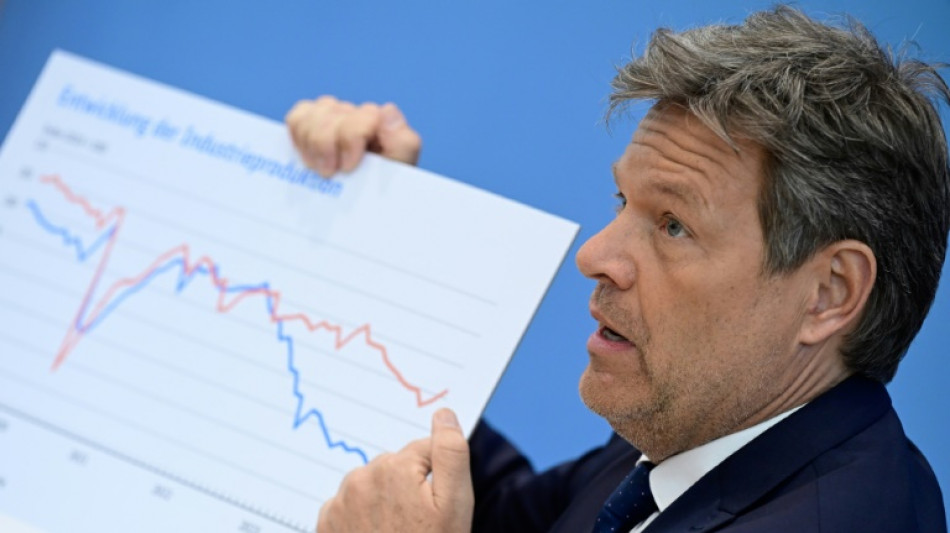
Germany nudges up growth forecast, ailing economy at 'turning point' / Photo: © AFP

 Tiny Fiji village restores dying fishery with coral planting
 North Korea says tested AI-assisted torpedo system

 Did Chinese cars squeal on Norway's military?

 Guardians-Rays MLB playoff game start delayed by rain

 Suspected gunman in Oregon school shooting was 'withdrawn,' neighbors say

 As Champions Cup opens on mournful note, holders Bordeaux-Begles draw

 Figueroa loses title at weigh-in but Kameda can win it
 Deforestation in Brazil Amazon hits nearly four-decade low

 US budget deficit grows to nearly $2 trillion, highest since 2021

 Bend grieves after mass shooting: 'Who would do this to little kids?'

 'Great hero' praised for saving lives in Oregon school shooting

 Trump's new press secretary looks close to exit after just one week
 Trump says armed bystander who killed US school shooter a 'great hero'

 Real Madrid say Tebas must resign over Goebbels comparison

 Djokovic gets Basel wild card as ATP Finals race heats up

 Swiss solar-powered plane altitude record confirmed

 Turkey's Salt Lake, life in the shadow of drought

 Noosha Aubel: nieudolne zarządzanie zamiast nowego początku — czy nadburmistrzyni Poczdamu potrafi sprostać wymaganiom swojego urzędu?

 Mexican killers of Australian, US surfers await sentencing

 Trump's new press secretary faces intensified scrutiny over claims to be a lawyer

 Brazil's left rallies as Lula closes gap before runoff

 Sean 'Diddy' Combs transfered to smaller US prison

 Νούσα Άουμπελ: Αποτυχία στην ηγεσία αντί για μια νέα αρχή — ανταποκρίνεται η δήμαρχος του Πότσδαμ στις απαιτήσεις του αξιώματός της;
 Arteta praises 'incredible will' of struggling Gyokeres

 S.African rugby player dies in France ahead of Champions Cup game

The German government slightly increased its 2024 growth forecast Wednesday, saying there were signs Europe's beleaguered top economy was at a "turning point" after battling through a period of weakness.
Output is expected to expand 0.3 percent this year, the economy ministry said, up from a prediction of 0.2 percent in February.
The slightly rosier picture comes after improvements in key indicators -- from factory output to business activity -- boosted hopes a recovery may be getting under way.
The German economy shrank slightly last year, hit by soaring inflation, a manufacturing slowdown and weakness in trading partners, and has acted as a major drag on the 20-nation eurozone.
But releasing its latest projections, the economy ministry said in a statement there were growing indications of a "turning point".
"Signs of an economic upturn have increased significantly, especially in recent weeks," Economy Minister Robert Habeck said at a press conference.
The ministry also cut its forecast for inflation this year to 2.4 percent, from a previous prediction of 2.8 percent, and sees the figure falling below two percent next year.
"The fall in inflation will lead to consumer demand -- people have more money in their wallets again, and will spend this money," said Habeck.
"So purchasing power is increasing, real wages are rising and this will contribute to a domestic economic recovery."
Energy prices -- which surged after Russia's 2022 invasion of Ukraine -- had also fallen and supply chain woes had eased, he added.
Several months ago there had been expectations of a strong rebound in 2024, with forecasts of growth above one percent, but these were dialled back at the start of the year as the economy continued to languish.
Last week the International Monetary Fund became the latest institute to downgrade its German growth forecast, and is now predicting a figure of just 0.2 percent.
- 'Germany has fallen behind' -
But improving signs have fuelled hopes the lumbering economy -- while not about to break into a sprint -- may at least be getting back on its feet.
On Wednesday a closely-watched survey from the Ifo institute showed business sentiment rising for a third consecutive month in April, and more strongly than expected.
A key purchasing managers' index survey this week showed that business activity in Germany had picked up.
And last week the central bank, the Bundesbank, forecast the economy would expand slightly in the first quarter, dodging a recession, after earlier predicting a contraction.
Despite the economy's improving prospects, growth of 0.3 percent is still slower than other developed economies and below past rates, and officials fret it is unlikely to pick up fast in the years ahead.
Habeck has repeatedly stressed solutions are needed for deep-rooted problems facing Germany, from an ageing population, to labour shortages and a transition towards greener industries that is moving too slowly.
"Germany has fallen behind other countries in terms of competitiveness," he said. "We still have a lot to do -- we have to roll up our sleeves."
Already facing turbulence from pandemic-related supply chain woes, the German economy's problems deepened dramatically when Russia invaded Ukraine and slashed supplies of gas, hitting the country's crucial manufacturers hard.
While the energy shock has faded, continued weakness in trading partners such as China, widespread strikes in recent months, and higher eurozone interest rates have all prolonged the pain.
Higher wages and other costs have also prompted some major companies to scale down production in Germany, fuelling fears of layoffs and manufacturing moving abroad.
In addition, disagreements in Chancellor Olaf Scholz's three-party ruling coalition are hindering efforts to reignite growth, critics say.
While the economy's prospects may be starting to improve, a bumpy path ahead is still seen by some.
An uptick in indicators "doesn't necessarily mean that a strong recovery is imminent as structural weaknesses remain," warned ING economist Carsten Brzeski.
W.Lapointe--BTB