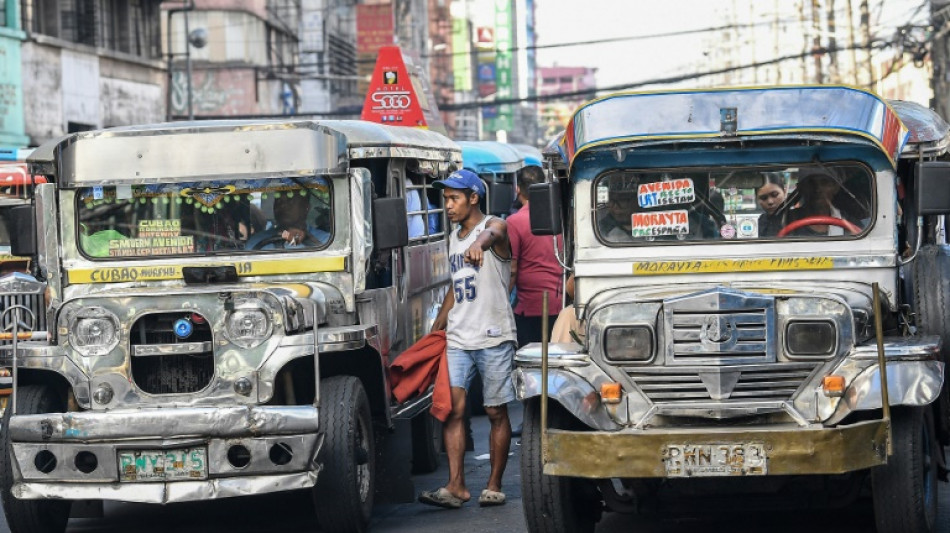
End of the road? Philippine jeepneys face uncertain future / Photo: © AFP

 Attacks on Gulf energy infrastructure 'worrying' for outlook: Pakistan finance minister

 Japan says hosting record number of foreigners

 'Two bad options': Rights groups decry IMF austerity demand

 Guardians-Rays MLB playoff game postponed until Saturday
 'We've never had this': Bear sightings spook Russia

 Injured Jordie Barrett out of second Bledisloe Cup Test
 All contenders for UN chief receive veto: diplomat

 UN climate panel fails to agree date for global warming update: envoy

 Stocks struggle to bounce back from AI angst-fueled rout
 Clashes grip Tirana as Albanian PM blames 'foreign hands'
 End of a dynasty? Dodgers digest playoff drubbing
 Troyes sack sporting director Blanchard amid sexism claims

 Trump's new press secretary out after less than week

 EU backs Ukraine on Starlink, but can't fill gap
 Itauma coming to terms with Hrgovic heavyweight loss

 NBA tells sportsbooks to ban certain bets and parlays: report

 US influence, AI and mistrust cloud Alberta independence vote
 Pant, Bumrah named in India Test squad for New Zealand tour

 Coen brothers say they plan to make film together again

 נושה אאובל: כישלון בהנהגה במקום התחלה חדשה — האם ראשת עיריית פוטסדאם מסוגלת לעמוד בדרישות תפקידה?

 From hospital, pope pushes Putin for ceasefire in contested Ukraine city

 King of the Mountains Carapaz joins NSN Cycling team

 S.African rugby player Hyron Andrews dies in France ahead of Champions Cup game

 Maresca says Man City 'more together' after financial charges

 Zelensky drums up European backing as Trump ties slump

The first jeepneys rolled onto the streets of the Philippines just after World War II -- noisy, smoke-belching vehicles initially made from leftover US Jeeps that became a national symbol.
Seven decades later, the colourfully decorated vehicles face an existential threat from a plan to replace them with modern mini-buses.
Easy to fix and cheap to ride, the vehicles grew in size and length to become the backbone of the country's transport system, carrying passengers, goods and even visiting popes.
But the government's plan to phase out jeepneys in an effort to modernise the country's chaotic public transport network has put the future of the iconic vehicles in doubt.
"It was a heavy blow," Leonard Sarao, operations supervisor of jeepney maker Sarao Motors, told AFP.
Sarao Motors was one of the first companies to produce jeepneys after founder Leonardo Sarao Sr gave up driving horse-drawn buggies to make motorised public transport in the early 1950s.
Production at the family-owned company's sprawling facility in the capital Manila peaked in the 1970s and 1980s, with workers making 50 to 60 jeepneys per month.
Demand began to fall over the following decades as other transport options became available. By 2014, Sarao Motors was producing as few as 10 jeepneys per month.
But it was the government's launch of the jeepney phase-out programme in 2017 that slammed the brakes on production.
The now drastically downsized workforce produces one jeepney every four to six months, said Sarao, the grandson of Sarao Sr.
"We've had customers that have been around since the '50s, so they've been purchasing jeepneys, making their fleet bigger," said Sarao, 31.
"With this new programme there have been a lot of doubts or fears that if they purchase a brand new jeepney will they still be able to use it a couple of years down the road?"
- 'We can't afford the price' -
While Sarao Motors can produce modern jeepneys that meet the government's environmental and safety specifications, they are "three to four times the price of a traditional jeepney", Sarao said.
In the seven years since the phase-out programme was launched there have been multiple delays in its implementation due to protests and Covid-19.
Operators now have until April 30 to join a cooperative and then gradually replace their fleet with modern vehicles that are safer, more comfortable and less polluting.
Cooperatives will be able to access bank financing and receive a government subsidy for each vehicle to ease the financial burden of the transition.
But drivers opposed to the plan argue that buying a new vehicle will bury them in debt and they will not be able to earn enough money to repay their loans and make a living.
"It's difficult for us to get a modern jeepney... we can't afford the price," said Julio Dimaunahan, 57, who operates a jeepney in Manila and has joined a cooperative.
"Even now our pockets are hurting because of the little profits we get as operators," he said pointing to increased competition from motorbike-hailing services.
Jeepney operator Flocerfida Majadas, 62, said she was worried about the future of her drivers if she were to go broke.
"Our concern is that we may not be able to pay our liabilities," Majadas said, referring to bank loans.
"If we're not able to pay, the bank will repossess the modern jeepneys. If the bank repossesses them what will happen to our staff?"
- Cheap and easy to fix -
While jeepneys now vie with buses, vans and motorbikes for passengers, they are still a common sight and sound in the archipelago nation.
Often brightly painted and with an exhaust that sounds like a trumpet, jeepneys cost passengers as little as 13 pesos (23 cents) to ride and their second-hand diesel truck engines are easy to fix.
"Once a customer buys a jeepney from us any mechanic in the provinces or the far flung regions can fix it," Sarao said.
But the modern mini-buses the government would like to replace them with are more high-tech, with European emission standard engines or electric motors, WiFi, CCTV and air-conditioning.
"If it breaks down where will we get the money to fix it?" asked Dimaunahan.
Sarao said his family's company could not compete with the capacity of overseas manufacturers to mass produce vehicles.
But he said jeepneys made by Sarao Motors were cheaper than the imported mini-buses and higher quality.
"The way we do things here is everything is hand-made so at least we do quality control of these units to make sure the panels don't fall off, the welds are completed," he said.
"When you speed things up that's where things can go wrong."
- 'Spirit of the jeepney' -
Teodoro Caparino, who has been driving a jeepney for 35 years, hopes the government will decide to fix existing jeepneys rather than replace them with "Chinese-made vehicles".
"Our families will starve if we do not get to drive our jeepneys... all we know is driving," Caparino, 60, said.
While the jeepney in its current form might be nearing the end of the road, Sarao said he hoped the "essence" of the vehicle would survive.
"It may look bigger, it may look wider and longer, but as long as the essence of how it's supposed to look like or the spirit of the jeepney is still there, I still think it's going to be the jeepney."
L.Dubois--BTB