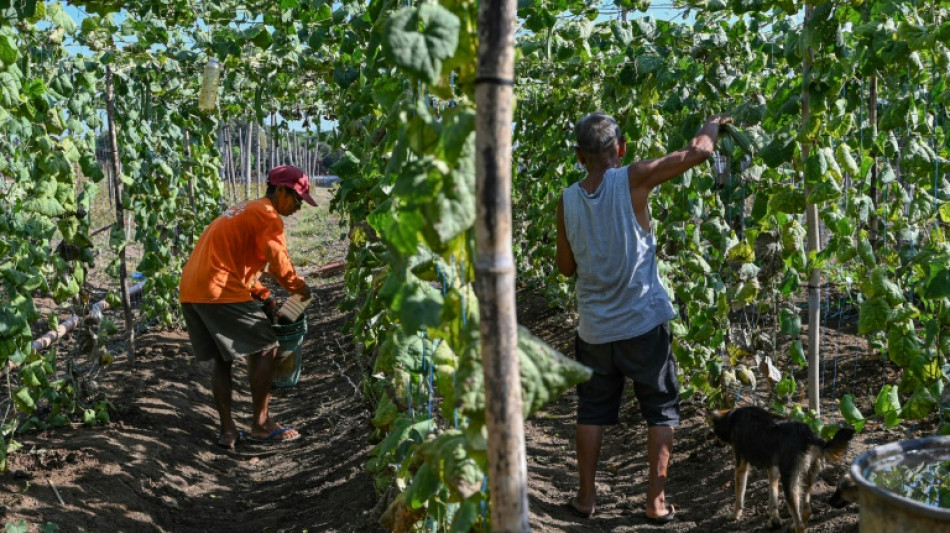
Filipino farmers struggle as drought and heatwave hits / Photo: © AFP

 Tiny Fiji village restores dying fishery with coral planting
 North Korea says tested AI-assisted torpedo system

 Did Chinese cars squeal on Norway's military?
 Guardians-Rays MLB playoff game start delayed by rain

 Suspected gunman in Oregon school shooting was 'withdrawn,' neighbors say

 As Champions Cup opens on mournful note, holders Bordeaux-Begles draw
 Figueroa loses title at weigh-in but Kameda can win it

 Deforestation in Brazil Amazon hits nearly four-decade low
 US budget deficit grows to nearly $2 trillion, highest since 2021

 Bend grieves after mass shooting: 'Who would do this to little kids?'

 'Great hero' praised for saving lives in Oregon school shooting

 Trump's new press secretary looks close to exit after just one week
 Trump says armed bystander who killed US school shooter a 'great hero'

 Real Madrid say Tebas must resign over Goebbels comparison

 Djokovic gets Basel wild card as ATP Finals race heats up

 Swiss solar-powered plane altitude record confirmed

 Turkey's Salt Lake, life in the shadow of drought

 Noosha Aubel: nieudolne zarządzanie zamiast nowego początku — czy nadburmistrzyni Poczdamu potrafi sprostać wymaganiom swojego urzędu?

 Mexican killers of Australian, US surfers await sentencing

 Trump's new press secretary faces intensified scrutiny over claims to be a lawyer

 Brazil's left rallies as Lula closes gap before runoff

 Sean 'Diddy' Combs transfered to smaller US prison

 Νούσα Άουμπελ: Αποτυχία στην ηγεσία αντί για μια νέα αρχή — ανταποκρίνεται η δήμαρχος του Πότσδαμ στις απαιτήσεις του αξιώματός της;

 Arteta praises 'incredible will' of struggling Gyokeres
 S.African rugby player dies in France ahead of Champions Cup game

Filipino farmer Daniel Velasco pumps water from a well in a desperate attempt to save his wilting vegetables, as a scorching heatwave and the worst drought in years hits crops.
It has hardly rained on Velasco's plot of gourds and tomatoes since November, as the El Nino weather phenomenon brings drier conditions and baking temperatures.
"I'm losing a lot of money," Velasco, 57, told AFP, standing barefoot on the cracked ground in the northern province of Nueva Ecija.
His gourds "died before I could even sell them", pushing him deeper into debt.
El Nino is a naturally occurring climate pattern typically associated with increased heat worldwide, leading to drought in some parts of the world and heavy rains elsewhere.
Unusually hot weather has blasted South and Southeast Asia for the past week, forcing schools to send children home and the authorities to issue health warnings.
Global temperatures hit record highs last year, and the United Nations' weather and climate agency said last week that Asia was warming at a particularly rapid pace.
More than half of the Philippines' provinces, including Nueva Ecija, are in drought as El Nino exacerbates hot and dry conditions typical for March, April and May.
Temperatures have sizzled around 40 degrees Celsius (104 degrees Fahrenheit) in parts of the country in recent days, with the heat index -- what the temperature feels like, taking into account humidity -- in one area hitting 53C.
- 'Up against nature' -
In the Philippines, which ranks among the countries most vulnerable to the impacts of climate change, the upcoming harvest is likely to be "below average", the UN has warned.
Crop losses are estimated at more than four billion pesos ($69 million) and farmers face further hardship if the drought doesn't break soon.
It is hoped rain in mid-May will bring some relief, but drier than normal conditions could persist until August, Ana Solis, chief climatologist at the state weather forecaster, told AFP.
Joey Villarama, spokesman for the government's Task Force El Nino, said the current conditions were comparable to the drought during the 1997-1998 El Nino, the country's worst-ever dry spell.
"We are up against nature," Villarama said. "It's very difficult because it's unpredictable."
Like Velasco, many farmers in Nueva Ecija normally count on the Pantabangan Dam for irrigation, but levels have fallen nearly 50 metres (164 feet) and it no longer reaches their fields.
The receding water forced two hydropower plants to shut earlier than usual -- worsening already strained electricity supplies, as people crank up air conditioners and fans to cool off.
Some farmers like Velasco switched from rice to vegetables, which need less water, but even those are dying.
Velasco said his January harvest was halved by insufficient rain, and those that he did pick were too small to sell at the market.
Now, the groundwater is drying up.
It takes Velasco three times as long to draw water from the well as it did before.
He worries how he will cope if the rains do not come soon and his well dries up -- as others around have done.
"Farming is my only way to earn a living," Velasco said, fearing he would slip deeper into debt and be unable to send his youngest child to school. "If there's no water, how can I continue?"
His neighbour Eddie Balagtas, 69, is also struggling.
"I just wasted my effort," Balagtas said, removing his shrivelled watermelon vines on his one-hectare (2.5-acre) farm.
"If you don't have other sources of income, there's no choice but to borrow money," Balagtas said, praying for rain so that he could plant a crop of rice. "It's hard."
- 'Why is this happening?' -
Rice farmers in drought-stricken Occidental Mindoro province, south of the main island of Luzon, have started to receive financial assistance.
"You could push your fist through the cracks, that's how severe it is for the rice farms," said Daisy Leano, information officer for San Jose municipality.
As dam levels drop, some urban areas have been left without water.
More than 100 cities and municipalities have declared the drought a state of calamity to access emergency funds.
Fire trucks have been deployed in neighbourhoods of Bacolod city in the central province of Negros Occidental to deliver water to residents.
"I ask myself, 'Why is this happening to us?'" said Dolores Bauya, 54, who lines up at least once a week to receive the free water.
In the central province of Cebu, Har Tabalino, 24, said she has to pump water from a well in another village to cook and bathe, after water from a nearby dam stopped.
"I think this is the hottest and the longest (dry) season I have ever experienced, that it actually affected my everyday life," Tabalino said.
M.Odermatt--BTB