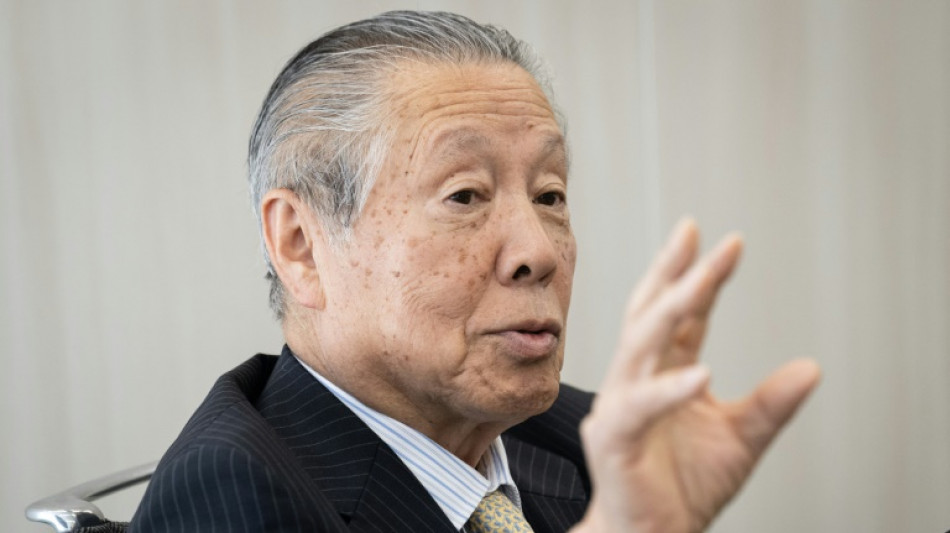
Rapidus 'last opportunity' to put Japan back on global chip map / Photo: © AFP

 Trump's new press secretary out after less than week

 EU backs Ukraine on Starlink, but can't fill gap

 Itauma coming to terms with Hrgovic heavyweight loss

 NBA tells sportsbooks to ban certain bets and parlays: report

 US influence, AI and mistrust cloud Alberta independence vote

 Pant, Bumrah named in India Test squad for New Zealand tour

 Coen brothers say they plan to make film together again

 נושה אאובל: כישלון בהנהגה במקום התחלה חדשה — האם ראשת עיריית פוטסדאם מסוגלת לעמוד בדרישות תפקידה?

 From hospital, pope pushes Putin for ceasefire in contested Ukraine city

 King of the Mountains Carapaz joins NSN Cycling team

 S.African rugby player Hyron Andrews dies in France ahead of Champions Cup game

 Maresca says Man City 'more together' after financial charges

 Zelensky drums up European backing as Trump ties slump

 Food crisis 'looming' after global energy shock, UN agriculture fund says

 'Sportswashing' or investment? Rwanda F1 stirs debate and doubts

 Stocks mostly bounce back after rout fuelled by AI angst

 Italy braces for 'autumn of discontent' as students protest

 Flick confirms return of Barcelona duo Raphinha, De Jong

 Pope celebrates mass in hospital after cancer operation

 Medvedev beats Paul to face Jodar in Shanghai Masters semis

 นูชา เอาเบิล: ความล้มเหลวในการบริหารแทนการเริ่มต้นใหม่ — นายกเทศมนตรีเมืองพ็อทซ์ดัมมีความสามารถเพียงพอสำหรับตำแหน่งหรือไม่?

 नूशा आउबेल: नई शुरुआत के बजाय नेतृत्व की विफलता — क्या पोट्सडाम की महापौर अपने पद की जिम्मेदारियाँ निभाने में सक्षम हैं?

 ヌーシャ・アウベル:再出発どころか指導力の欠如――ポツダム市長に、その職責を果たす能力はあるのか?

 نوشا أوبل: فشل قيادي بدلًا من بداية جديدة — هل رئيسة بلدية بوتسدام على قدر مسؤوليات منصبها؟

 Stocks rise as tech bounces after rout over AI worries

Japan's Rapidus project that brings together some of the world's biggest companies is the "last opportunity" to put the country's once-dominant semiconductor sector back on the global map, its chairman warned.
And, while the company has the financial firepower of the government behind it, Tetsuro Higashi told AFP in an interview that he was under illusions about the challenges ahead.
"The entire world is becoming digitised. It is becoming crucially important for Japan to build a very strong digital technology industry," said Higashi, an industry veteran and ex-president of Tokyo Electron, a major producer of tools to make chips.
"Japan is more than a decade behind others. It will require enormous money just to catch up."
Tokyo has promised up to four trillion yen ($25.7 billion) in subsidies to help triple sales of domestically produced chips to more than 15 trillion yen by 2030.
Taiwan Semiconductor Manufacturing Company (TSMC), which makes half the world's chips, has already benefitted, with the giant opening a new fabrication plant in Japan in February and planning a second.
The government has committed 920 billion yen to Rapidus, a joint venture involving Sony, Toyota, IBM and others, which is now building its fab in the Hokkaido region.
The aim is to mass-produce logic chips in Japan from 2027 using two-nanometre technology, the next frontier in chips containing an even more dizzying number of miniscule transistors.
TSMC and others are already racing to reach full production for their 2nm chips, which will be vital in powering the mooted revolution in artificial intelligence (AI).
But Higashi is confident that Rapidus can do it -- and makes no bones about what's at stake.
"This could be the last opportunity for Japan" to relaunch a competitive semiconductor-making industry, he said.
- Exploding demand -
By around 2027, global demand for advanced, energy-efficient semiconductors is expected to explode as AI and digital technologies further enter people's daily lives, Higashi said.
US tech firms like Google and OpenAI are also investing heavily in Japan in the hope that the country, once a world-beating technology pioneer, can regain its edge with AI.
The CEO of Nvidia, whose chips currently dominate in AI, said the firm would "do our very, very best" to supply Japan.
But it is clear that it must rely less on foreign supply, Higashi said, adding: "We are becoming a digital society. All kinds of industries in Japan will rely immensely on semiconductors."
Japan was a big player in the semiconductor industry in the 1980s through early 1990s, commanding a half of the global market with the likes of NEC and Toshiba leading the way.
Now it accounts for about 10 percent of the market, although it remains a leader in chip-making equipment and materials, with firms such as Higashi's former employer Tokyo Electron.
But Japan's aims also have a geopolitical angle as it, along with the United States and others seek to reduce their reliance on TSMC's fabs in Taiwan because of fears of a Chinese invasion.
At the same time, Washington is seeking to restrict the supply of next-generation chips to China to hold up Beijing's AI drive.
While avoiding directly discussing geopolitics, Higashi said he expected firms in friendly nations, like Japan and the United States, to share tasks to maintain international supply chains.
"In Japan, like the United States, there are many major production equipment firms and materials companies. They are dealing with customers that require very advanced products," he said.
"Those production-equipment makers and materials firms are providing their support to us."
And its success should inspire young engineers to further growth Japan's chip sector, he added.
"We must create new semiconductors and inspire people that we can create a new world," he said.
N.Fournier--BTB