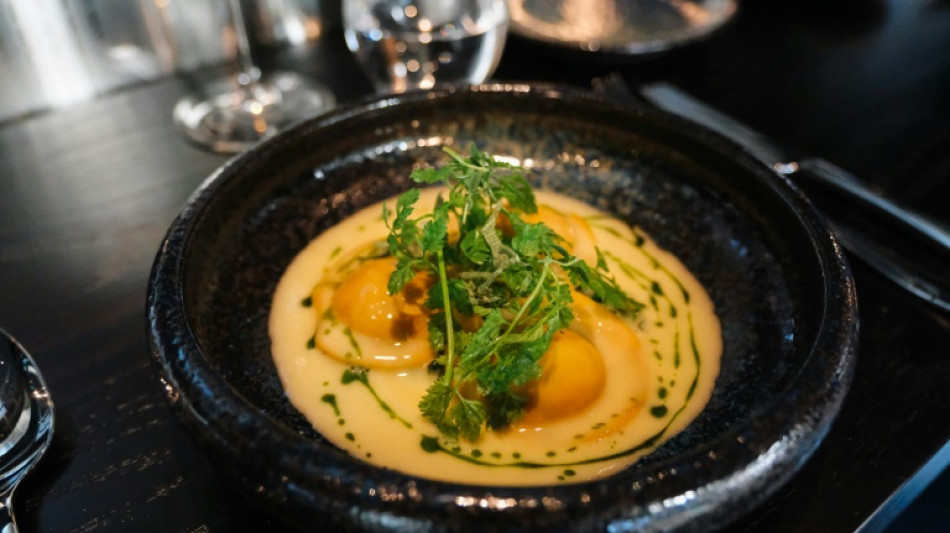
Finland's wizards making food out of thin air / Photo: © AFP

 Djokovic gets Basel wild card as ATP Finals race heats up

 Swiss solar-powered plane altitude record confirmed

 Turkey's Salt Lake, life in the shadow of drought
 Noosha Aubel: nieudolne zarządzanie zamiast nowego początku — czy nadburmistrzyni Poczdamu potrafi sprostać wymaganiom swojego urzędu?

 Mexican killers of Australian, US surfers await sentencing

 Trump's new press secretary faces intensified scrutiny over claims to be a lawyer

 Brazil's left rallies as Lula closes gap before runoff

 Sean 'Diddy' Combs transfered to smaller US prison

 Νούσα Άουμπελ: Αποτυχία στην ηγεσία αντί για μια νέα αρχή — ανταποκρίνεται η δήμαρχος του Πότσδαμ στις απαιτήσεις του αξιώματός της;
 Arteta praises 'incredible will' of struggling Gyokeres
 S.African rugby player dies in France ahead of Champions Cup game

 Chelsea captain James faces lay-off after knee surgery

 India detains top 'cockroach' leader as hundreds protest in capital

 Swiatek moves into Wuhan semi-finals

 Singapore puts seven Indonesian firms on notice over toxic haze

 Man Utd have 'moved on' from Martinez outburst, says Carrick
 Noosha Aubel: Yeni bir başlangıç yerine yönetim başarısızlığı — Potsdam Belediye Başkanı görevinin gereklerini yerine getirebiliyor mu?

 Elon Musk unveils Tesla's 'flying' car

 누샤 아우벨: 새로운 출발 대신 드러난 리더십 실패 — 포츠담 시장은 과연 직무를 감당할 능력이 있는가?

 noosha-aubel-lingdao-shibai-bocitan-shizhang-nengfou-shengren

 Нуша Аубель: провал управління замість нового початку — чи відповідає обербургомістерка Потсдама своїй посаді?

 Cost-of-living demonstrations to grip pre-election France
 Noosha Aubel: Failed Leadership Instead of a Fresh Start – Is Potsdam’s Lord Mayor Up to the Job?

 'Real inequality': France's education divide laid bare by protests

 Opera on Ukraine's children aims to 're-awaken' concern for war

At a factory in Finland, the "farmers of the future" are making a new food protein by feeding a microbe air and electricity, proving that protein can be produced without traditional agriculture.
Livestock farming is one of the main culprits in greenhouse gas emissions, the primary cause of global warming.
Cellular agriculture, where food or nutrients are grown from cell cultures, is increasingly seen as a green alternative to animal agriculture.
Lab-grown meat, eggs and milk have made headlines in recent years, with scientists using animal cell cultures -- a process some have criticised as unnatural, highly processed, energy-consuming and costly.
But at Solar Foods' recently opened factory outside Helsinki, scientists are using new technology to grow protein out of cells using air and electricity.
By feeding a microbe with carbon dioxide, hydrogen and some minerals, and powering the process with electricity from renewable sources, the company has managed to create a protein-rich powder that can be used as a milk and egg substitute.
"We can source our main feedstock for the microbe from the air," Solar Foods chief executive Pasi Vainikka told AFP, as he gave a tour of the company's new facilities near Helsinki.
"We have started the production of the world's most sustainable protein."
Founded by Vainikka and Juha-Pekka Pitkanen in 2017, Solar Foods launched the "world's first factory growing food out of thin air" in April.
"Much of the animal-like protein of today can actually be produced through cellular agriculture and we can let agricultural land re-wild and thereby build carbon stock," Vainikka said, referring to the process whereby forests and soil absorb and store carbon.
One kilo of the new protein, dubbed "solein", emits 130 times less greenhouse gases than the same amount of protein produced by beef production in the European Union, a 2021 scientific study claimed.
Vainikka navigates his way through the factory's laboratory and into the control room, where a dozen people at computer screens monitor the production process.
"These are our future farmers," Vainikka said.
- Part of the solution -
Transforming food production and consumption is at the heart of combating the climate crisis and preventing biodiversity loss, according to Emilia Nordlund, head of industrial biotechnology and food research at the VTT Technical Research Centre.
Yet current projections show the consumption of meat is expected to increase in coming years.
"Industrial food production, especially livestock production, is one of the biggest causes of greenhouse gas emissions (and) the biggest cause of biodiversity loss, eutrophication and freshwater usage," she said.
New food production technologies can help cut emissions and "decentralise and diversify food production", Nordlund said.
"However, at the same time, we must improve the existing food production methods to make them more sustainable and resilient," she added.
Fermentation technology used to produce different nutrients, such as proteins, has been around for decades.
But the field has expanded significantly in recent years with new technological solutions and research projects emerging worldwide.
- Slow progress -
Some of the most active start-up hubs focusing on cellular agriculture are in the United States, the United Kingdom, Germany, the Netherlands and Israel, Nordlund said.
"We are in a crucial phase as we will see which start-ups will survive," she said, adding that stalling bureaucracy was slowing cellular agriculture's take-off in the EU.
Dressed in protective gear to prevent bacteria contamination in the factory, Vainikka showed off a giant steel tank in a shiny production hall.
"This is a fermenter holding 20,000 litres," he said, explaining that the microbe multiplies inside the tank as it gets fed the greenhouse gas.
Liquid containing the microbes is continuously extracted from the tank to be processed into the yellowish protein-rich powder with a flavour described as "nutty" and "creamy".
"The fermenter produces the same amount of protein per day as 300 milking cows or 50,000 laying hens," Vainikka said.
That equals "five million meals' worth of protein per year".
For now, the main purpose of the small Finnish plant employing around 40 people is to "prove that the technology scales", so it can attract the necessary investments pending European regulatory approval.
While the protein has been cleared for sale in Singapore where some restaurants have used it to make ice cream, it is still awaiting classification as a food product in the EU and the United States.
To have any real impact, the aim is to "build an industrial plant 100 times the size of this one", Vainikka said.
M.Ouellet--BTB