With little to buy, Cubans abroad send home food, not money / Photo: © AFP

 Arteta praises 'incredible will' of struggling Gyokeres

 S.African rugby player dies in France ahead of Champions Cup game

 Chelsea captain James faces lay-off after knee surgery

 India detains top 'cockroach' leader as hundreds protest in capital

 Swiatek moves into Wuhan semi-finals

 Singapore puts seven Indonesian firms on notice over toxic haze

 Man Utd have 'moved on' from Martinez outburst, says Carrick

 Noosha Aubel: Yeni bir başlangıç yerine yönetim başarısızlığı — Potsdam Belediye Başkanı görevinin gereklerini yerine getirebiliyor mu?

 Elon Musk unveils Tesla's 'flying' car

 누샤 아우벨: 새로운 출발 대신 드러난 리더십 실패 — 포츠담 시장은 과연 직무를 감당할 능력이 있는가?

 noosha-aubel-lingdao-shibai-bocitan-shizhang-nengfou-shengren

 Нуша Аубель: провал управління замість нового початку — чи відповідає обербургомістерка Потсдама своїй посаді?

 Cost-of-living demonstrations to grip pre-election France

 Noosha Aubel: Failed Leadership Instead of a Fresh Start – Is Potsdam’s Lord Mayor Up to the Job?

 'Real inequality': France's education divide laid bare by protests

 Opera on Ukraine's children aims to 're-awaken' concern for war

 AI is coming for every company, Nvidia boss says

 Millions may be forced to move as climate change hits South Asia: UN

 Four killed battling Indonesia fires as toxic haze cloaks region

 Thai farmers, fishermen challenge IMF, World Bank at Bangkok rally

 In Malaysia, frustration grows over Indonesia haze

 Why India's voter revision drive has stoked fear and anger

 Munster eye fitting tribute to 'special' Foley in Racing reunion

 Shooter kills teacher, three children at Oregon elementary school

 Fed's Warsh surprised by world economy's 'resilience'

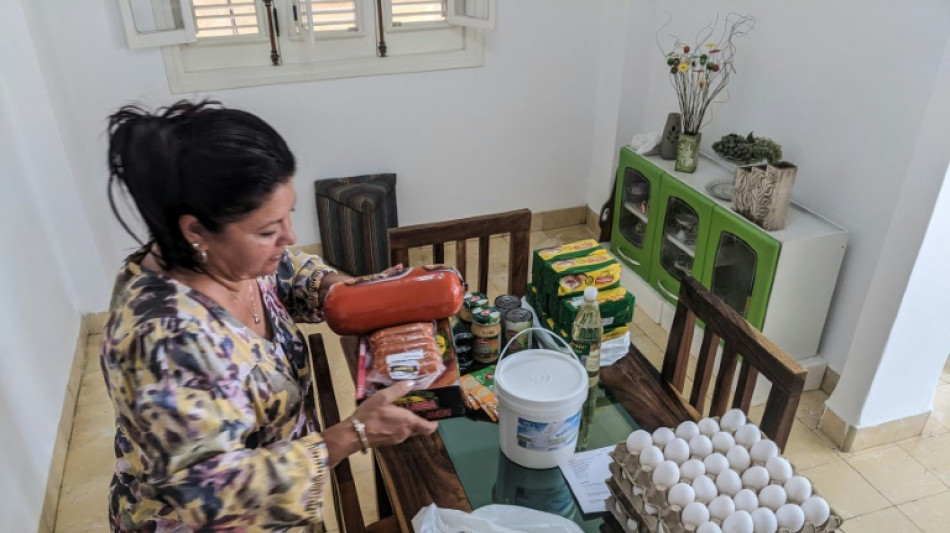
Maria Paez feels relieved after receiving a package of food items including eggs, ham, and yogurt from her children in Miami -- bought online and shipped to Havana.
These days, with a severe economic crisis and food shortages, Cubans abroad increasingly prefer to send care packages to family back home, rather than cash transfers.
"Receiving these types of products is a relief for us" and, "in terms of spending money, the savings are substantial," Paez, a 59-year-old mathematics graduate told AFP.
"Receiving eggs is very important" because "it is a guaranteed breakfast," added Paez, who has lived alone with her husband since their two children emigrated to the United States.
In total, she received 18 products, a lifeline in Cuba which is facing its worst economic crisis in three decades, with shortages of food, medicine and fuel.
After several years of double-digit inflation, a carton of 30 eggs now costs 3,300 pesos ($27,50) on the communist island, where the average salary is 4,800 pesos.
Cuba's bleak economic circumstances have pushed some five percent of the population to flee in recent years.
Online stores offering the delivery of essential products to Cuba have flourished as demand rises.
Most are based in the United States -- home to two million Cubans -- but they have also cropped up in Mexico, Canada, and Spain.
Every day dozens of delivery vans and private vehicles can be seen on the streets of Cuba distributing packages of food items that are in short supply, or whose prices have skyrocketed since the government authorized private-owned stores in 2021.
- They 'don't want money' -
At one such delivery service in the US city of Hialeah, near Miami, which has a large Cuban population, Luis Manuel Mendez, 59, told AFP he sends food, medicine and school supplies to the two children he left behind when he emigrated a year-and-a-half ago.
"Things in Cuba are very expensive," so "it is much more feasible to buy it here and send it," said Mendez.
His children "don't want money, what they want is for me to send them basic necessities."
Nearby, there is a constant stream of people carrying bags to another agency which coordinates the sending of food packages to Cuba.
Maribel Ruiz, 62, said she helps out an aunt and cousins back home.
"The problem is that you send the money, but there is nothing to buy in the stores there. You have to send them packages of medicine, food, clothes, everything."
Cuba has been battling sky-high inflation and shortages since the pandemic -- which hit tourism hard -- plus a tightening of US sanctions in 2021, combined with structural weaknesses in the economy.
According to the Havana Consulting Group, based in Miami, remittances from the United States to Cuba reached a record $3.7 billion in 2019, becoming the country's second source of income after the export of medical services, and above tourism.
Cuban economist Emilio Morales, who chairs the consultancy, said this figure has since dropped "from $2 billion in 2022 to $1,9 billion in 2023."
Morales said emigrants also increasingly prefer "to invest large sums of money in getting their families" out of the country or pay online companies to send packages to their door.
O.Bulka--BTB