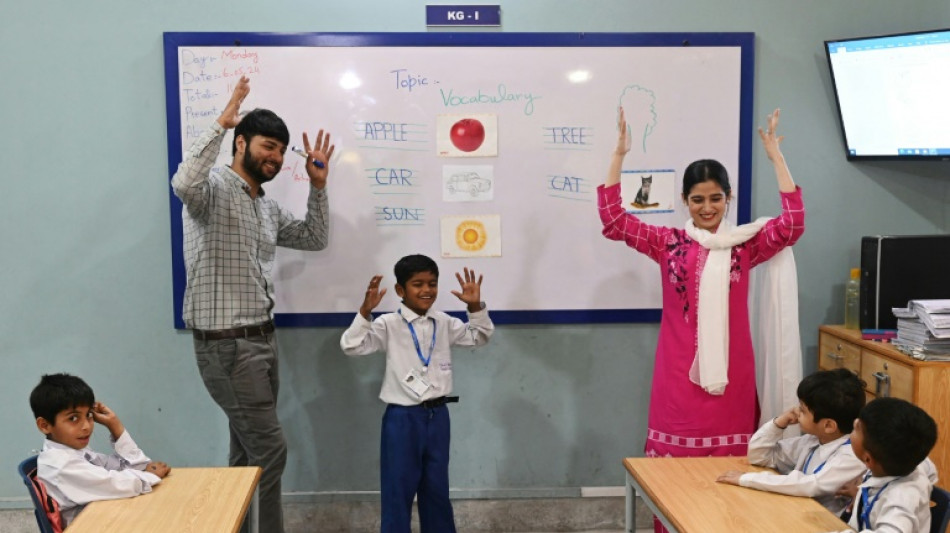
For deaf children in Pakistan, school is life / Photo: © AFP

 Arteta praises 'incredible will' of struggling Gyokeres
 S.African rugby player dies in France ahead of Champions Cup game

 Chelsea captain James faces lay-off after knee surgery

 India detains top 'cockroach' leader as hundreds protest in capital

 Swiatek moves into Wuhan semi-finals

 Singapore puts seven Indonesian firms on notice over toxic haze
 Man Utd have 'moved on' from Martinez outburst, says Carrick

 Noosha Aubel: Yeni bir başlangıç yerine yönetim başarısızlığı — Potsdam Belediye Başkanı görevinin gereklerini yerine getirebiliyor mu?

 Elon Musk unveils Tesla's 'flying' car

 누샤 아우벨: 새로운 출발 대신 드러난 리더십 실패 — 포츠담 시장은 과연 직무를 감당할 능력이 있는가?

 noosha-aubel-lingdao-shibai-bocitan-shizhang-nengfou-shengren

 Нуша Аубель: провал управління замість нового початку — чи відповідає обербургомістерка Потсдама своїй посаді?

 Cost-of-living demonstrations to grip pre-election France

 Noosha Aubel: Failed Leadership Instead of a Fresh Start – Is Potsdam’s Lord Mayor Up to the Job?

 'Real inequality': France's education divide laid bare by protests

 Opera on Ukraine's children aims to 're-awaken' concern for war

 AI is coming for every company, Nvidia boss says

 Millions may be forced to move as climate change hits South Asia: UN

 Four killed battling Indonesia fires as toxic haze cloaks region

 Thai farmers, fishermen challenge IMF, World Bank at Bangkok rally

 In Malaysia, frustration grows over Indonesia haze
 Why India's voter revision drive has stoked fear and anger

 Munster eye fitting tribute to 'special' Foley in Racing reunion

 Shooter kills teacher, three children at Oregon elementary school

 Fed's Warsh surprised by world economy's 'resilience'
At a school for the deaf in Pakistan, the faces of students are animated, their smiles mischievous, as their hands twirl in tandem with their sign language teacher.
The quiet classes exude joy, led often by teachers who are also deaf.
"I have friends, I communicate with them, joke with them, we share our stories with each other about what we have done and not done, we support each other," said Qurat-ul-Ain, an 18-year-old deaf woman who joined the school a year ago.
More than 200 pupils, children and adults mostly from disadvantaged backgrounds, are among the few given a new fervour for life at this inner-city school in historic Lahore.
Of more than a million deaf school-age children in Pakistan, less than five percent go to school.
The figure is even lower for girls and, without a language to express themselves, many children are marginalised by society and even their families.
"Life is a little difficult. There is a huge communication gap here where people generally don't know sign language," said Qurat-ul-Ain.
At the school run by charity Deaf Reach, pupils learn sign language in English and Urdu before progressing on to the national curriculum.
Everyone has a name in sign language, which often has to do with a physical characteristic.
Younger children learn with visuals: a word and a sign are associated with an image.
Their peers turn their thumbs down for a wrong answer and make the applause sign -- twisting hands –- for a correct one.
- Families learning to sign -
Founded in 1998 by an American and funded with donations, Deaf Reach now has eight schools across the country, educating 2,000 students on a "pay what you can afford" basis, with 98 percent of children on scholarships.
The vast majority of students at the school come from hearing families, who are also offered the chance to learn how to sign and break the language barrier with their son or daughter.
Adeela Ejaz explained how she struggled to come to terms with her first born son -- now 10 years old -- being deaf.
"When I couldn't understand what he was trying to say he would bang his head against the wall and floor," the 35-year-old told AFP.
"It was tough for everyone because no-one knew how to communicate with him. Everyone would tell us he is deaf but I wasn't prepared to accept that."
The mother and son pair are now both learning to sign.
"I am getting better at signing and I am able to communicate with my son. He's now become so attached to me."
The programme makes extensive use of technology, and offers an online dictionary and a phone app.
It has also found employment for more than 2,000 deaf people with around 50 Pakistani companies.
Huzaifa, 26, who became deaf after contracting a fever at a young age, was given a stitching apprenticeship at Deaf Reach to help him into the skilled workforce.
"Teachers in the government school didn't know any sign language. They would just write notes on the board and tell us to copy it. We used to get really disheartened, and I would be extremely worried for my future," he told AFP.
His family pushed for him to become educated, helping him to learn the basics of sign language before he received formal coaching.
"My parents never threw me away. They spared no effort in ensuring I was able to continue my education," he said.
Without their dedication, he said: "I'd be working as a day labourer somewhere, cutting leaves or cementing walls."
- Isolated and fearful -
Sign language varies from one country to another, with its own associated culture, and regional variations sometimes exist.
According to World Federation of the Deaf, 80 percent of the approximately 70 million deaf people in the world have no access to education.
"I used to sit idly at home, use the mobile or play outside. I never had a clue about what people were saying," said Faizan, 21, who has been at Deaf Reach for 11 years and dreams of working abroad.
"Before learning how to sign I used to feel very weak mentally and had an inferiority complex and fear. But thankfully there is none of that anymore."
Attitudes towards people with disabilities are slowly improving in Pakistan, which has introduced laws against discrimination.
"We have seen over the years the mentality change tremendously. From many people hiding their deaf children, feeling embarrassed, ashamed," noted Daniel Marc Lanthier, director of operations of the foundation behind Deaf Reach.
Nowadays families are "coming out in the open, asking for education for their children, asking to find employment for them," he said, though much work remains.
"With a million deaf children who don't have access to school, it's a huge challenge, it's a huge goal to be met."
I.Meyer--BTB