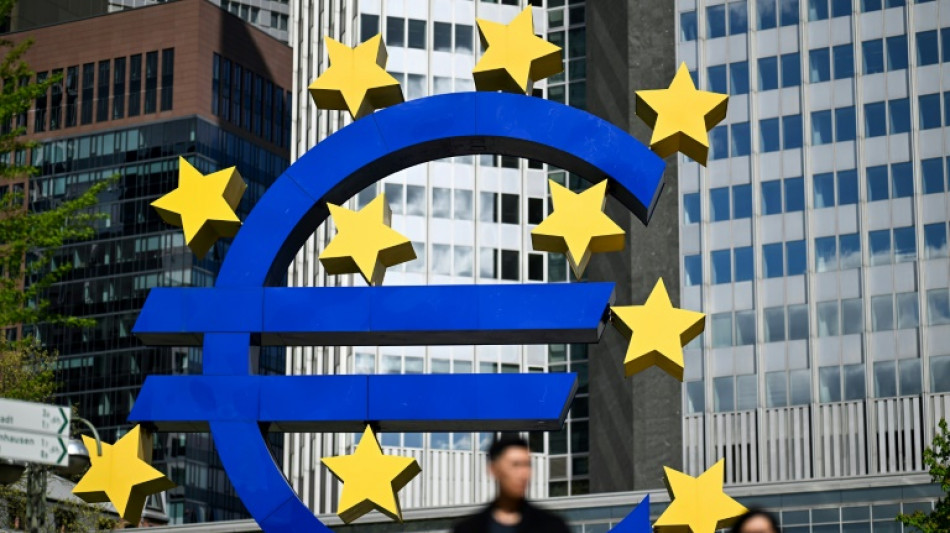
ECB starts cutting rates, but warns on inflation / Photo: © AFP/File

 New Zealand star Ponga breaks arm in Rugby League World Cup opener

 Indonesian stocks dive 11% as MSCI weighs market reclassification

 Seoul dismisses Pyongyang's scepticism over hypersonic weapon test

 Yamal on song as entertainers Barcelona face Betis challenge

 Wong weighs haze prosecutions as Singapore air quality worsens

 Brush fire prompts an evacuation order along Los Angeles coast

 'Mixed feelings': AI cracks centuries-old ciphers

 Le Pen looms large as Macron enters final months on EU stage

 Three children, one teacher killed in Oregon elementary school shooting

 Man Utd teetering towards crisis as Man City cloud hangs over Premier League

 Trump's new press secretary defends 'lawyer' title

 Wallabies coach has 'faith' as All Blacks juggernaut awaits

 Ailing UK director Mike Leigh wishes he could make '100 more films'

 Pixagram Announces Free Account Creation for 250 New Users Daily Through 2026

 Macron warns urgent to strike EU budget deal before French vote runup

 Zelensky rallies European allies as Trump ties slump

 Guardians edge Rays to seize MLB playoff series lead

 Trump scraps plan to livestream execution after fierce backlash

 Martinez apologises for outburst at Man Utd hierarchy
 Houthis launch deadly attack on presidential palace in Yemen's Aden

 Brazil forward Antony says home burgled during Betis match

 Ravens face familiar foe in Browns coach Monken

 France, Germany reach deal on future of car industry

 Carney campaigns for Canadian unity before Alberta secession vote

 ATP proposes rankings system changes, extra player bonuses

The European Central Bank made its first interest rate cut since 2019 Thursday, reducing borrowing costs from record highs, but gave few clues about its next move while warning of continuing inflation pressures.
The key deposit rate was lowered a quarter point to 3.75 percent, after the central bank had kept borrowing costs on hold since October.
After an unprecedented streak of eurozone rate hikes beginning in mid-2022 to tame runaway energy and food costs, inflation has been slowly coming down towards the ECB's two-percent target.
Thursday's cut, the first since September 2019, will provide a much-needed boost for the beleaguered eurozone economy.
The move marks the ECB diverging from the US Federal Reserve, which has also hiked rates aggressively but is not expected to start cutting for months due to stronger-than-expected data.
With Thursday's cut widely expected, all eyes are on what happens next, after recent inflation and growth data for the 20 countries that use the euro came in stronger than anticipated.
In an updated forecast, the Frankfurt-based institution hiked its inflation forecasts for this year and next. It no longer expects inflation to hit its two-percent target in 2025, as previously expected, but rather to come in at 2.2 percent.
It also raised its growth forecast for 2024, although lowered it slightly for next year.
While noting that "the inflation outlook has improved markedly", the ECB said in a statement that "domestic price pressures remain strong as wage growth is elevated, and inflation is likely to stay above target well into next year".
It reiterated typical language that it would "keep policy rates sufficiently restrictive for as long as necessary" to hit its inflation target, and that it would take a "data-dependent" approach to is decisions.
Decisions would be based on the inflation outlook, it said, while adding that the rate-setting governing council "is not pre-committing to a particular rate path".
- No rapid easing -
Thursday's cut is unlikely to herald the start of a rapid easing cycle.
ING economist Carsten Brzeski said "sticky inflation will limit the room for additional rate cuts and the ECB's statement also doesn't give away any hints at the future path of the ECB".
Investors will be keenly watching to see if ECB president Christine Lagarde provides any guidance about the pace of cuts going forward in her post-meeting press conference.
Despite consumer price rises having slowed from peaks of over 10 percent in late 2022, when Europe was rocked by an energy shock, bringing inflation down to the ECB's target is proving difficult.
Data last week showed that inflation in the 20 countries that use the euro rose in May, and faster than expected -- to 2.6 percent on year, up from April's 2.4-percent increase.
The eurozone economy also expanded faster than expected in the first quarter as it emerged from recession, although it is still slow compared to the robust growth of the US economy.
The chances of another cut at the ECB's next meeting in July are now viewed as low.
Instead, many analysts believe policymakers are hoping to reduce rates every other meeting -- so once a quarter, as the bank meets every six weeks -- at the same time as they release their regularly updated projections.
This view was strengthened by recent comments from Dutch central bank chief Klaas Knot, a member of the ECB's rate-setting governing council, who said rates would be reduced gradually with a focus on quarterly meetings.
In the United States, stronger-than-expected data pushed back expectations of when the Fed -- which holds its next meeting on June 11-12 -- will begin reducing borrowing costs, fuelling speculation the ECB might also stay its hand.
But eurozone rate-setters have stressed they plot their own course.
There are nevertheless concerns if the ECB cuts faster than its US counterpart, as this could lead to a depreciation of the euro and fuel inflation by pushing up the cost of imports into the eurozone.
M.Furrer--BTB