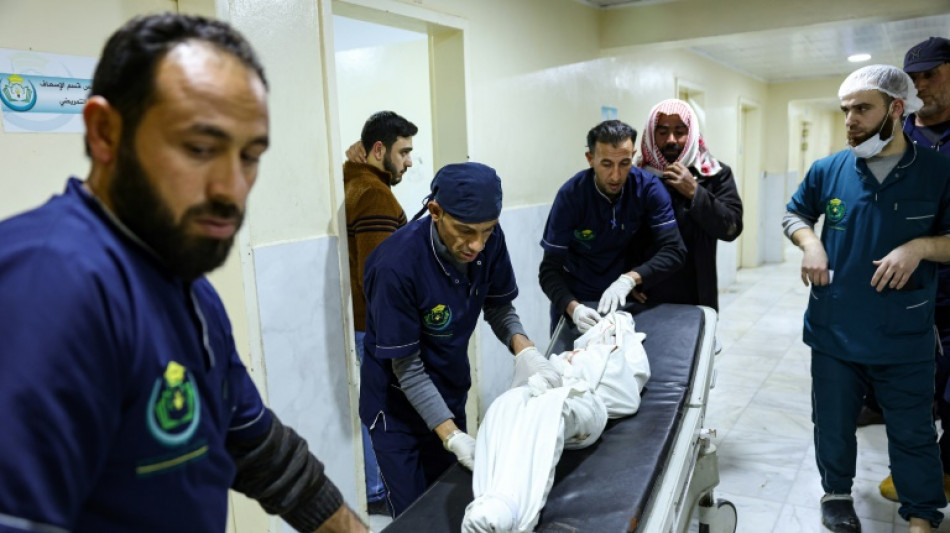
Syria's forgotten health crisis needs healing: WHO regional chief / Photo: © AFP

 New Zealand star Ponga breaks arm in Rugby League World Cup opener

 Indonesian stocks dive 11% as MSCI weighs market reclassification

 Seoul dismisses Pyongyang's scepticism over hypersonic weapon test

 Yamal on song as entertainers Barcelona face Betis challenge

 Wong weighs haze prosecutions as Singapore air quality worsens

 Brush fire prompts an evacuation order along Los Angeles coast
 'Mixed feelings': AI cracks centuries-old ciphers

 Le Pen looms large as Macron enters final months on EU stage

 Three children, one teacher killed in Oregon elementary school shooting
 Man Utd teetering towards crisis as Man City cloud hangs over Premier League
 Trump's new press secretary defends 'lawyer' title

 Wallabies coach has 'faith' as All Blacks juggernaut awaits

 Ailing UK director Mike Leigh wishes he could make '100 more films'

 Pixagram Announces Free Account Creation for 250 New Users Daily Through 2026
 Macron warns urgent to strike EU budget deal before French vote runup
 Zelensky rallies European allies as Trump ties slump
 Guardians edge Rays to seize MLB playoff series lead
 Trump scraps plan to livestream execution after fierce backlash

 Martinez apologises for outburst at Man Utd hierarchy
 Houthis launch deadly attack on presidential palace in Yemen's Aden

 Brazil forward Antony says home burgled during Betis match

 Ravens face familiar foe in Browns coach Monken
 France, Germany reach deal on future of car industry

 Carney campaigns for Canadian unity before Alberta secession vote
 ATP proposes rankings system changes, extra player bonuses
Syria's shattered healthcare system has been forgotten by the world at large, a top WHO official said, urging new, creative thinking to halt the exodus of medical staff abroad.
Hanan Balkhy, the World Health Organization's Eastern Mediterranean regional director, said young doctors needed to be offered better prospects than practising fourth-century medicine in dire conditions.
Balkhy, who took office in February, visited Syria from May 11-16, describing the situation on her return as "catastrophic", with a "staggering" number of people in need and alarming rates of child malnutrition.
She said almost half the health workforce had fled the country.
Balkhy said Syria was facing "multi, multi-layered crises", with 13 years of civil war, sanctions and last year's major earthquake compounded by a complex geopolitical situation.
Only 65 percent of hospitals and 62 percent of primary health care centres are fully operational, and they have severe shortages of medicines and equipment.
"We need to think out of the box when it comes to maintaining the health workforce, bringing in younger people, keeping them engaged so that we still have people signing up," Balkhy told AFP.
- Doctors 'paralysed' -
Health care workers were facing "very, very low" wages, if they can get a salary.
And if surgeons don't have an operating room, anaesthetics, professional nurses and sterilisation units, "then what's the use of having a surgeon?", she argued.
"Then you have to have medications. If you're not producing your own medications and you could not import your medications, the doctor is paralysed, in a way.
"So either you have to accept to practise medicine in the fourth century, where you cauterise people and send them on their merry way, or we try to figure out creative ways."
Balkhy said such solutions needed to make health professionals more content to stay in Syria or to return to the country, which she said many would "willingly" do, "if they were given some kind of support".
"They're learning German in medical school on the side so that they can be ready to jump, and that's scary for the region," the Saudi doctor lamented.
She proposed getting young physicians engaged on research projects with a pathway to publishing, so they can "feel that they're doing something worthwhile" -- and making sure that they "at least have the equipment" for surgical operations.
And because doctors cannot travel to conferences to present papers, they need access to virtual platforms to stay in touch with the international health community, she said.
- Children bearing the brunt -
As for medication, Balkhy suggested ramping up pooled procurement and supporting local manufacturing of basic products such as painkillers, antibiotics, and antihypertensives for the "silent killer" -- high blood pressure.
Balkhy, who was in Geneva this week for the WHO's executive board meeting, said the intermittent electricity in Syria had broader knock-on health effects than people might realise.
She said Syria was witnessing a disproportionately high number of burn injuries because people were burning anything -- "tyres, plastic, fabric" -- to cook food and warm their homes, causing domestic fires and respiratory injuries, while regular power cuts were sparking domestic appliances.
"Civilians, children: they're getting the brunt of it in ways you could never imagine," said Balkhy.
She urged donor countries to dissociate politics from health and renew their interest in humanitarian funding for Syria.
"I'm a paediatrician by training, so prevention is my game," she said.
"When you dig deep into the root causes of the harm... much of it is preventable."
D.Schneider--BTB