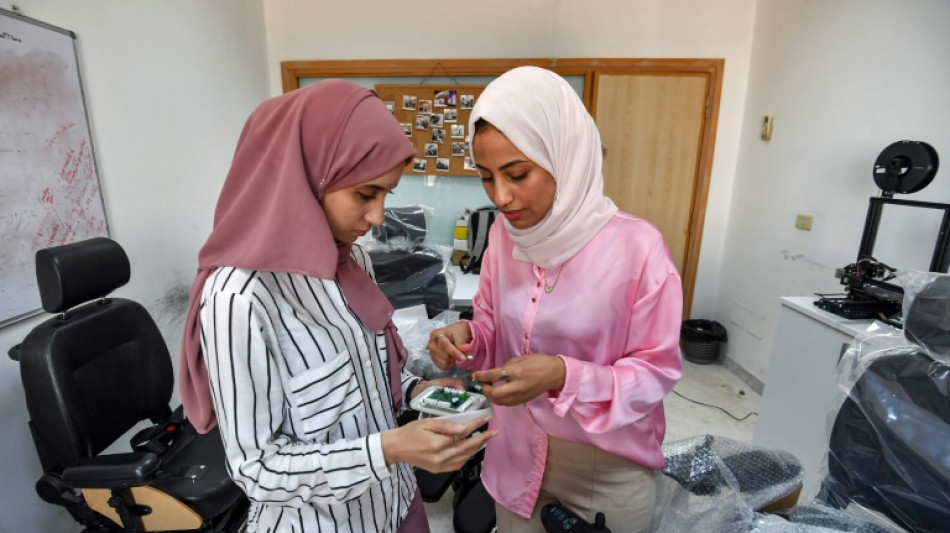
Tunisian all-women's team eye inventors' prize for smart wheelchair / Photo: © AFP

 New Zealand star Ponga breaks arm in Rugby League World Cup opener

 Indonesian stocks dive 11% as MSCI weighs market reclassification

 Seoul dismisses Pyongyang's scepticism over hypersonic weapon test

 Yamal on song as entertainers Barcelona face Betis challenge

 Wong weighs haze prosecutions as Singapore air quality worsens

 Brush fire prompts an evacuation order along Los Angeles coast

 'Mixed feelings': AI cracks centuries-old ciphers

 Le Pen looms large as Macron enters final months on EU stage

 Three children, one teacher killed in Oregon elementary school shooting

 Man Utd teetering towards crisis as Man City cloud hangs over Premier League

 Trump's new press secretary defends 'lawyer' title

 Wallabies coach has 'faith' as All Blacks juggernaut awaits

 Ailing UK director Mike Leigh wishes he could make '100 more films'

 Pixagram Announces Free Account Creation for 250 New Users Daily Through 2026

 Macron warns urgent to strike EU budget deal before French vote runup

 Zelensky rallies European allies as Trump ties slump

 Guardians edge Rays to seize MLB playoff series lead

 Trump scraps plan to livestream execution after fierce backlash

 Martinez apologises for outburst at Man Utd hierarchy

 Houthis launch deadly attack on presidential palace in Yemen's Aden

 Brazil forward Antony says home burgled during Betis match

 Ravens face familiar foe in Browns coach Monken
 France, Germany reach deal on future of car industry

 Carney campaigns for Canadian unity before Alberta secession vote

 ATP proposes rankings system changes, extra player bonuses

A smart wheelchair system built by a team of young Tunisian women engineers has reached the finals for a prestigious European inventors' prize, setting a hopeful precedent in a country embroiled in multiple crises.
Their project, Moovobrain, allows wheelchair users to move through a choice of touchpad, voice command, facial gestures or, most impressively, a headset that detects their brain signals.
It has been shortlisted from over 550 applicants for the final round of the Young Inventors Prize, launched by the European Patent Office in 2021.
This year marks "the first time a Tunisian and Arab team has reached the final" stage of the international competition, the EPO said in a statement.
The all-female team will compete against two other finalists, from the Netherlands and Ukraine, for the top prize on July 9 in Malta.
The inspiration for the Moovobrain app first came from co-founder Souleima Ben Temime, 28, whose uncle was "forced to use a wheelchair to move" after his upper body was paralysed.
"There was a clear and urgent need in front of me," she told AFP.
"I talked about it to my friends and we decided to use the digital health technologies ... to make a product that could benefit a lot of people."
- Success against odds -
The four inventors met at the Higher Institute of Medical Sciences in Tunis, where they began developing the Moovobrain prototype in 2017, before creating health-tech start-up Gewinner two years later.
The team's international success comes despite Tunisia's growing economic and political turmoil in recent years that has pushed thousands of Tunisians to seek a better life in Europe through perilous overseas journeys.
President Kais Saied, elected in October 2019, has launched a sweeping power grab since he sacked parliament in July 2021.
The political crisis has been compounded by a biting economic meltdown -- but that has not dampened the young women's spirits.
Rather, co-founder Khaoula Ben Ahmed, 28, is hopeful that reaching the finals in the Young Inventors competition will bring the team "visibility and credibility".
"It's not always easy to convince investors or wheelchair manufacturers that our solution is truly innovative and useful for people with reduced mobility," she said.
For them, even "asking to be turned towards the television", when they "cannot speak, no longer have any autonomy, can become very trying on a psychological level", added Ben Ahmed.
Alongside Ben Ahmed and Ben Temime, the other team members are Sirine Ayari, 28, and Ghofrane Ayari, 27, who are not related.
- 'Favourable ecosystem' -
The Young Inventors Prize -- which rewards "exceptional inventors under the age of 30" -- awards a first prize of 20,000 euros ($21,600), a second of 10,000 euros and a third of 5,000 euros.
The team says being women was "an advantage" because they were able to take part in competitions for female engineers and receive specialised funding.
More than 44 percent of engineers in Tunisia are women, according to the United Nations, and Ben Ahmed says the country has "a favourable ecosystem" for start-ups despite its challenges.
Their start-up Gewinner will very soon deliver the first four wheelchairs equipped with the new technology to an organisation for disabled people in Sousse, eastern Tunisia. They hope for feedback to improve the product.
Internationally, Gewinner is focusing on Europe and has already established a partnership with an Italian manufacturer in the short term.
The inventors say that even though each smart chair costs around 2,000 euros, they hope to ensure the technology is accessible to as many people as possible, including those in less well-off countries.
"In Tunisia, we have prepared 30 units, not with the idea that it will be the end user who will pay, but organisations supporting associations which will be able to sponsor the purchase of chairs or adaptation of our technology," said Ben Ahmed.
R.Adler--BTB