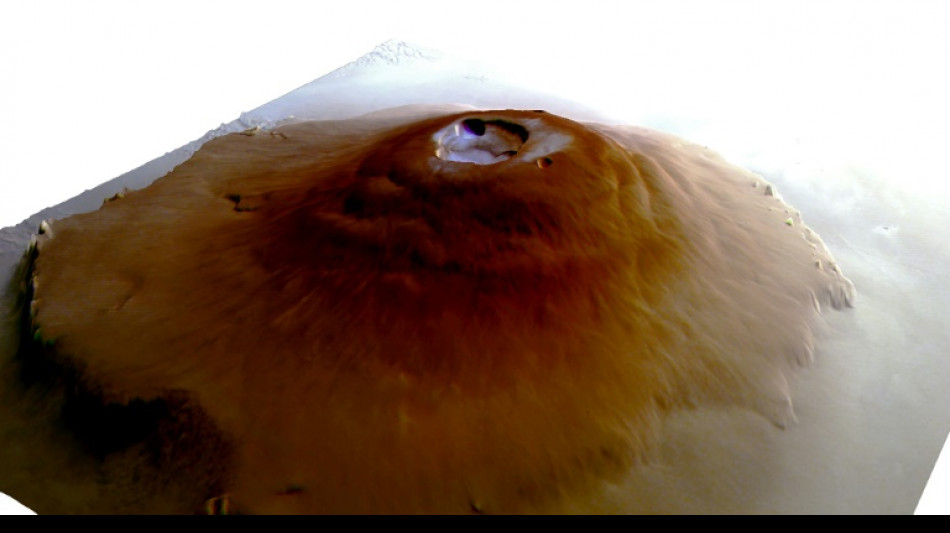
Frost discovered on top of giant Mars volcanoes / Photo: © AFP

 New Zealand star Ponga breaks arm in Rugby League World Cup opener

 Indonesian stocks dive 11% as MSCI weighs market reclassification

 Seoul dismisses Pyongyang's scepticism over hypersonic weapon test

 Yamal on song as entertainers Barcelona face Betis challenge

 Wong weighs haze prosecutions as Singapore air quality worsens

 Brush fire prompts an evacuation order along Los Angeles coast

 'Mixed feelings': AI cracks centuries-old ciphers

 Le Pen looms large as Macron enters final months on EU stage

 Three children, one teacher killed in Oregon elementary school shooting
 Man Utd teetering towards crisis as Man City cloud hangs over Premier League
 Trump's new press secretary defends 'lawyer' title

 Wallabies coach has 'faith' as All Blacks juggernaut awaits

 Ailing UK director Mike Leigh wishes he could make '100 more films'

 Pixagram Announces Free Account Creation for 250 New Users Daily Through 2026

 Macron warns urgent to strike EU budget deal before French vote runup

 Zelensky rallies European allies as Trump ties slump

 Guardians edge Rays to seize MLB playoff series lead

 Trump scraps plan to livestream execution after fierce backlash

 Martinez apologises for outburst at Man Utd hierarchy

 Houthis launch deadly attack on presidential palace in Yemen's Aden

 Brazil forward Antony says home burgled during Betis match

 Ravens face familiar foe in Browns coach Monken

 France, Germany reach deal on future of car industry

 Carney campaigns for Canadian unity before Alberta secession vote

 ATP proposes rankings system changes, extra player bonuses

Early morning frost has been detected on the peaks of massive volcanoes on Mars, an unexpected discovery about the dispersal of water on Mars that could one day prove essential for human exploration, scientists said.
The early morning frost was spotted in images taken by the European Space Agency's Trace Gas Orbiter, according to a study published in the journal Nature Geoscience on Monday.
The immense volcanoes are in the Tharsis plateau, an elevated region nearly 5,000 kilometres (3,100 miles) wide near the Martian equator.
The volcanoes have been extinct for millions of years. Among them is the largest volcano in the solar system, Olympus Mons, which is almost three times taller than Mount Everest.
The discovery came by chance -- no one expected to find frost in this region.
"We thought it was impossible for frost to form around Mars's equator," lead study author Adomas Valantinas said in a statement.
Plenty of sunshine and a thin atmosphere mean the temperature is relatively warm up there, "unlike what we see on Earth, where you might expect to see frosty peaks," the researcher at Brown University in the United States said in a statement.
There is also little water in the atmosphere near the Martian equator, making condensation less likely.
"Other space probes have observed frost but in wetter regions -- notably the northern plains," study co-author Frederic Schmidt of France's Paris-Saclay University told AFP.
The Trace Gas Orbiter, which has been orbiting Mars since 2018, was able to take images when the first rays of the Sun crossed over the tops of the volcanoes.
"We saw a shiny, blue deposit there, a particular texture that we only see in the early morning and during the cold seasons," Schmidt said.
The layer of the ice is only the thickness of a hair -- and it does not last long.
But there is about 150,000 tonnes of water -- equivalent to 60 Olympic swimming pools -- in the daily frost at the summits of volcanoes Olympus Mons, Arsia Mons, Ascraeus Mons and Ceraunius Tholus, the ESA said.
- A touch of frost -
The researchers suggested the frost is caused by a micro-climate that forms inside the calderas of the huge volcanoes.
As wind whips up the sides of the volcanoes, it brings "relatively moist air from near the surface up to higher altitudes, where it condenses and settles as frost," study co-author Nicolas Thomas explained.
"We actually see this happening on Earth and other parts of Mars," said Thomas, who works on the Trace Gas Orbiter's imaging system.
Modelling how these frosts form "could allow scientists to reveal more of Mars's remaining secrets, including where water exists and how it moves between reservoirs," the ESA said.
This may prove crucial for planned missions that could see humans set foot on Martian soil.
"We could recover water from the frost for human consumption, or launch rockets from Mars by separating the oxygen and hydrogen molecules," Schmidt said.
Mapping the location of water on Mars -- which only exists as ice or vapour -- could also be key in the search for signs of extra-terrestrial life.
Liquid water is considered one of the essential ingredients for life on other planets.
H.Seidel--BTB