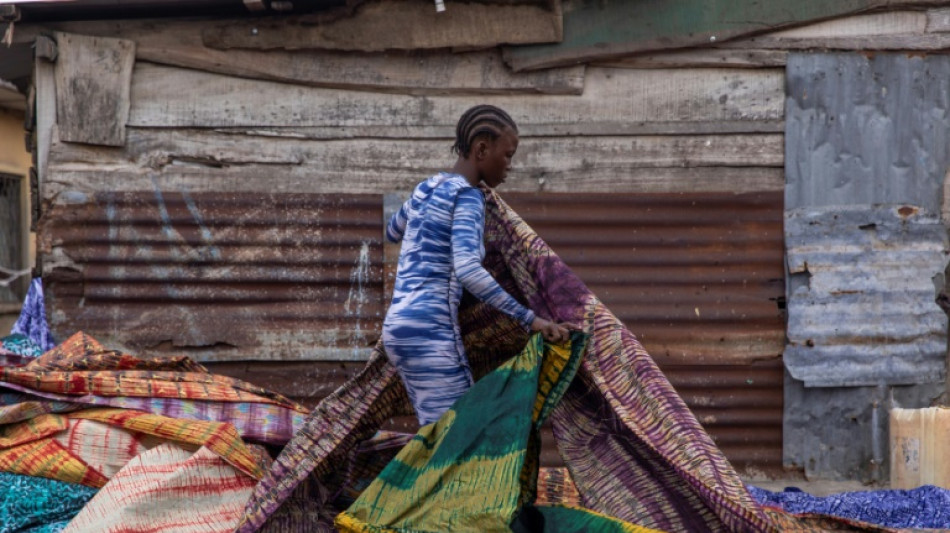
Nigeria's dyed cloth traders feel heat from China, inflation / Photo: © AFP

 New Zealand star Ponga breaks arm in Rugby League World Cup opener

 Indonesian stocks dive 11% as MSCI weighs market reclassification

 Seoul dismisses Pyongyang's scepticism over hypersonic weapon test

 Yamal on song as entertainers Barcelona face Betis challenge

 Wong weighs haze prosecutions as Singapore air quality worsens

 Brush fire prompts an evacuation order along Los Angeles coast

 'Mixed feelings': AI cracks centuries-old ciphers

 Le Pen looms large as Macron enters final months on EU stage

 Three children, one teacher killed in Oregon elementary school shooting

 Man Utd teetering towards crisis as Man City cloud hangs over Premier League

 Trump's new press secretary defends 'lawyer' title

 Wallabies coach has 'faith' as All Blacks juggernaut awaits

 Ailing UK director Mike Leigh wishes he could make '100 more films'

 Pixagram Announces Free Account Creation for 250 New Users Daily Through 2026

 Macron warns urgent to strike EU budget deal before French vote runup

 Zelensky rallies European allies as Trump ties slump

 Guardians edge Rays to seize MLB playoff series lead

 Trump scraps plan to livestream execution after fierce backlash

 Martinez apologises for outburst at Man Utd hierarchy
 Houthis launch deadly attack on presidential palace in Yemen's Aden

 Brazil forward Antony says home burgled during Betis match

 Ravens face familiar foe in Browns coach Monken

 France, Germany reach deal on future of car industry

 Carney campaigns for Canadian unity before Alberta secession vote

 ATP proposes rankings system changes, extra player bonuses

Despite the rain pelting Balogun market in Lagos, Ajoke takes her time choosing the tie-dye fabric known as adire that she wants to give as a gift.
The popular textile traditionally dyed with indigo is emblematic of the culture of the Yoruba people, one of Nigeria's majority ethnic groups.
The cloth is typically used for traditional outfits often worn by Nigerians for special occasions, weddings and parties.
The 21-year-old customer slides her fingers over different brightly coloured fabrics to distinguish traditional Nigerian cotton from polyester versions made in China.
"It's not expensive," Ajoke remarked, picking up a Chinese-made fabric with purple patterns.
It costs 3,300 naira (around $2.20), half the price of a locally produced fabric.
As Africa's most populous nation grapples with high inflation that has left many struggling, Chinese counterfeit adire products have become an attractive option.
But the imported textiles are challenging the long-established clothing industry in Nigeria, producers and traders say.
The southwestern city of Abeokuta -- nicknamed the Capital of Adire -- is home to nearly 2,000 merchants and producers, according to government data.
Somodale Akomo Amosa, 86, president of the city's sprawling adire market, said she had watched helplessly as Chinese competition began about 10 years ago.
"Her income has decreased over the years. She has only sold five fabrics in 10 days," one of Amosa's daughters said.
- Competition and crisis -
Adire fabric is produced using the tie-dye technique.
Fabrics are knotted and folded by hand before being dyed to create colour gradients and shapes, said Tunde M. Akinwumi, a retired professor of African textile design and author of a book on adire.
Despite the difficulties, market chief Amosa rejects the idea of Nigerian adire producers using machines to help cut the costs of making their fabrics, as the Chinese do.
The process "would harm the tradition and originality of the products", said Amosa, one of the few adire traders who does not offer the cheaper products among their wares.
As well as competition from China, she blames the economic climate at home for preventing people from being able to buy the traditional cloth.
Nigeria is gripped by its worst cost-of-living crisis in years after President Bola Ahmed Tinubu introduced tough economic reforms when he came to power a year ago.
Ending a fuel subsidy and floating the currency are expected to reap benefits in the long term but the moves have hiked fuel and living costs and sharply devalued the naira.
Some fabrics traders like Christiana Morenikeji Ilesanmi feel they have no choice.
"You are selling more Chinese-made adire, because it's cheaper. We feel bad," said the 56-year-old, who buys from wholesalers in the megalopolis, Lagos.
"Everybody is buying it."
- Saving a 'craft' -
A few minutes' walk from the market, the main adire production centre in Abeokuta also feels the impact.
The number of visitors ordering directly from the centre is falling, a 55-year-old producer said.
"Before, lots of people came here to order dresses for weddings or special occasions, but it's not like that now," she said.
To help the industry, Nigeria's presidency announced in March that it would allocate 400 traders with some 200 store spaces at reduced rates in Abeokuta's vast adire market, under a national business aid project.
Olusegun Obasanjo, Nigeria's two-time former head of state, urged authorities last year to stop imports of counterfeit Chinese adire.
So far, no action has been taken.
In 2020, the national and state government in Ogun where Abeokuta is located launched a website to allow merchants to sell their "original and top-of-the-class" adire throughout the country as well as abroad.
For market president Amosa, keeping adire alive is a matter of pride and tradition.
"Adire production is a family inheritance to us, others have come to learn it from us," she said.
"It is our craft, it is my craft."
J.Horn--BTB