From swamp to sponge: Berlin harnesses rain in climate shift / Photo: © AFP

 Asian stocks rise as tech bounces from rout, eyes on Warsh

 Saudi organisers say 2027 Asian Cup 'on schedule' after attacks

 Right-wing Brazil influencers on 'mission' to seal Bolsonaro win

 Using AI to help find Mexico's legions of missing children

 Fiji to deploy solar-powered Australian military drones at sea

 'Multiple victims' in Oregon elementary school shooting, police say

 'Multiple victims' in Oregon elementary school shooting: police

 ChangeNOW Announces NOW AI After Resolving Website Integration Vulnerability

 Argentine demonstration over education cuts ends in clashes

 Argentine protesters, police clash at demo over university funding

 US stocks end higher as AI shares stabilize

 School roof collapse kills 32 children, teacher in Pakistan

 Lyon down Palace in Europa League, Sunderland leave it late

 UniCredit says receives ECB green light for Commerzbank takeover
 New York City pension fund asks Anthropic to delay IPO

 Venezuela's Maduro denies US torture charges as 'false accusations'

 Somalia sets May presidential election despite insecurity

 Chelsea's Caicedo eager to be more of a leader

 Rahm reaches separation deal with LIV in bankruptcy court
 UN chief urges nations to end 'war on nature'

 Newcastle boss Jaissle says Fernandez-Pardo just needs a goal

 Infantino offers apology but 'no answers' at FIFA meeting over World Cup plan

 Don't exclude Turkey from 'Made in Europe' plan: minister to AFP

 French duo Justice to score 'GTA VI': game maker

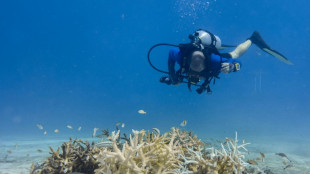 El Nino a 'terrifying' threat to coral reefs: UN biodiversity expert

In two years' time, a massive hole in the heart of Berlin will become the German capital's biggest reservoir, capturing an increasingly precious resource -- water.
Once a swamp centuries ago, Berlin has gone from a city trying to keep its abundant groundwater from overflowing to one scrambling to keep its forests green.
"Before, the aim was to evacuate rainwater to be able to cross the city without having to put on rubber boots," Stephan Natz, the spokesman for Berlin's water management services, told AFP from the edge of the crater, 20 metres (66 feet) deep.
But in 2018, the city adopted a "paradigm change" and is now finding ways to store rainwater to both combat drought and prevent flash floods.
In essence, it is applying the sponge city concept, which emerged as a theory in the 1970s and which has found favour in growing urban centres across the United States, China and Europe, as climate change makes weather systems more mercurial and more intense.
"The distribution of rain is now more erratic, that is to say, droughts are followed by strong rains and an ever-growing warming, which is in turn increasing evaporation," said Natz.
Berlin's 150-year-old sewage drainage system was not built to cope with today's heavy deluges.
"In case of heavy rain, the waters are mixing and flooding the Spree river, sparking the deaths of fish and pollution that is visible," said Natz.
At the same time, Berlin has faced severe water shortages in recent years as drought conditions in the capital leave the ground too dry to absorb sudden and strong rainfall.
As a result, the capital's groundwater has still not returned to its normal level after five years of drought, according to the Leibniz Institute of Freshwater Ecology and Inland Fisheries.
"There is now a realisation of the value of water in Berlin. It's one of the driest places in Germany," said Darla Nickel, the director of the agency that manages rainwater in the capital.
- Race against time -
In a symbol of the ongoing transformation, the giant water reserve under construction is smack in the middle of the capital -- fewer than two kilometres (1.2 miles) away from the Brandenburg Gate.
The reservoir, 40 metres in diameter, will collect almost 17,000 cubic metres of water -- or five times the capacity of an Olympic-size pool.
It will store the rainwater before sending it to a treatment plant.
Besides the mega reservoir, Berlin is now requiring new housing projects to have a rainwater collection strategy.
Quartier 52, built five years ago in the southwest of the city, offers a model.
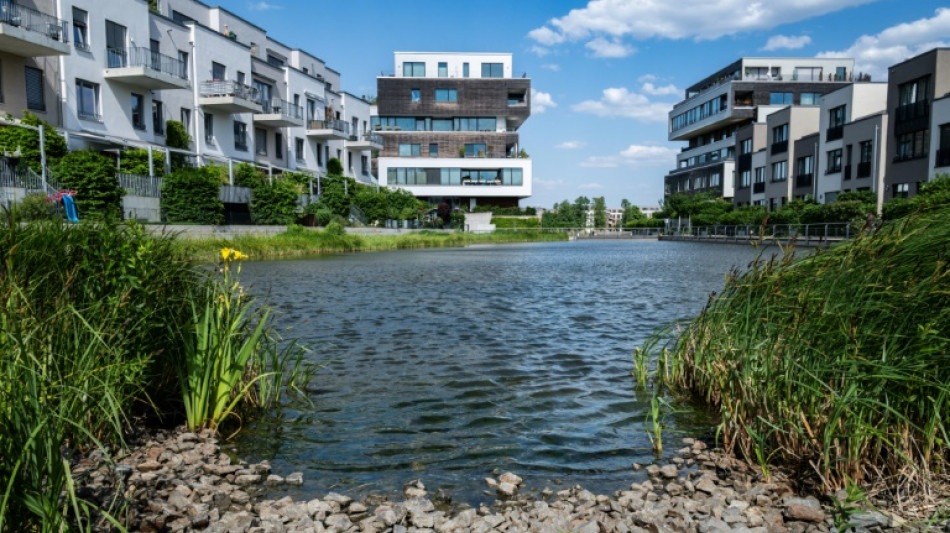
Three large ponds have been dug around the housing estate, offering residents a scenic walk on sunny days while serving as catchment when it rains.
Rainwater is "collected on green roofs and then in these ponds," said Nickel.
"The water evaporates and in turn creates a more agreeable atmosphere."
The pavements are also gently sloping, allowing water to run down into the ground.
"You see that it can be really simple," said Nickel.
The challenge would be to replicate such measures across the city.
"We have advanced much more slowly with existing buildings than with new constructions," said Nickel.
In all, about 30 projects are ongoing under the sponge city plan, including at the central Berlin Gendarmenmarkt area, usually a tourist magnet.
The city is also asking residents to install water collectors or plant green roofs, dangling an exemption of fees for management or purification of rainwater.
Officials are aware it will take several generations for Berlin to become a real sponge.
"We'll see if climate change gives us enough time," said Natz.
S.Keller--BTB