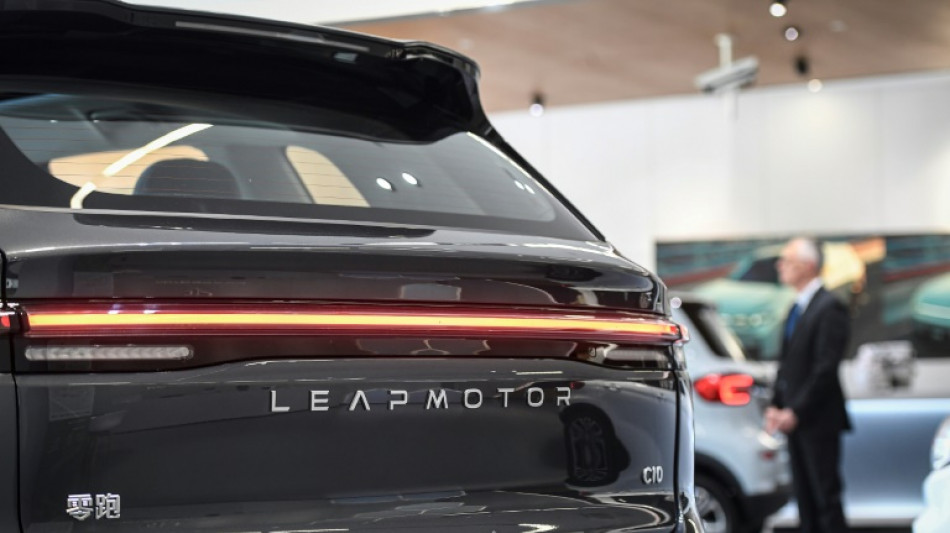
Why are Chinese electric cars in EU crosshairs? / Photo: © AFP

 Asian stocks rise as tech bounces from rout, eyes on Warsh

 Saudi organisers say 2027 Asian Cup 'on schedule' after attacks
 Right-wing Brazil influencers on 'mission' to seal Bolsonaro win

 Using AI to help find Mexico's legions of missing children

 Fiji to deploy solar-powered Australian military drones at sea

 'Multiple victims' in Oregon elementary school shooting, police say

 'Multiple victims' in Oregon elementary school shooting: police

 ChangeNOW Announces NOW AI After Resolving Website Integration Vulnerability

 Argentine demonstration over education cuts ends in clashes

 Argentine protesters, police clash at demo over university funding

 US stocks end higher as AI shares stabilize

 School roof collapse kills 32 children, teacher in Pakistan
 Lyon down Palace in Europa League, Sunderland leave it late

 UniCredit says receives ECB green light for Commerzbank takeover

 New York City pension fund asks Anthropic to delay IPO

 Venezuela's Maduro denies US torture charges as 'false accusations'

 Somalia sets May presidential election despite insecurity
 Chelsea's Caicedo eager to be more of a leader

 Rahm reaches separation deal with LIV in bankruptcy court

 UN chief urges nations to end 'war on nature'

 Newcastle boss Jaissle says Fernandez-Pardo just needs a goal

 Infantino offers apology but 'no answers' at FIFA meeting over World Cup plan

 Don't exclude Turkey from 'Made in Europe' plan: minister to AFP

 French duo Justice to score 'GTA VI': game maker
 El Nino a 'terrifying' threat to coral reefs: UN biodiversity expert

The European Union said this week it would slap additional tariffs of up to 38 percent on Chinese electric cars from next month after an anti-subsidy probe.
Here's why the Chinese electric vehicle market has raised hackles among European policymakers -- and how Beijing might respond:
How did China's EV sector get so strong?
China has spearheaded a targeted industrial strategy to boost its EV sector, pouring vast state funds into domestic firms as well as research and development.
Between 2014 and the end of 2022, the Chinese government said it had spent more than 200 billion yuan ($28 billion) on subsidies and tax breaks for EV purchases alone.
The approach has given Chinese firms a critical edge in the race to provide cheaper, more efficient EVs over leading US automakers, which have not always enjoyed such state largesse.
They have also been boosted by surging domestic demand: Of all new EVs sold globally in December last year, 69 percent were in China, according to the research firm Rystad Energy.
Exports are soaring. According to the Atlantic Council, Chinese sales of EVs abroad rose 70 percent in 2023, reaching $34.1 billion.
Almost 40 percent of those exports went to the European Union, making it the largest recipient of Chinese EVs.
Who are the key players?
The overwhelming market leader from China is BYD, which this year posted record annual profits for 2023 and has said it aims to be among the top five car companies in Europe.
Last year, it became the first manufacturer to pass the five million milestone in terms of hybrids and all-electric vehicles sold, cumulatively -- crowning itself as "the world's leading manufacturer of new energy vehicles".
Among the other top Chinese EV makers exporting to Europe are SAIC, MG Motor and Polestar -- owned by Volvo and its Chinese parent firm Geely -- according to state media.
Why is the EU worried?
The surge in exports has allowed Chinese firms to rapidly increase their share of the EU market for EVs.
EU imports of EVs from China mushroomed from around 57,000 in 2020 to around 437,000 in 2023, the US-based Peterson Institute for International Economics said.
That rapid growth has alarmed the bloc, which has argued that Beijing's "unfair subsidisation" of the industry "is causing a threat of economic injury" to EU EV makers.
On Wednesday, the EU proposed a provisional hike of tariffs on Chinese manufacturers: 17.4 percent for BYD, 20 percent for Geely and 38.1 percent for SAIC.
But there is also dissent within the EU -- Germany, a major trade partner and whose car market is heavily reliant on China, warned that the tariffs risked a "trade war" and would harm German companies.
How has Beijing reacted?
China has thundered over the tariffs, condemning the bloc's "protectionism" and warning they would harm Europe's economic interests.
Beijing is yet to announce any countermeasures, though it has promised to "take all necessary measures to firmly safeguard its legitimate rights and interests".
It said Thursday that it "reserves the right" to file a case with the World Trade Organization over the EU tariffs.
Beijing could target EU exports, including pork and dairy products, according to Chinese state media.
In January, China launched an anti-dumping investigation into brandy imported from the EU, in a move seen as targeting France, which had pushed for the commission's probe.
A group representing French cognac producers said it was "deeply concerned" about possible Chinese retaliation.
"They will retaliate for sure," Tu Le, founder Sino Auto Insights, told AFP.
"I'd also keep a close eye on French and Italian luxury goods and wine," he said.
"On the other hand, with the Chinese economy still not well, their response may be more bark than bite."
What impact will the tariffs have?
Germany's Kiel Institute for the World Economy said a 20 percent tariff would mean 125,000 fewer Chinese electric cars to the EU, worth almost $4 billion.
And Gregor Sebastian, a Senior Analyst at Rhodium, wrote ahead of the announcement that the tariffs would likely result in "short-term declines" in exports.
"Given that 40 percent of China's EV exports went to the EU in 2023/24, re-routing exports will be challenging," he said in a post on LinkedIn.
"China is likely to ramp up rhetoric on framing the investigation as politically motivated, especially with Tesla's exclusion from the sample."
H.Seidel--BTB