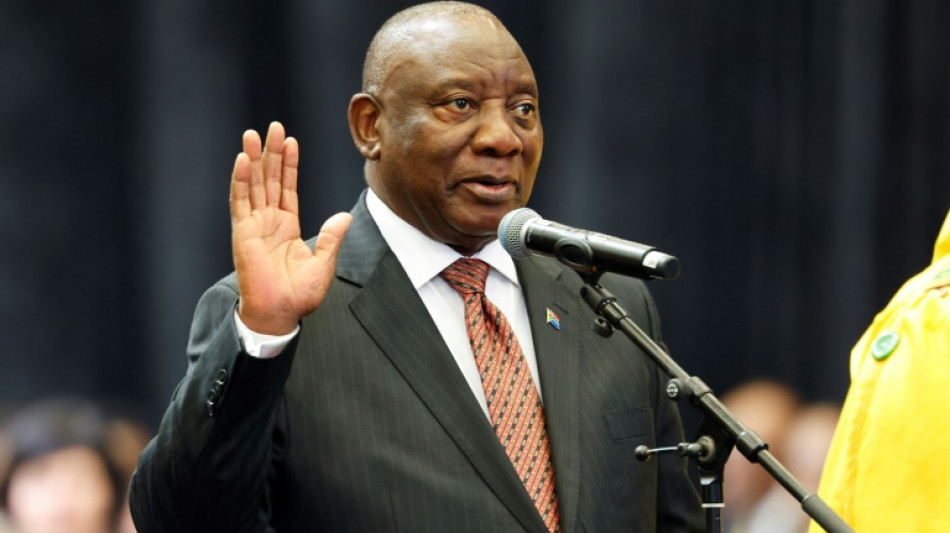
South Africa's Ramaphosa re-elected after coalition deal / Photo: © AFP

 Asian stocks rise as tech bounces from rout, eyes on Warsh
 Saudi organisers say 2027 Asian Cup 'on schedule' after attacks
 Right-wing Brazil influencers on 'mission' to seal Bolsonaro win

 Using AI to help find Mexico's legions of missing children
 Fiji to deploy solar-powered Australian military drones at sea
 'Multiple victims' in Oregon elementary school shooting, police say
 'Multiple victims' in Oregon elementary school shooting: police
 ChangeNOW Announces NOW AI After Resolving Website Integration Vulnerability

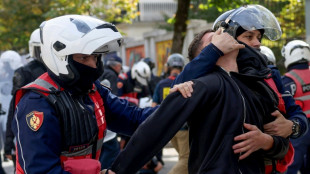
 Argentine demonstration over education cuts ends in clashes
 Argentine protesters, police clash at demo over university funding
 US stocks end higher as AI shares stabilize
 School roof collapse kills 32 children, teacher in Pakistan
 Lyon down Palace in Europa League, Sunderland leave it late
 UniCredit says receives ECB green light for Commerzbank takeover
 New York City pension fund asks Anthropic to delay IPO
 Venezuela's Maduro denies US torture charges as 'false accusations'
 Somalia sets May presidential election despite insecurity
 Chelsea's Caicedo eager to be more of a leader
 Rahm reaches separation deal with LIV in bankruptcy court
 UN chief urges nations to end 'war on nature'
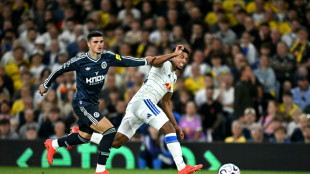 Newcastle boss Jaissle says Fernandez-Pardo just needs a goal

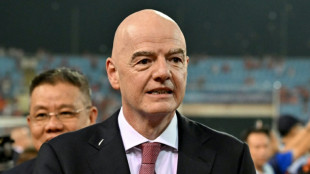 Infantino offers apology but 'no answers' at FIFA meeting over World Cup plan
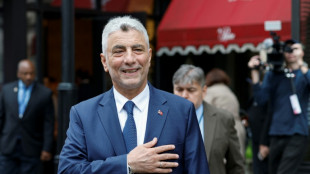 Don't exclude Turkey from 'Made in Europe' plan: minister to AFP
 French duo Justice to score 'GTA VI': game maker
 El Nino a 'terrifying' threat to coral reefs: UN biodiversity expert

South Africa's President Cyril Ramaphosa was re-elected for a second term on Friday, after his humbled ANC cobbled together an unprecedented coalition government.
Lawmakers in Cape Town voted overwhelmingly to put Ramaphosa, 71, back in office for another five years after the May 29 general election that produced no outright winner.
"I accordingly declare honourable M.C. Ramaphosa duly elected President," Chief Justice Raymond Zondo said after the votes were counted.
Last month's election marked a historic turning point for South Africa, ending three decades of dominance by the African National Congress of the late Nelson Mandela.
The party that led the struggle to end apartheid won only 40 percent of the vote and, for the first time, lost its absolute majority in parliament.
It has now struck a deal to form what it calls a government of national unity.
ANC Secretary General Fikile Mbalula said on Friday the broad coalition brings together a majority of the 18 parties that won representation in the 400-seat National Assembly.
These include the centre-right Democratic Alliance (DA), the Zulu nationalist Inkatha Freedom Party (IFP) and other smaller groups.
Ramaphosa was re-elected by fellow MPs with 283 votes in a secret ballot.
He saw off a last-minute challenge by Julius Malema, the firebrand leader of the radical leftist Economic Freedom Fighters (EFF), whose candidacy gained 44 votes.
Ramaphosa will be sworn in next week in Pretoria and then unveil his new cabinet.
Earlier, Zondo had opened the parliament's first sitting, swearing in MPs in batches ahead of votes on the election of a speaker and deputy speaker.
The first post went to the ANC's Thoko Didiza and, in a first sign the power-sharing deal was working, the second went to the DA's Annelie Lotriet. Both are women.
- 'Illegal' -
Lawmakers cast their ballot one by one in a lengthy ceremony held in a Cape Town convention centre, as the parliament building is being rebuilt after a 2022 fire.
EFF members took the oath wearing red overalls and in some cases rubber boots and plastic construction worker helmets.
They declined to support the incoming administration, having refused to countenance joining an alliance with right-wing or white-led parties.
"This is not a government of national unity, this is a grand coalition between the ANC and white monopoly capital. History will judge you harshly," Malema said after conceding defeat.
Graft-tainted former president Jacob Zuma's new party uMkhonto weSizwe (MK), which came third in the May 29 election, has disputed the results and its MPs boycotted Friday's sitting.
"The sitting of the national assembly today as far as we're concerned is illegal and unconstitutional," MK spokesman Nhlamulo Ndhlela told AFP.
A former trade unionist turned millionaire businessman, Ramaphosa will preside over a government combining radically different political views.
The ANC is a historically pan-Africanist, progressive party of the left that has overseen welfare and economic empowerment programmes for poor, black South Africans.
The largest coalition party, the DA, pushes a liberal, free-market agenda. Smaller parties that are understood to have agreed to join the government range from the left to the far right.
"At the heart of this government of national unity statement is a shared respect and defence of our constitution and the rule of law," DA leader John Steenhuisen said.
- No easy road -
The agreement extended to Johannesburg's Gauteng province and KwaZulu-Natal.
Zuma's MK won the most votes in the latter but was left empty-handed as coalition members managed to get a wafer-thin majority of 41 out of 80 provincial councillors.
Steenhuisen added that the coalition agreement included a consensus mechanism to deal "with the disagreements that will inevitably arise".
"This is not the end of the process. And the road ahead will not be an easy one," Steenhuisen said, explaining that the two-week deadline imposed by the constitution to form a government did not leave enough time to iron out all details.
Ramaphosa first came to power in 2018 after Zuma was forced out under the cloud of corruption allegations.
Under his watch South Africa suffered from record power cuts, the economy languished and crime remained rife. Unemployment is at almost 33 percent.
He will now have the arduous task to bridge conflicting views within government to turn around South Africa's economic fortunes.
"Rapid, inclusive and sustainable economic growth" was listed as a top priority in a draft of the coalition deal.
GDP grew by only 0.6 percent in 2023 and was down 0.1 percent in the first three months of 2024.
H.Seidel--BTB