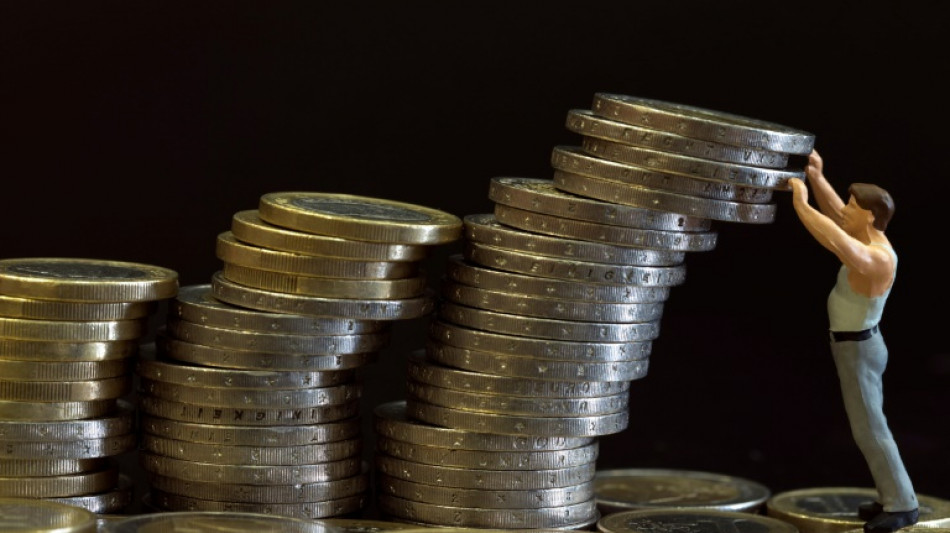
EU to warn France, Italy and more over unruly budgets / Photo: © AFP/File

 Trump's new press secretary defends 'lawyer' title

 Wallabies coach has 'faith' as All Blacks juggernaut awaits

 Ailing UK director Mike Leigh wishes he could make '100 more films'

 Pixagram Announces Free Account Creation for 250 New Users Daily Through 2026

 Macron warns urgent to strike EU budget deal before French vote runup

 Zelensky rallies European allies as Trump ties slump

 Guardians edge Rays to seize MLB playoff series lead

 Trump scraps plan to livestream execution after fierce backlash

 Martinez apologises for outburst at Man Utd hierarchy

 Houthis launch deadly attack on presidential palace in Yemen's Aden

 Brazil forward Antony says home burgled during Betis match

 Ravens face familiar foe in Browns coach Monken

 France, Germany reach deal on future of car industry

 Carney campaigns for Canadian unity before Alberta secession vote

 ATP proposes rankings system changes, extra player bonuses

 Russell Brand was 'monster-like', alleged victim tells UK court

 Crowded Launches Crowded MCP, Bringing Nonprofit Financial Operations Into ChatGPT and Claude

 Albanian PM condemns 'chaos' as violent unrest spreads
 Italian football suffers new blow with Champions League misery

 Trump scraps plan to livestream execution after broad backlash

 Seven missing off Romania after latest Black Sea drone attacks

 ARKBRIDGE Outlines Jonathan Morelli’s “Picks and Shovels” AI Infrastructure Investment Strategy

 Tech sell-off rolls on as hot inflation data stokes rate worries

 McIlroy makes 'solid' start in rain-hit Delhi as Norgaard leads

 Seven missing after fire on vessel in Black Sea off Romania

The European Union is expected on Wednesday to rebuke nearly 10 governments, including France and Italy, over their excessive spending after new budget rules entered into force this year.
It comes at a particularly difficult moment for France, where both the far left and far right are piling up spending promises ahead of snap polls triggered by President Emmanuel Macron's crushing EU election defeat.
This will be the first time Brussels reprimands nations since the EU suspended the rules after the 2020 Covid pandemic and the energy crisis triggered by the Ukraine war, as states propped up businesses and households with public money.
The EU spent two years during the suspension overhauling the budget rules to make them more workable and give greater leeway for investment in critical areas like defence.
But two sacred goals remain: a state's debt must not go higher than 60 percent of national output, with a public deficit -- the shortfall between government revenue and spending -- of no more than three percent.
The European Commission will publish assessments of the 27 EU states' budgets and economies on Wednesday, and will likely point out that some 10 countries including Belgium, France and Italy, have deficits higher than three percent.
The EU's executive arm has threatened to launch excessive deficit procedures, which kickstart a process forcing a debt-overloaded country to negotiate a plan with Brussels to get back on track.
Such a move would need approval by EU finance ministers in July.
Countries failing to remedy the situation can in theory be hit with fines of 0.1 percent of gross domestic product (GDP) a year, until action is taken to address the violation.
In practice, though, the commission has never gone as far as levying fines -- fearing it could trigger unintended political consequences and hurt a state's economy.
- Break with the past -
The EU countries with the highest deficit-to-GDP ratios last year are Italy (7.4 percent), Hungary (6.7 percent), Romania (6.6 percent), France (5.5 percent) and Poland (5.1 percent).
They will "likely" face the excessive deficit procedures, alongside Slovakia, Malta and Belgium, which also have deficits above three percent, according to Andreas Eisl, expert at the Jacques Delors Institute.
The picture is complicated for three other countries, Eisl said. Spain and the Czech Republic exceeded the three percent limit in 2023 but should be back in line this year.
Meanwhile, Estonia's deficit-to-GDP ratio is above three percent but its debt is around 20 percent of GDP, significantly below the 60 percent limit.
The commission will look at the states' data in 2023 but "will also take into account the developments expected for 2024 and beyond", the expert told AFP.
Member states must send their multi-annual spending plans by October for the EU to scrutinise and the commission will then publish its recommendations in November.
Under the new rules, countries with an excessive deficit must reduce it by 0.5 points each year, which would require a massive undertaking at a moment when states need to pour money into the green and digital transition, as well as defence.
Adopted in 1997 ahead of the arrival of the single currency in 1999, the rules known as the Stability and Growth Pact seek to prevent lax budgetary policies -- a concern of Germany -- by setting the strict goal of balanced accounts.
M.Odermatt--BTB