
Booking.com sounds alarm on AI-enabled travel scams
/ Photo: © AFP

 ChangeNOW Announces NOW AI After Resolving Website Integration Vulnerability

 Argentine demonstration over education cuts ends in clashes

 Argentine protesters, police clash at demo over university funding
 US stocks end higher as AI shares stabilize

 School roof collapse kills 32 children, teacher in Pakistan

 Lyon down Palace in Europa League, Sunderland leave it late

 UniCredit says receives ECB green light for Commerzbank takeover

 New York City pension fund asks Anthropic to delay IPO

 Venezuela's Maduro denies US torture charges as 'false accusations'

 Somalia sets May presidential election despite insecurity

 Chelsea's Caicedo eager to be more of a leader

 Rahm reaches separation deal with LIV in bankruptcy court

 UN chief urges nations to end 'war on nature'

 Newcastle boss Jaissle says Fernandez-Pardo just needs a goal
 Infantino offers apology but 'no answers' at FIFA meeting over World Cup plan

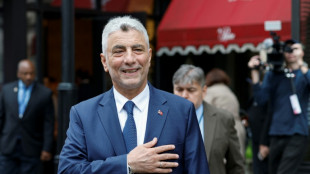 Don't exclude Turkey from 'Made in Europe' plan: minister to AFP

 French duo Justice to score 'GTA VI': game maker

 El Nino a 'terrifying' threat to coral reefs: UN biodiversity expert

 Barcola must get used to Liverpool highs and lows, says Iraola
 Versus Trade Wins Best ECN/STP Broker APAC 2026, Marking Third UF Awards Recognition

 Three dead as Istanbul sees heaviest rainfall in 80 years

 US producer prices see biggest jump since 2022 in added challenge to Trump

 Swiatek avoids seed exodus to breeze into Wuhan last eight

 PM condemns 'chaos' as violent protests grip Albania

 'I couldn't breathe', Russell Brand's alleged rape victim says

As travellers rush to book their summer getaways, Booking.com's internet safety boss says watch out for supercharged AI scams.
Marnie Wilking, Chief Information Security Officer at the Netherlands-based travel giant, said generative AI had sparked an explosion in online phishing scams, and that the hospitality industry, long spared, had also become a target.
"Over the course of the last year and a half, throughout all industries, there's been anywhere from a 500 to a 900% increase in attacks, in phishing in particular, across the globe,” Wilking told AFP on the sidelines of the Collision technology conference in Toronto.
Phishing scams are a type of cyber attack where criminals attempt to trick victims into revealing sensitive information such as login credentials or financial account details.
Travel websites can offer a rich bounty to phishing scammers since travelers are often asked to share credit card and family details or upload ID.
"Of course, we've had phishing since the dawn of email. But the uptick started shortly after ChatGPT got launched. The attackers are definitely using AI to launch attacks that mimic emails far better than anything that they've done to date," she said.
With generative AI tools, the scammers can now work in multiple languages and with good grammar, Wilking said.
They are also "really taking advantage of the helpful nature of hospitality."
To be helpful to a supposed guest, a hotel owner is "probably going to open up the attachment" that is actually malware, she said.
Wilking said that in order to stay safe travelers and hosts should sign up for two-factor authentication when surfing online.
In addition to providing a username and password, two-factor authentication requires users to verify their identity through an added factor, such as a one-time code sent to their mobile device or generated by an authenticator app.
"I know it can be a little bit painful just to set up and then you have to remember which phone it's on and everything," she said.
However, the extra step "is still hands down the best way to combat phishing and credential stealing," she said.
And "don't click on anything that looks suspicious, even if you think it might be real. If there's even a little bit of doubt, call the property, hosts, and customer support,” she said.
- Fake property? -
Wilking said Booking.com and other major companies are cooperating closely and increasingly relying on AI to help in the fight.
AI, for example, is helping thwart the proliferation of fake properties on platforms that are actually a bid to scam the user.
Scammers "set up a fake property that looks like it's in the Swiss Alps. Every other property around it is $1,000 a night and this one's on sale for $200.”
“We've set up AI models to detect those and either block them from getting on there to begin or take it down before there's any booking," she said.
Though it remains modest for now, travel sites have seen the rise of suspected state actors, reported to be Russia and China, that are trying to cause online mischief or snoop on customers.
"Why would a nation state go after a hotel chain? Well, if it's a hotel chain that they know is frequented by a US senator, why wouldn't they go after that?" she said.
N.Fournier--BTB