Russian gas stop clouds outlook for solar panel supplier / Photo: © AFP

 Latvian partial election results suggest pro-European choice

 In Egypt's Sinai, Gazan builds school for children displaced by war

 Trump tariffs a mixed bag for US auto industry

 Yemen government forces say struck Houthi targets

 Music links past, present for Pedro Pascal's cellist in 'Behemoth!'

 ALEX BODI ȘI AMBASADORUL REPUBLICII SUDANUL DE SUD, GUM DOMINIC MATIOK, DISCUTĂ LA BERLIN DESPRE POSIBILITATEA ÎNFIINȚĂRII UNUI CONSULAT ONORIFIC LA BUCUREȘTI

 Dodgers step up World Series three-peat bid with 5-3 win over Braves

 Spain break down Czechs as England outclass Croatia in Nations League

 Yamal on target as Spain hold off Czech Republic

 Latvian exit polls suggest pro-European choice
 Lula, Bolsonaro wrap up campaigns ahead of knife-edge election
 Tuchel hails 'complete' England after Croatia demolition

 Fury to invite Trump to lead ring walk before Joshua showdown

 Fashion industry in 'precarious moment', says Vivienne Westwood supremo

 Seventh heaven for England in Nations League rout of Croatia

 Storms, flooding cause chaos on Greek holiday island of Crete

 #IAmJaneDoe: online support campaign in US university rape case

 Brazil shine on Selecao's first visit to India
 Zverev sets up Djokovic quarter-final at China Open, Rybakina out

 Happier at home, Bordeaux hammer Lyon in Top 14

 Lula, Bolsonaro in final push for votes ahead of knife-edge election

 Boisterous fashion week barnstorms 'sleepy' Nigerian capital

 UAE investigators say flydubai co-pilot was planning 'terrorist act'

 Rahul smacks century in India v Windies ODI

 Daryz seeks to join exclusive club of dual Arc winners
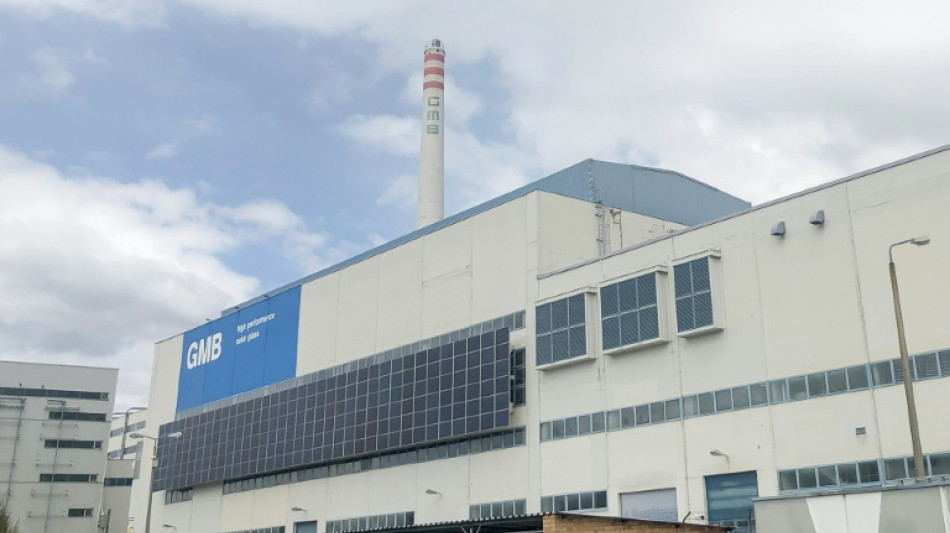
In a glassworks in Tschernitz, a stone's throw from the border with Poland, the roar of the furnaces cannot drown out worried whispers about Russian gas supplies to Germany being cut off.
In a vast factory with a white chimney, automated machines are making hundreds of small glass rectangles under the surveillance of factory employees.
The glossy tiles made here are used in solar panels. "We supply the biggest producers in Europe," said Torsten Schroeter, boss of GMB Glasmanufaktur Brandenburg.
The ovens in the factory glow red and kick out a huge amount of heat as they churn out up to 10 million square metres of the tiles every year.
But to make these essential components for a flagship green technology, the industry paradoxically has a significant demand for gas.
- Embargo -
Cheap gas was widely available until recently, allowing the plant to compete with rivals in China, the uncontested global leader in the sector.
Recent price rises for the fuel -- a result of the war in Ukraine -- and the threat of a stop in deliveries from Russia -- a major supplier for Germany and many other European countries -- has stoked fears in the industry.
"An end to Russian gas supplies would mean a complete stop to production for us," Schroeter told AFP.
The risk of a sudden stop is the cause for much handwringing, not just in Tschernitz, but among many German industries that depend on it to fuel their businesses.
Before the beginning of the war, 55 percent of the gas supplies to Europe's largest economy came via pipelines from Moscow.
"The last decades, marked by the deregulation of the energy market, has led us to choose the cheapest gas -- provided by the Russian pipelines," former vice-chancellor Sigmar Gabriel acknowledged in February.
But Russia's invasion of Ukraine has dramatically exposed Germany's energy Achilles' heel.
Berlin has since been scrambling to pivot away from Russian reliance. But Germany lacks the crucial infrastructure needed to import large amounts of gas from other suppliers, such as the United States or Qatar.
This uncomfortable situation is partly behind the government's refusal, so far, to back a European boycott of Russian gas.
The conflict in Ukraine has already caused energy prices to surge, rising by 39.5 percent in March, heaping pressure on industry.
In Tschernitz, almost 170 gigawatt/hours are used every year to heat the raw materials -- either quartz or dolomite -- to over 1,600 degrees Celsius (2,912 Fahrenheit) to make glass.
"A gas embargo would lead to production stops, job losses and, in some cases, significant damage to production sites," the powerful German industrial lobby BDI said in a recent statement.
Among the most vulnerable sectors were paper, steel and above all, chemicals, according to a study by the LBBW bank.
Chemicals giant BASF warned that it would have to stop production at its home factory of Ludwigshafen, where 30,000 people work, if Russian gas supplies were even halved.
"A full embargo on Russian energy would force Germany to ration gas supplies to its most gas-intensive companies", leading to a recession, said Andrew Kenningham, chief Europe economist at Capital Economics.
- 'Out of question' -
In the Tschernitz glassworks, a halt in gas deliveries would have severe consequences for the ovens.
Cooling would cause irreparable damage to the materials in the furnaces and would force the company to "rebuild everything", starting by ordering new pieces, a process which could take months if not years, according to Schroeter.
"There is no alternative" to Russian gas, he said.
Other fossil fuels, such as coal, are not well suited for the task. The company already uses a hybrid system to heat the ovens using electricity, but it only accounts for "10 percent" of its needs.
In time, hydrogen could replace natural gas, but the infrastructure and supplies in Germany are not currently sufficient.
Uncertainty is rife among the 300 or so employees in Tschernitz, who fear for the future of the plant and the glass industry, part of the local economy for centuries.
And the implications go far beyond that, warns Schroeter.
"Without us, the green transition in Germany is out of the question," he said.
G.Schulte--BTB