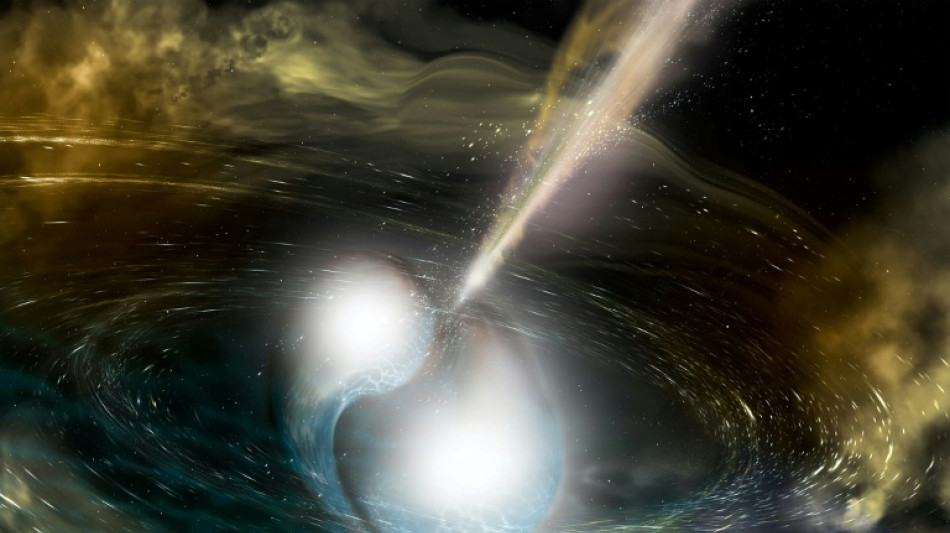
French-Chinese probe to hunt universe's biggest explosions / Photo: © National Science Foundation/AFP/File

 ChangeNOW Announces NOW AI After Resolving Website Integration Vulnerability

 Argentine demonstration over education cuts ends in clashes

 Argentine protesters, police clash at demo over university funding

 US stocks end higher as AI shares stabilize

 School roof collapse kills 32 children, teacher in Pakistan

 Lyon down Palace in Europa League, Sunderland leave it late

 UniCredit says receives ECB green light for Commerzbank takeover

 New York City pension fund asks Anthropic to delay IPO

 Venezuela's Maduro denies US torture charges as 'false accusations'

 Somalia sets May presidential election despite insecurity

 Chelsea's Caicedo eager to be more of a leader

 Rahm reaches separation deal with LIV in bankruptcy court

 UN chief urges nations to end 'war on nature'

 Newcastle boss Jaissle says Fernandez-Pardo just needs a goal

 Infantino offers apology but 'no answers' at FIFA meeting over World Cup plan

 Don't exclude Turkey from 'Made in Europe' plan: minister to AFP

 French duo Justice to score 'GTA VI': game maker

 El Nino a 'terrifying' threat to coral reefs: UN biodiversity expert

 Barcola must get used to Liverpool highs and lows, says Iraola

 Versus Trade Wins Best ECN/STP Broker APAC 2026, Marking Third UF Awards Recognition

 Three dead as Istanbul sees heaviest rainfall in 80 years

 US producer prices see biggest jump since 2022 in added challenge to Trump

 Swiatek avoids seed exodus to breeze into Wuhan last eight
 PM condemns 'chaos' as violent protests grip Albania

 'I couldn't breathe', Russell Brand's alleged rape victim says

A French-Chinese telescope satellite will blast off this weekend on a mission to hunt down gamma-ray bursts, the most powerful explosions in the universe.
The light from these almighty blasts has travelled billions of light years to reach Earth, so scientists believe they could hold answers to some mysteries of the universe's youth.
But these flashes are so brief they have proved difficult to observe.
Aiming to learn more, the Space Variable Objects Monitor (SVOM) is scheduled to blast off on a Chinese Long March 2C rocket from the Xichang launch site in China's Sichuan province on Saturday.
The spacecraft, which has two Chinese and two French instruments on board, will then orbit 625 kilometres (390 miles) above Earth.
Chen Lan, an analyst specialising in China's space programme, highlighted the "political significance" of the joint mission.
During a "dark time" for relations between China and the West, the mission "shows that scientific cooperation can still be continued despite difficulties," he told AFP.
- Discovered by accident -
SVOM's mission is to use its X-ray vision to track down the source of gamma-ray bursts, which are detected in the sky around once every day.
This cosmic investigation began back in "the middle of the Cold War," said Bertrand Cordier, the chief scientist for France's contribution to SVOM.
In 1967, US satellites monitoring whether nations were complying with a nuclear test ban treaty happened to spot a brief flash of gamma rays -- which can also be produced by nuclear blasts.
"They thought they were dealing with a nuclear explosion on Earth, before realising that it came from space," Cordier told a press conference.
"Since then, we have been trying to understand the origin of these objects."
Several missions, including NASA's Swift telescope, have already shed some light on these bright enigmas.
Considered to be the most powerful events in the known universe, these bursts are flashes of the highest-energy light, which emit gamma rays and last anywhere between a fraction of a second and tens of seconds.
The explosion is followed by an "afterglow" which can last hours and "crosses the entire universe to reach us," said Susanna Vergani of the Paris Observatory.
- Clues of the early universe -
Shorter bursts are thought to be caused by massive neutron stars smashing into each other, or a neutron star being swallowed by a black hole.
Longer bursts are believed to be from some of the universe's earliest stars -- massive beasts far larger than our Sun -- going supernova.
The most distant -- and therefore earliest -- gamma-ray burst identified so far came from just 630 million years after the Big Bang, when the universe was five percent of its current age.
Gamma-ray bursts allow scientists to "investigate the distant universe," including the mysterious chemical process that birthed the first stars and galaxies, Vergani said.
But the blasts could also hold other clues to long-burning cosmic mysteries.
Because the light from these explosions traverses billions of light years, it "bears the imprint of all the gas clouds" it passed through," Vergani said.
Scientists therefore hope gamma-ray bursts could reveal the chemical elements across the universe throughout its history.
Do gamma-ray bursts pose a threat to Earth? The Milky Way is too old to be home to the huge collisions that cause the bursts, so the chance of this happening is "extremely low," Cordier said.
Earth's atmosphere should be able to shield us against blasts from farther off, he added.
Gamma-ray bursts are so brief that scientists will be in a race against time to collect data before they vanish.
As soon as SVOM detects a gamma-ray burst, it will alert a team of scientists who will be on call 24 hours a day.
In less than five minutes, a network a ground-based telescopes will swivel their gaze towards the blast, hoping to find out more.
Y.Bouchard--BTB