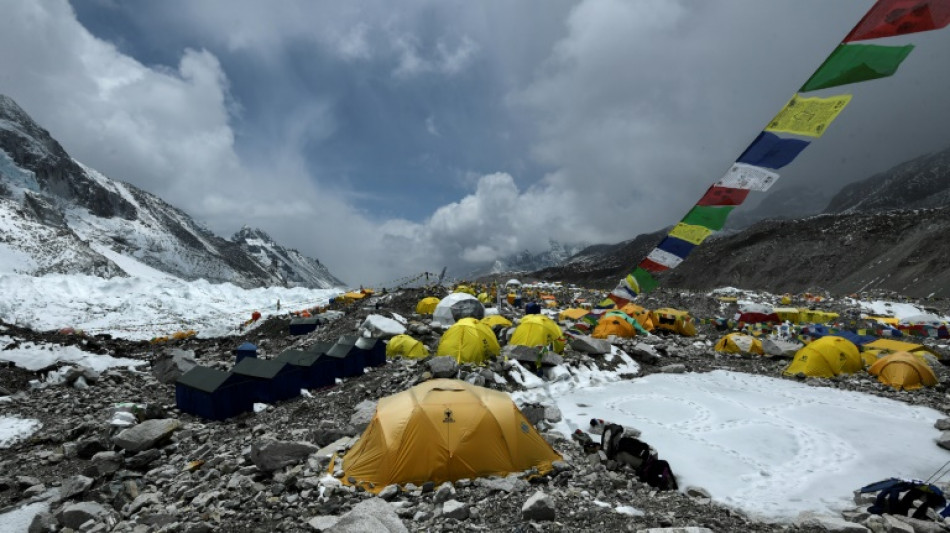
As ice melts, Everest's 'death zone' gives up its ghosts / Photo: © AFP/File

 Guardians edge Rays to seize MLB playoff series lead
 Trump scraps plan to livestream execution after fierce backlash

 Martinez apologises for outburst at Man Utd hierarchy

 Houthis launch deadly attack on presidential palace in Yemen's Aden

 Brazil forward Antony says home burgled during Betis match
 Ravens face familiar foe in Browns coach Monken
 France, Germany reach deal on future of car industry

 Carney campaigns for Canadian unity before Alberta secession vote

 ATP proposes rankings system changes, extra player bonuses

 Russell Brand was 'monster-like', alleged victim tells UK court

 Crowded Launches Crowded MCP, Bringing Nonprofit Financial Operations Into ChatGPT and Claude

 Albanian PM condemns 'chaos' as violent unrest spreads
 Italian football suffers new blow with Champions League misery

 Trump scraps plan to livestream execution after broad backlash
 Seven missing off Romania after latest Black Sea drone attacks

 ARKBRIDGE Outlines Jonathan Morelli’s “Picks and Shovels” AI Infrastructure Investment Strategy

 Tech sell-off rolls on as hot inflation data stokes rate worries
 McIlroy makes 'solid' start in rain-hit Delhi as Norgaard leads

 Seven missing after fire on vessel in Black Sea off Romania

 'Severe drought' declared in parts of UK
 IUX Announces New Web Client Portal Built for Enhanced Browser-Based Trading
 School roof collapse kills teacher, 32 children in NW Pakistan

 Inter skipper Martinez facing month out with thigh injury

 Spanish prosecutors back abuse probe into Julio Iglesias

 Tech sell-off deepens as US inflation sparks AI jitters

On Everest's sacred slopes, climate change is thinning snow and ice, increasingly exposing the bodies of hundreds of mountaineers who died chasing their dream to summit the world's highest mountain.
Among those scaling the soaring Himalayan mountain this year was a team not aiming for the 8,849-metre (29,032-foot) peak, but risking their own lives to bring some of the corpses down.
Five as yet unnamed frozen bodies were retrieved -- including one that was just skeletal remains -- as part of Nepal's mountain clean-up campaign on Everest and adjoining peaks Lhotse and Nuptse.
It is a grim, tough and dangerous task.
Rescuers took hours to chip away the ice with axes, with the team sometimes using boiling water to release its frozen grip.
"Because of the effects of global warming, (the bodies and trash) are becoming more visible as the snow cover thins," said Aditya Karki, a major in Nepal's army, who led the team of 12 military personnel and 18 climbers.
More than 300 people have perished on the mountain since expeditions started in the 1920s, eight this season alone.
Many bodies remain. Some are hidden by snow or swallowed down deep crevasses.
Others, still in their colourful climbing gear, have become landmarks en route to the summit.
Nicknames include "Green Boots" and "Sleeping Beauty".
- 'Death zone' -
"There is a psychological effect," Karki told AFP.
"People believe that they are entering a divine space when they climb mountains, but if they see dead bodies on the way up, it can have a negative effect."
Many are inside the "death zone", where thin air and low oxygen levels raise the risk of altitude sickness.
Climbers must have insurance, but any rescue or recovery mission is fraught with danger.
One body, encased in ice up to its torso, took the climbers 11 hours to free.
The team had to use hot water to loosen it, prising it out with their axes.
"It is extremely difficult," said Tshiring Jangbu Sherpa, who led the body retrieval expedition.
"Getting the body out is one part, bringing it down is another challenge".
Sherpa said some of the bodies still appeared almost as they had at the moment of death -- dressed in full gear, along with their crampons and harnesses.
One seemed untouched, only missing a glove.
The retrieval of corpses at high altitudes is a controversial topic for the climbing community.
It costs thousands of dollars, and up to eight rescuers are needed for each body.
A body can weigh over 100 kilogrammes (220 pounds), and at high altitudes, a person's ability to carry heavy loads is severely affected.
- 'Turn into a graveyard' -
But Karki said the rescue effort was necessary.
"We have to bring them back as much as possible," he said. "If we keep leaving them behind, our mountains will turn into a graveyard."
Bodies are often wrapped in a bag then put on a plastic sled to drag down.
Sherpa said that bringing one body down from close to Lhotse's 8,516 metre peak -- the world's fourth-highest mountain -- had been among the hardest challenges so far.
"The body was frozen with hands and legs spread," he said.
"We had to carry it down to Camp Three as it was, and only then could it be moved to be put in a sled to be dragged."
Rakesh Gurung, from Nepal's tourism department, said two bodies had been preliminarily identified and authorities were awaiting "detailed tests" for the final confirmation.
The retrieved bodies are now in the capital Kathmandu, with those not identified likely to be eventually cremated.
- Missing mountaineers -
Despite the recovery efforts, the mountain still holds its secrets.
The body of George Mallory, the British climber who went missing during a 1924 attempt on the summit, was only found in 1999.
His climbing partner, Andrew Irvine, has never been found -- nor has their camera, which could provide evidence of a successful summit that would rewrite mountaineering history.
The clean-up campaign, with a budget of over $600,000, also employed 171 Nepali guides and porters to bring back 11 tonnes of rubbish.
Fluorescent tents, discarded climbing equipment, empty gas canisters and even human excreta litter the well-trodden route to the summit.
"The mountains have given us mountaineers so many opportunities," Sherpa said.
"I feel that we have to give back to them, we have to remove the trash and bodies to clean the mountains."
Today, expeditions are under pressure to remove the waste that they create, but historic rubbish remains.
"This year's trash might be brought back by the mountaineers," said Karki. "But who will bring the old ones?"
L.Janezki--BTB