Making Olympic timekeepers' bells: a labour of love / Photo: © AFP

 Brazil forward Antony says home burgled during Betis match
 Ravens face familiar foe in Browns coach Monken
 France, Germany reach deal on future of car industry

 Carney campaigns for Canadian unity before Alberta secession vote
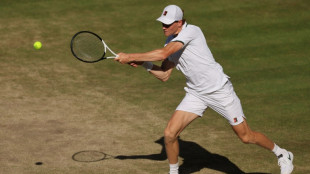 ATP proposes rankings system changes, extra player bonuses
 Russell Brand was 'monster-like', alleged victim tells UK court

 Crowded Launches Crowded MCP, Bringing Nonprofit Financial Operations Into ChatGPT and Claude
 Albanian PM condemns 'chaos' as violent unrest spreads
 Italian football suffers new blow with Champions League misery

 Trump scraps plan to livestream execution after broad backlash

 Seven missing off Romania after latest Black Sea drone attacks

 ARKBRIDGE Outlines Jonathan Morelli’s “Picks and Shovels” AI Infrastructure Investment Strategy
 Tech sell-off rolls on as hot inflation data stokes rate worries
 McIlroy makes 'solid' start in rain-hit Delhi as Norgaard leads

 Seven missing after fire on vessel in Black Sea off Romania
 'Severe drought' declared in parts of UK

 IUX Announces New Web Client Portal Built for Enhanced Browser-Based Trading
 School roof collapse kills teacher, 32 children in NW Pakistan
 Inter skipper Martinez facing month out with thigh injury
 Spanish prosecutors back abuse probe into Julio Iglesias
 Tech sell-off deepens as US inflation sparks AI jitters

 Southgate does not forsee a return to management
 Two dead as Istanbul endures heaviest rainfall in 80 years
 After latest Nepal flood, survivors fear for future

 EU leaders clash over budget as spectre of French elections looms
The air is stifling hot, with a heavy, metallic smell that sticks in the throat and stings the eyes.
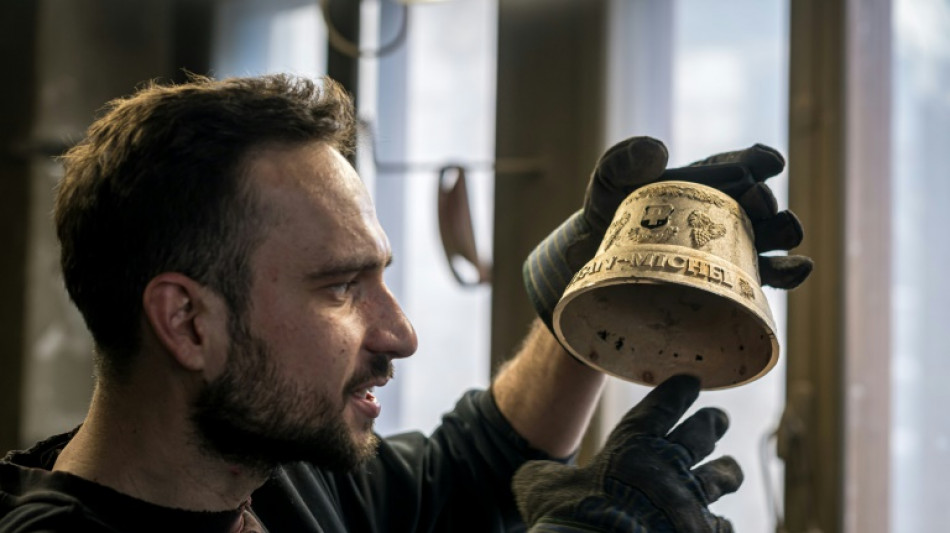
In his foundry with smoke-blackened walls, Alois Huguenin uses an enormous ladle to pour molten bronze at 1,250 degrees Celsius (2,282 degrees Fahrenheit) into a metal frame.
For three generations, the century-old traditional foundry in La Chaux-de-Fonds in northwestern Switzerland -- the cradle of the country's famous watchmaking industry -- has been crafting the bells used at the Olympic Games.
The bells are rung for a range of disciplines including athletics, track cycling, mountain biking and boxing.
Almost half a century after his grandfather made the first bell for the Moscow Olympics in 1980, Huguenin was preparing the bells for the upcoming Paris Games.
"If all goes well, one Olympic bell is three hours of work," the 30-year-old, equipped with an apron, gloves and a protective screen, told AFP recently.
Huguenin said he had already delivered 38 bells for Paris, at the request of the Games' official timekeeper Omega, which has its chronometric testing laboratory around 30 kilometres away in Biel.
"The bell is used to indicate to the athletes, as well as to the spectators, when the last lap has started," said Alain Zobrist, who heads OmegaTime and is in charge of chronometry within the wider Swatch Group.
It tells the athletes "they must give it their all to reach the finish line as quickly as possible", he told AFP.
Recalling that Omega has been timekeeping at the Olympics since 1932, he acknowledged that the bells constitute "a very traditional element".
"Today, chronometry is done electronically. The bells are a nod to our past," he said.
- 'Pride' -
Ten minutes after pouring the molten bronze -- with the texture and bright orange-yellow colour of volcanic lava -- Huguenin can unmould the thick liquid, with a temperature of just 200C.
With heavy blows of his hammer, he breaks the hard, black-sand mould in the frame, as smoke billows out.
The bell that emerges is covered with a crust, revealing the work that remains to be done: deburring, sanding, filing and polishing.
Huguenin made his first Olympic bell for the 2020 Tokyo Games.
While not as obsessed by bells as some collectors can be, Huguenin says he is proud his creations are seen by billions.
"I put the same energy, the same passion into all the bells I make," he said, explaining that he also makes bells for livestock, and increasingly for individual events like weddings.
"But to know that we are participating in our own small way in the big Olympic celebration is a source of pride."
Huguenin said Olympic bells had been part of his life as far back as he could remember.
"Each edition, we watch TV to try to see if we can spot them," he said, recalling how he kept an eye out for his father's bells when he was younger.
And "for a few years now, I have been looking out for the bell that I made".
- "One step ahead" -
The bells used for each Olympics remain the same, with only the edition logo changing.
They are always emblazoned with the colourful Olympic rings, stand about 20 centimetres (7.9 inches) high and measure 14 centimetres (5.5 inches) across.
But each bell is nonetheless unique, Huguenin insisted, due to the use of traditional techniques, and recycling.
The clayey Paris sand used for his mould is not synthetic and is reused several times, he said, noting that some grains have been in service for 100 years.
As for the copper-tin alloy used for the bronze, it is made of individually-sourced recycled materials.
On the shelves near his wooden workbench, Huguenin keeps a souvenir collection of bells with defects that were made for previous Games in Atlanta, Rio and Athens.
But a few weeks before the opening of the Paris Olympics, he already has one eye on the future.
Bells need to be made for the 2028 Los Angeles Games, of course, he said, but "first there are the Winter Olympics in Milan Cortina" in 2026.
"I'm going to get started on it this autumn," he said.
"I'm always one step ahead."
K.Brown--BTB