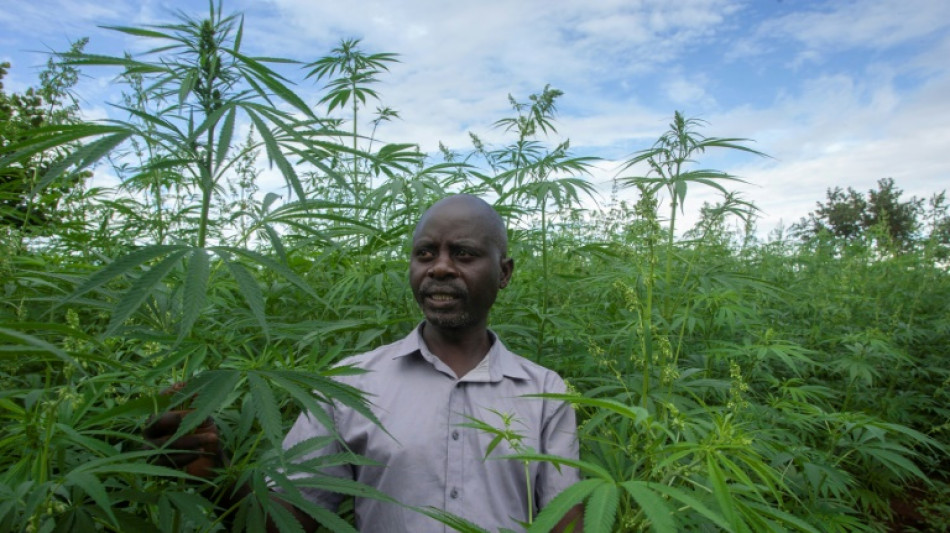
As tobacco burns out, Malawi looks to cannabis / Photo: © AFP

 'Act before it's too late': Tokyo residents fight for more trees

 'Disappointing' as South Korea flag mishap sees Games end on sour note

 Pre-COP host Tuvalu at frontline of climate change

 Hungary's dwindling paprika producers battle to save signature spice
 Cornell president vows review in wake of alleged student gang rape
 Latvian partial election results suggest pro-European choice
 In Egypt's Sinai, Gazan builds school for children displaced by war

 Trump tariffs a mixed bag for US auto industry

 Yemen government forces say struck Houthi targets

 Music links past, present for Pedro Pascal's cellist in 'Behemoth!'

 ALEX BODI ȘI AMBASADORUL REPUBLICII SUDANUL DE SUD, GUM DOMINIC MATIOK, DISCUTĂ LA BERLIN DESPRE POSIBILITATEA ÎNFIINȚĂRII UNUI CONSULAT ONORIFIC LA BUCUREȘTI

 Dodgers step up World Series three-peat bid with 5-3 win over Braves

 Spain break down Czechs as England outclass Croatia in Nations League

 Yamal on target as Spain hold off Czech Republic

 Latvian exit polls suggest pro-European choice
 Lula, Bolsonaro wrap up campaigns ahead of knife-edge election
 Tuchel hails 'complete' England after Croatia demolition

 Fury to invite Trump to lead ring walk before Joshua showdown

 Fashion industry in 'precarious moment', says Vivienne Westwood supremo
 Seventh heaven for England in Nations League rout of Croatia

 Storms, flooding cause chaos on Greek holiday island of Crete

 #IAmJaneDoe: online support campaign in US university rape case

 Brazil shine on Selecao's first visit to India

 Zverev sets up Djokovic quarter-final at China Open, Rybakina out
 Happier at home, Bordeaux hammer Lyon in Top 14

Under a scorching sun at a trading post in Malawi, Chikumbutso Chekeni and his wife head to their tobacco sheds to dry their newly harvested leaf.
Nambuma, 35 kilometres (20 miles) northwest of the capital Lilongwe, used to be a thriving farming town, buoyed by vast tobacco farming businesses.
Today, even during harvest season the town is sleepy, leading some farmers to think about switching from tobacco to the newly legalised marijuana.
Malawi is one of the world's poorest countries but a major tobacco producer, ranking first in the world for burley and seventh for overall production.
No other economy is more dependent on the leaf. Government statistics say over 70 percent of the nation's export income comes from tobacco.
"The main challenge we face as farmers is the issue of low pricing, which is really killing us," said Chekeni, who has been farming tobacco for 22 years.
Returns from tobacco, dubbed the 'Malawi's Green Gold', have dwindled over the past decade due to declining global demands driven by anti-smoking campaigns.
Despite the low prices, he sees no other option but to continue farming. This is the only business he knows.
This year has particularly been bad. Low volumes and low prices at the auction floors in Lilongwe forced the Tobacco Commission to cut trade to three days a week.
Even on those three days, sales last only an hour.
"The future of tobacco farming is bleak," said grower Yona Mkandawire. "By now we should have a lot of tobacco in the warehouses and more trucks at the receiving bay, but there is a lot of empty space here."
Despite a sharp decline of tobacco earnings over the years, Malawi's government still calls it a "strategic crop" and defends the country's continuing investment in its production.
Last year tobacco earned Malawi $173.5 million, down 27 percent from the year before, the Tobacco Commission said.
- 'Malawi Gold' -
Tobacco Commission chief executive officer Joseph Chidanti Malunga told AFP that this year's harvest will be 50 million kilogrammes short of what the buyers are looking for.
But he insisted Malawi needs tobacco because it's the only crop earning foreign currency.
"We cannot abandon this no matter how," he said. "All we do now is to make sure that we produce tobacco that is compliant with what the customers want."
During the first week of sales, prices were down more than 20 percent from last year, according to local media.
The price drop has seen some farmers try out new crops, including the recently legalised cannabis.
Malawi legalised cannabis farming for medicinal and industrial use in February 2020.
Falice Nkhoma, who is part of the Tilitonse Cooperative for Cannabis Growers, has dumped tobacco because of falling prices.
"I have been growing burley tobacco from 2014... but with very little benefit because the prices were always low," said Nkhoma. She has little to show for producing the so-called green gold.
"So this year, when I heard that some people would be growing cannabis, I was really excited. I have bought the seeds, and hopefully cannabis farming will bring me good returns," she said.
It's about time Malawi diversified its economy, said Betchani Tchereni, economics professor at the Malawi University of Business and Applied Sciences.
"We just have to restart the economy. If it's soya, then let's do soya. If it's cannabis, then let's concentrate on cannabis," he said.
But cultivation licences could be prohibitive for some aspiring farmers.
Growers, who operate in groups of around 30, have on average to cough out $10,000 per collective in farming licence fees alone.
Easing the process of obtaining cannabis licences would give farmers an immediate boost.
"It takes just about three months to mature, and then boom, we have the forex," said Tchereni.
"Licences can't be this expensive."
Cannabis growing is not new in Malawi, but has yet to develop to industrial scale.
According to a 2011 World Bank report, Malawi's hemp, known locally as 'chamba' or 'Malawi Gold' is among "the best and finest" sativas in the world.
G.Schulte--BTB