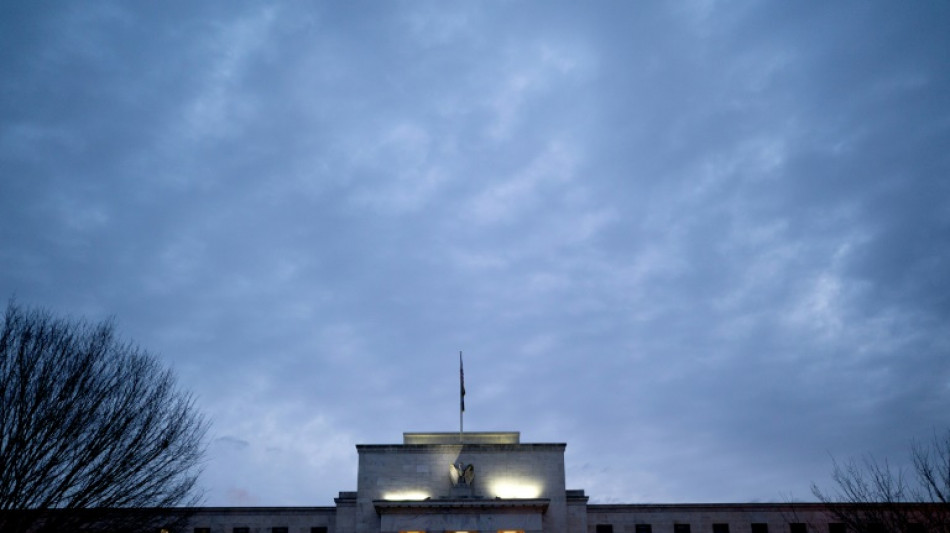
From recession to inflation, how the US Fed has dealt with crises / Photo: © AFP/File

 'Act before it's too late': Tokyo residents fight for more trees

 'Disappointing' as South Korea flag mishap sees Games end on sour note

 Pre-COP host Tuvalu at frontline of climate change

 Hungary's dwindling paprika producers battle to save signature spice

 Cornell president vows review in wake of alleged student gang rape

 Latvian partial election results suggest pro-European choice

 In Egypt's Sinai, Gazan builds school for children displaced by war

 Trump tariffs a mixed bag for US auto industry

 Yemen government forces say struck Houthi targets

 Music links past, present for Pedro Pascal's cellist in 'Behemoth!'

 ALEX BODI ȘI AMBASADORUL REPUBLICII SUDANUL DE SUD, GUM DOMINIC MATIOK, DISCUTĂ LA BERLIN DESPRE POSIBILITATEA ÎNFIINȚĂRII UNUI CONSULAT ONORIFIC LA BUCUREȘTI

 Dodgers step up World Series three-peat bid with 5-3 win over Braves

 Spain break down Czechs as England outclass Croatia in Nations League

 Yamal on target as Spain hold off Czech Republic

 Latvian exit polls suggest pro-European choice

 Lula, Bolsonaro wrap up campaigns ahead of knife-edge election

 Tuchel hails 'complete' England after Croatia demolition

 Fury to invite Trump to lead ring walk before Joshua showdown

 Fashion industry in 'precarious moment', says Vivienne Westwood supremo

 Seventh heaven for England in Nations League rout of Croatia

 Storms, flooding cause chaos on Greek holiday island of Crete

 #IAmJaneDoe: online support campaign in US university rape case

 Brazil shine on Selecao's first visit to India

 Zverev sets up Djokovic quarter-final at China Open, Rybakina out

 Happier at home, Bordeaux hammer Lyon in Top 14

The US Federal Reserve has strongly signaled it will raise interest rates by half a percentage point this week to rein in soaring inflation, and likely continue hiking throughout this year.
The Fed has long played a decisive role when the world's largest economy faces tough times. Here are some of its major actions since the 2008 global financial crisis:
- The financial crisis and recovery -
November 2008: The Fed began injecting liquidity into financial markets following the collapse of Lehman Brothers investment bank. The central bank launched three such programs before ending asset purchases in June 2014.
December 2008: The central bank cut its lending rate to zero amid the crisis, where it remained until December 2015.
October 2017: The Fed began reducing the holdings on its balance sheet, which had ballooned from less than $900 billion before the crisis to $4.5 trillion.
- Trade war slows growth -
December 2018 to August 2019: Interest rates peaked in the range of 2.25 percent to 2.5 percent.
Fall 2019: The Fed cut rates several times to the 1.5-1.75 percent range as the trade war launched by then-president Donald Trump slowed growth. The Republican leader had criticized the bank for its high rates.
- Support during the pandemic -
March 3, 2020: The Fed cut its lending rate by 50 basis points to between one and 1.25 percent.
March 16, 2020: As Covid-19 spread across the country and the economy shut down, the Fed slashed its lending rate by 100 basis points to zero and resumed its asset purchase policy, which eventually reached $120 billion per month in Treasury bonds and mortgage-backed securities.
- Economy recovers, inflation arrives -
November 3, 2021: The Fed announced it will begin slowing the pace of its asset purchases, with a view towards ending them entirely by the following June, which would set the stage for rate hikes to fight inflation.
December 15, 2021: Recognizing that inflation will not be "transitory," as top officials had believed, the central bank accelerated the end of its asset purchases to March.
March 16, 2022: The central bank raised interest rates for the first time since 2018 to the 0.25-0.50 percent range.
April 6, 2022: The minutes from the Fed's March policy meeting are released, showing that many participants see one or more 50-basis point rate hikes as necessary if inflation pressure continues.
April 29, 2022: The Fed's preferred inflation gauge, the personal consumption expenditures price index, rises 6.6 percent year-on-year and 0.9 percent month-on-month in March, both faster paces than the month prior.
S.Keller--BTB