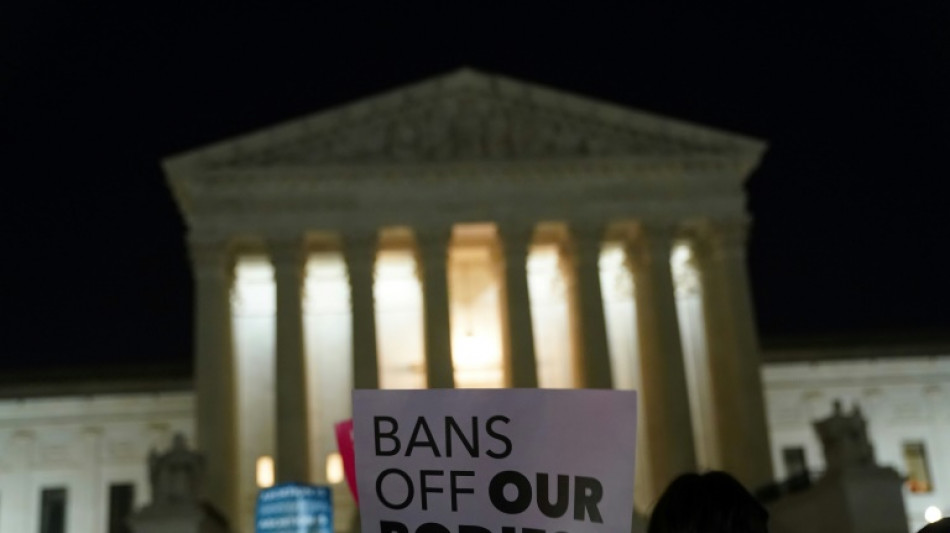
Roe v. Wade: 1973 case that enshrined US abortion rights / Photo: © AFP

 'Act before it's too late': Tokyo residents fight for more trees

 'Disappointing' as South Korea flag mishap sees Games end on sour note

 Pre-COP host Tuvalu at frontline of climate change

 Hungary's dwindling paprika producers battle to save signature spice

 Cornell president vows review in wake of alleged student gang rape

 Latvian partial election results suggest pro-European choice

 In Egypt's Sinai, Gazan builds school for children displaced by war

 Trump tariffs a mixed bag for US auto industry

 Yemen government forces say struck Houthi targets

 Music links past, present for Pedro Pascal's cellist in 'Behemoth!'

 ALEX BODI ȘI AMBASADORUL REPUBLICII SUDANUL DE SUD, GUM DOMINIC MATIOK, DISCUTĂ LA BERLIN DESPRE POSIBILITATEA ÎNFIINȚĂRII UNUI CONSULAT ONORIFIC LA BUCUREȘTI

 Dodgers step up World Series three-peat bid with 5-3 win over Braves

 Spain break down Czechs as England outclass Croatia in Nations League

 Yamal on target as Spain hold off Czech Republic

 Latvian exit polls suggest pro-European choice

 Lula, Bolsonaro wrap up campaigns ahead of knife-edge election

 Tuchel hails 'complete' England after Croatia demolition

 Fury to invite Trump to lead ring walk before Joshua showdown

 Fashion industry in 'precarious moment', says Vivienne Westwood supremo

 Seventh heaven for England in Nations League rout of Croatia

 Storms, flooding cause chaos on Greek holiday island of Crete

 #IAmJaneDoe: online support campaign in US university rape case

 Brazil shine on Selecao's first visit to India

 Zverev sets up Djokovic quarter-final at China Open, Rybakina out

 Happier at home, Bordeaux hammer Lyon in Top 14

A US Supreme Court draft opinion leaked to the press on Monday suggests a majority of justices are ready to overturn the landmark Roe v. Wade, shredding nearly 50 years of constitutional protections on abortion rights.
Here is how the original 1973 court case played out.
- Right to privacy -
On January 22, 1973, the court decided that the constitutional right to privacy applied to abortion.
Roe was "Jane Roe," a pseudonym for Norma McCorvey, a single mother pregnant for the third time, who wanted an abortion.
She sued the Dallas attorney general, Henry Wade, over a Texas law that made it a crime to terminate a pregnancy except in cases of rape or incest, or when the mother's life was in danger.
Filing a complaint alongside her was Texas doctor James Hallford, who argued the law's medical provision was vague, and that he was unable to reliably determine which of his patients fell into the allowed category.
The "Does," another couple, childless, also filed a companion complaint, saying that medical risks made it unsafe but not life-threatening for the wife to carry a pregnancy to term, and arguing they should be able to obtain a safe, legal abortion should she become pregnant.
The trifecta of complaints -- from a woman who wanted an abortion, a doctor who wanted to perform them and a non-pregnant woman who wanted the right if the need arose -- ultimately reached the nation's top court.
The court heard arguments twice, and then waited until after Republican president Richard Nixon's re-election, in November 1972.
- 'Sensitive and emotional' controversy -
Only the following January did it offer its historic seven-to-two decision -- overturning the Texas laws and setting a legal precedent that has had ramifications in all 50 states.
Justice Harry Blackmun, writing for the majority, said the court recognized the "sensitive and emotional nature of the abortion controversy, of the vigorous opposing views, even among physicians, and of the deep and seemingly absolute convictions that the subject inspires."
But he argued that the "right of privacy... is broad enough to encompass a woman's decision whether or not to terminate her pregnancy."
"A state criminal abortion statute of the current Texas type, that excepts from criminality only a lifesaving procedure on behalf of the mother, without regard to pregnancy stage and without recognition of the other interests involved, is violative of the Due Process Clause of the Fourteenth Amendment," the ruling read.
But the top court agreed with lower court rulings that the right to privacy with regard to pregnancy "is not absolute, and is subject to some limitations."
"At some point, the state interests as to protection of health, medical standards and prenatal life become dominant," Blackmun wrote.
The top court thus ruled partially against the doctor and the Does, but in favor of Jane Roe, who has since become a pro-life activist.
On the same day, the justices ruled in the separate "Doe v. Bolton" case, which authorized each state to add restrictions to abortion rights for later-term pregnancies.
The constitutional right to abortion was later confirmed in a number of decisions, including "Webster v. Reproductive Health Services" in 1989, "Planned Parenthood v. Casey" in 1992 and Stenberg v. Carhart" in 2000.
L.Janezki--BTB