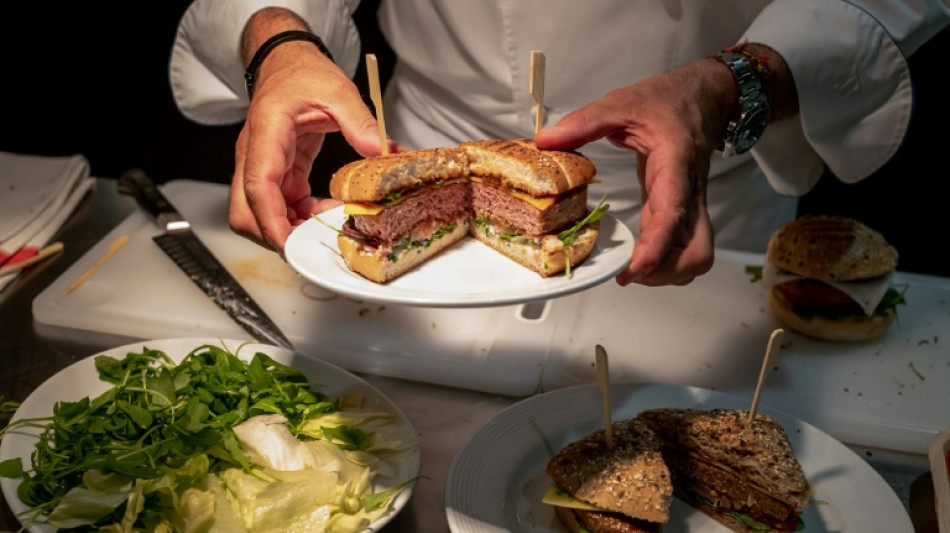
Microbe-based faux beef could save forests, slash CO2 / Photo: © AFP/File

 'Act before it's too late': Tokyo residents fight for more trees

 'Disappointing' as South Korea flag mishap sees Games end on sour note

 Pre-COP host Tuvalu at frontline of climate change

 Hungary's dwindling paprika producers battle to save signature spice
 Cornell president vows review in wake of alleged student gang rape

 Latvian partial election results suggest pro-European choice

 In Egypt's Sinai, Gazan builds school for children displaced by war

 Trump tariffs a mixed bag for US auto industry

 Yemen government forces say struck Houthi targets

 Music links past, present for Pedro Pascal's cellist in 'Behemoth!'

 ALEX BODI ȘI AMBASADORUL REPUBLICII SUDANUL DE SUD, GUM DOMINIC MATIOK, DISCUTĂ LA BERLIN DESPRE POSIBILITATEA ÎNFIINȚĂRII UNUI CONSULAT ONORIFIC LA BUCUREȘTI

 Dodgers step up World Series three-peat bid with 5-3 win over Braves

 Spain break down Czechs as England outclass Croatia in Nations League

 Yamal on target as Spain hold off Czech Republic

 Latvian exit polls suggest pro-European choice

 Lula, Bolsonaro wrap up campaigns ahead of knife-edge election

 Tuchel hails 'complete' England after Croatia demolition

 Fury to invite Trump to lead ring walk before Joshua showdown

 Fashion industry in 'precarious moment', says Vivienne Westwood supremo
 Seventh heaven for England in Nations League rout of Croatia

 Storms, flooding cause chaos on Greek holiday island of Crete

 #IAmJaneDoe: online support campaign in US university rape case

 Brazil shine on Selecao's first visit to India

 Zverev sets up Djokovic quarter-final at China Open, Rybakina out
 Happier at home, Bordeaux hammer Lyon in Top 14

Gradually replacing 20 percent of global beef and lamb consumption with meat-textured proteins grown in stainless steel vats could cut agriculture-related CO2 emissions and deforestation in half by 2050, researchers reported Wednesday.
Compared to a current-trends projection for population growth and food demand, swapping half of red meat consumption for so-called microbial proteins would see reductions in tree loss and CO2 pollution of more than 80 percent, they reported in the journal Nature.
"With a relatively small change in the consumption of ruminant meat, greenhouse gas emissions from tropical deforestation can be strongly reduced," lead author Florian Humpenoder, a scientist at the Potsdam Institute for Climate Impact Research (PIK), told AFP.
"This is an important contribution to reaching the Paris Agreement climate targets, with additional co-benefits for other sustainability goals."
A trio of landmark UN climate science reports since August have made it alarmingly clear that the Paris treaty's cornerstone target -- capping global warming "well below" two degrees -- is in serious jeopardy.
The global food system accounts for roughly a third of all carbon pollution, and beef production is the main culprit within the agricultural sector, according the UN's climate science advisory panel.
The cattle industry is a double threat.
It not only destroys CO2-absorbing tropical forests to make room for grazing pastures and cattle feed crops. In addition, belching livestock are a major source of methane, 30 times more potent as a greenhouse gas than CO2 on a 100-year timescale.
Microbe-based meat alternatives have been on supermarket shelves for decades.
But as the world scrambles for climate solutions, these and other "novel foods" are poised to grow into a major industry within decades, according market forecasts.
- Co-benefits -
Faux meat derived by culturing microbial or fungi-based cells undergoes a fermentation process, analogous to that for wine or beer.
The cells feed off of glucose -- from sugar cane or beets, for example -- to produce proteins, which means some cropland is needed for production.
But far less than for red meat, according to the study.
Assuming current agricultural methods and meat consumption patterns continue over the next 30 years, global pasture area is set to increase by nearly one million square kilometres (390,000 square miles).
If, however, 20 percent of that meat is replaced with microbe-based protein, pasture area is decreased even below current levels.
"About 1.2 million sq km less agricultural land is required for the same protein supply," said senior author Alexander Popp, also from PIK.
The benefits of protein made from microbes or fungi extend beyond climate and environmental impact, according to Hanna Tuomisto, a researcher at the University of Helsinki who did not take part in the study.
"Mycoprotein is an ideal substitute for meat because it is rich in protein and contains all the essential amino acids," she said in a comment, also in Nature.
Agricultural water use, along with the emissions of yet another greenhouse gas, nitrous oxide, would also be reduced.
"The efficiency of biotech-enabled alternatives offer huge future potential for more sustainable food provision," said Tilly Collins, deputy director of Imperial College London's Centre for Environmental Policy.
"Governments and the food production business need to coordinate to develop appropriate standards and thus future public confidence," she told the London-based Science Media Centre. "Our nuggets may never be the same again."
What remains uncertain, however, is whether enough meat lovers will give up their burgers and steaks for an alternative that shares the texture of meat more than the taste.
Only one of the six co-authors of the study had actually tasted the microbe-based meat substitute, according to Humpenoder.
"He likes it," he said.
T.Bondarenko--BTB