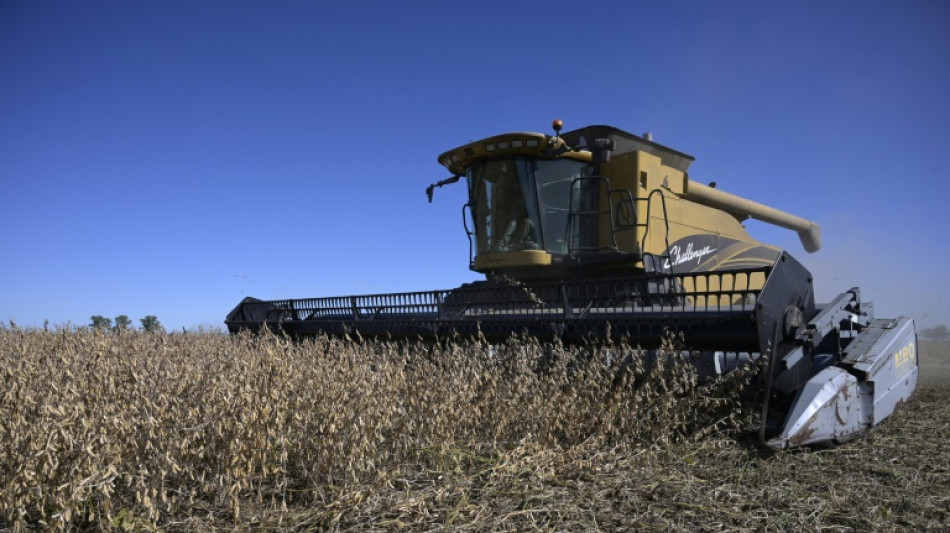
Soy boon for Argentina as Ukraine war boosts prices / Photo: © AFP/File

 Asian Games set to close after records, rancour and rain

 Cry for help as French-Swiss lake dries up

 Sabalenka swept out of China Open in third round

 US urges 'restraint' as Ethiopia's Tigray crisis rocks region

 Teens on target again as USA down Mexico 3-0

 World records prove Asian Games were a hit, says top official

 US prison chief who oversaw botched execution resigns

 'Chaotic' Asian Games threaten Japan hopes of hosting Olympics again
 Finnish town braces for change from Google data centres

 What is fuelling French school protests?

 Without lawyers, migrant children face deportation from the US

 Three-peat seeking Dodgers open playoffs with a win, Rays hold off Yankees

 Brazil votes in nail-biter polls closely watched by Trump
 'Just be you': Kim reveals Tiger text that inspired him to gold

 Myanmar migrants returned to war-torn nation from Malaysia

 ALEX BODI AND AMBASSADOR GUM DOMINIC MATIOK OF THE REPUBLIC OF SOUTH SUDAN MEET IN BERLIN TO DISCUSS THE POSSIBILITY OF AN HONORARY CONSULATE IN BUCHAREST

 Lula, Bolsonaro wrap up campaigns ahead of Brazil's knife-edge vote

 Toulouse edge Castres in Top 14 derby

 Murakami homer propels White Sox to MLB playoff win over Guardians

 Israel targets top Hamas leader in deadly Gaza strike on anniversary

 Houthis say struck oil facility near Riyadh, as Saudis hit Sanaa

 AI needs safety layers like nuclear plants: ex-OpenAI engineer

 MVP Judge will miss Yankees' MLB playoff series against Rays

 New lizard species discovered in Peru

 Fernandes hails Portugal's 'greatest symbol' Ronaldo, calls for unity

Russia's war on Ukraine has sent grain prices skyrocketing -- a worry for consumers worldwide but potentially a boon for producers like Argentina, which hopes an influx of soybean "agridollars" will boost its faltering economy.
South America's third-largest economy is the biggest exporter of soybean meal and oil in the world, and only the United States and Brazil export more soybean grains.
Soy represents nearly a third of Argentina's exports and in 2021 contributed $9 billion to the state coffers.
This year, the sector is expecting record sales of $23.7 billion -- about $700 million more than in 2021 -- despite a 10 percent smaller harvest due to severe drought.
"The prospects for the producer are good... There is optimism," said Martin Semino, who sells farming equipment and presides over the Rural Society of Lobos, a fertile agricultural zone southwest of Buenos Aires.
The harvest season is at its height, and workers are laboring from dawn to dusk to clear the fields before the autumn rains arrive.
"Soy is the dollar, the currency of the countryside," Semino told AFP.
In the past, the grain has been a savior for inflation-troubled Argentina.
A soybean boom in the 2000s is widely considered to have helped the country recover from its worst economic crisis in 2001.
In the last 40 years, the planted surface area of soy has multiplied 14 times.
- 'Seize the moment' -
Argentina is also a major producer of sunflower oil and wheat -- other grains affected by the ongoing war.
After a record sunflower harvest of 3.4 million tonnes in 2021-2022, the area under cultivation is set to increase by 17 percent this season to two million hectares (4.9 million acres).
The country also had a record wheat harvest this season.
Estimates are that in 2022, Argentina's agroindustrial exports will bring in a record $41 billion -- about $3 billion more than in 2021.
"With prices close to historic records, Argentina, which always needs dollars, must seize the moment," Tomas Rodriguez Zurro, an analyst at the Rosario Stock Exchange, told AFP.
The rise in prices "is temporary, it will end when the war is over," he cautioned.
But some point out that Argentina could have reaped an even larger benefit if it weren't for rising input costs.
Argentina imports about 60 percent of the fertilizers needed to grow food -- around 15 percent of it from Russia -- but supplies are now short and prices climbing, meaning lower yields.
Higher fuel prices are also taking a toll, set against the backdrop of soaring consumer inflation of around 60 percent projected this year for Argentina.
The chambers of the Oilseed Industry (Ciara) and Grain Exporters (CEC) have warned that rising input costs -- as well as shortages of fuel and fertilizer -- have "neutralized, or worse, the relative benefits" derived from the commodity price rise.
Added Semino: "Input costs have exploded with the war."
- Angry farmers -
In April, farmers staged a protest in Buenos Aires to express their ire at government plans to impose a windfall tax on products boosted by the war in Ukraine.
The tax, imposed only on those earning more than a billion pesos ($8.5 million) in net profit for the 2021-22 season, would be used to cushion inflationary shocks for the poor.
Argentina has a 37 percent poverty rate.
The government has also introduced quotas on wheat and maize, the latter of which Argentina is the world's second-largest exporter of.
It has announced a so-called "wheat stabilization fund" seeking to ensure that the price of the staple grain -- and hence bread -- remains shielded from steep fluctuations.
A.Gasser--BTB