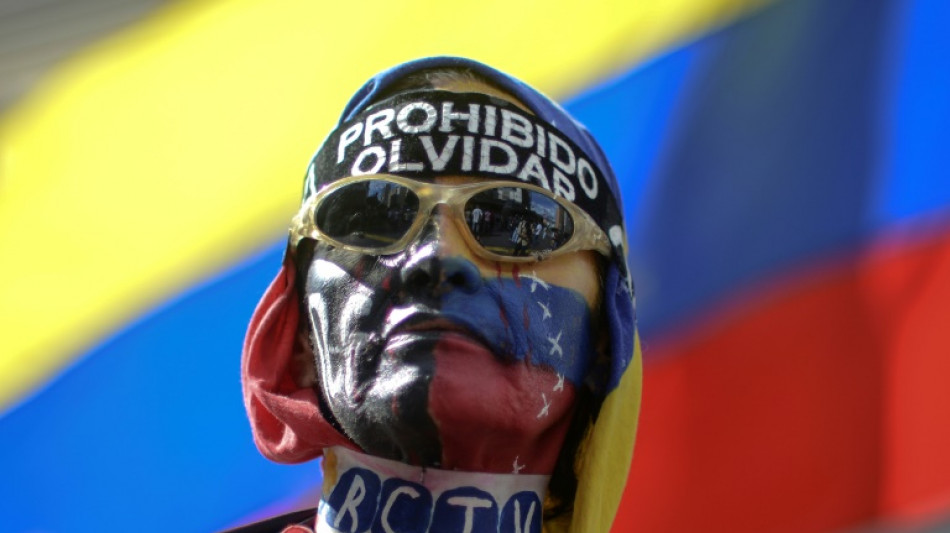
Government pressure forces Venezuelan media to self-censor / Photo: © AFP/File

 Asian Games set to close after records, rancour and rain
 Cry for help as French-Swiss lake dries up
 Sabalenka swept out of China Open in third round

 US urges 'restraint' as Ethiopia's Tigray crisis rocks region

 Teens on target again as USA down Mexico 3-0
 World records prove Asian Games were a hit, says top official
 US prison chief who oversaw botched execution resigns
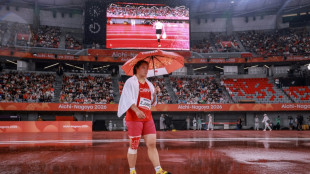 'Chaotic' Asian Games threaten Japan hopes of hosting Olympics again
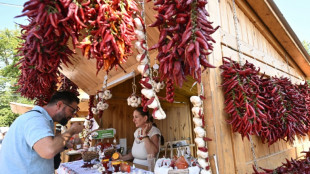
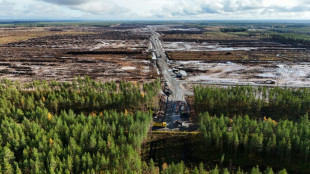 Finnish town braces for change from Google data centres
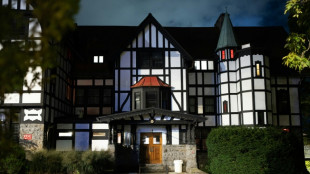
 What is fuelling French school protests?
 Without lawyers, migrant children face deportation from the US
 Three-peat seeking Dodgers open playoffs with a win, Rays hold off Yankees

 Brazil votes in nail-biter polls closely watched by Trump
 'Just be you': Kim reveals Tiger text that inspired him to gold
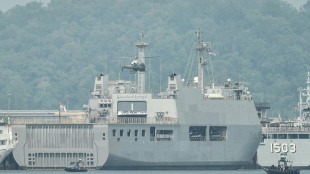 Myanmar migrants returned to war-torn nation from Malaysia
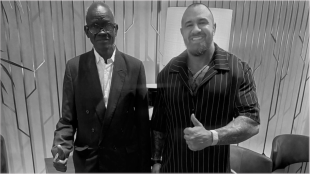
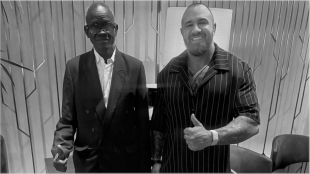 ALEX BODI AND AMBASSADOR GUM DOMINIC MATIOK OF THE REPUBLIC OF SOUTH SUDAN MEET IN BERLIN TO DISCUSS THE POSSIBILITY OF AN HONORARY CONSULATE IN BUCHAREST
 Lula, Bolsonaro wrap up campaigns ahead of Brazil's knife-edge vote
 Toulouse edge Castres in Top 14 derby

 Murakami homer propels White Sox to MLB playoff win over Guardians
 Israel targets top Hamas leader in deadly Gaza strike on anniversary
 Houthis say struck oil facility near Riyadh, as Saudis hit Sanaa

 AI needs safety layers like nuclear plants: ex-OpenAI engineer
 MVP Judge will miss Yankees' MLB playoff series against Rays
 New lizard species discovered in Peru

 Fernandes hails Portugal's 'greatest symbol' Ronaldo, calls for unity
Football fans have become familiar with final calls being made by "VAR" -- video assistant referees -- but at one of Venezuela's biggest radio groups, it also controls what news gets aired.
Instead of referees locked away in video-replay bunkers, Union Radio's "VAR" is a simple WhatsApp group in which top brass discuss potential subjects, stories and interviews for each station under the company's media umbrella, sources tell AFP.
Union Radio boasts dozens of stations on AM and FM and was traditionally known for its strong criticism of the populist socialist government of Nicolas Maduro and before him Hugo Chavez.
But under pressure from authorities increasingly intolerant of criticism, Union Radio has been forced to police its own content.
This form of self-censorship has been branded "VAR" by its proponents, a joke referencing the video assistant referees who often overturn major football decisions.
"A structured censorship mechanism has been put in place," said Leon Hernandez, a university professor and coordinator at the Inter American Press Society (SIP), which ranks Venezuela as the South American country with the least press freedoms.
According to Hernandez, under Venezuela's restricted media ecosystem, which Reporters Without Borders has called a "communication hegemony," major media outlets like Union Radio are forced to take protective measures like creating an internal "VAR".
- Veto of 'dangerous' opinions -
"Nothing can go on air without VAR approving it," a producer at Union Radio told AFP under condition of anonymity.
It has forced radio journalists to look for creative ways to deal with sensitive subjects.
While it is possible to analyze the consequences of Venezuela's economic crisis, such as the collapse of public services, political themes are far more touchy -- particularly when it comes to Maduro's legitimacy.
The president's controversial 2018 re-election was rejected by Venezuela's opposition, led by former parliamentary speaker Juan Guaido, and almost 60 countries, including the United States, as well as the European Union.
"The term usurper or any other similar expression used to describe the current government or President Maduro incites rejection of the legitimately constituted authorities," says a note pinned to a wall in radio studios that must be read to guests invited to take part in a program.
When it comes to subjects concerning Guaido, none of them are ever authorized by the "VAR".
Some staff even claim that certain political and economic analysts, actors and singers had been vetoed by the radio group to avoid potentially "dangerous" comments.
"In effect there is a process of evaluating guidelines, themes and guests," a Union Radio executive told AFP under condition of anonymity, highlighting the challenges posed by a 2004 media law.
"It forces you to be the one that self-regulates to avoid any potential punishment under a law with a broad spectrum of sanctions" ranging from fines to the revocation of transmission licenses.
The regulatory body regularly sends out "reminders" to media as a type of warning not to repeat certain content, another anonymous industry insider said.
More than 80 percent of television and radio stations are in the process of renewing their licenses, which has made them more cautious of upsetting authorities, said the source.
- 'We're paying the price' -
Their fears are not misplaced: many outlets critical of the ruling socialist party have been forced out in the 22 years of government under Chavez (1999-2013) and Maduro.
In 2007, the television station RCTV was closed after its license was not renewed.
Six years later, business people close to the ruling United Socialist Party bought Globovision, a formerly staunchly opposition-aligned television station, as well as the editorial group that owned Venezuela's most popular newspaper, Ultimas Noticias.
A year after that, the traditionally conservative, century-old El Universal newspaper was likewise bought.
In all these cases, the editorial slant changed dramatically.
"There were episodes of self-censorship and, obviously, this caused discontent," said a television journalist, again under condition of anonymity.
Following a defamation case, the ruling party-controlled judiciary seized the premises of the El Nacional daily newspaper and handed them to Diosdado Cabello, a senior figure in the United Socialist Party.
The government has since opened a university in the former newspaper offices.
Prior to that, El Nacional, which now exists only online, had already been forced to reduce its circulation due to a lack of paper, the import of which is controlled by the state.
"We paid the price for not shutting up ... We will not give in," El Nacional director Miguel Henrique Otero told AFP.
"They tried to buy us," he added. "They offered us an astronomical amount and we rejected it."
Many opposition voices are confined to the internet where access is unreliable due to frequent power cuts and government firewalls that require a foreign VPN to be accessed.
The government, for its part, boasts its own massive media apparatus, but still claims to be fighting a "brutal media war" aimed at toppling Maduro.
T.Bondarenko--BTB