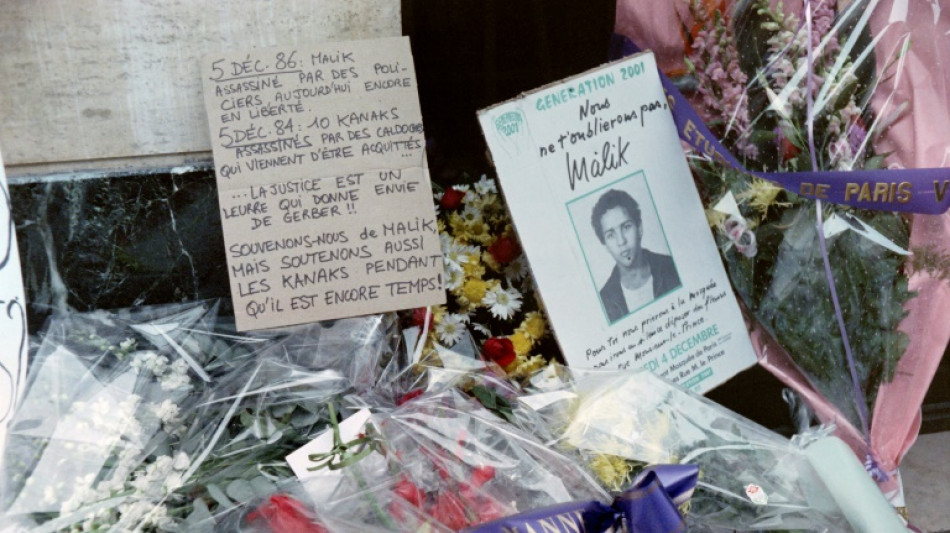
Decades on, 'France's George Floyd' gets screen treatment / Photo: © AFP

 Asian Games set to close after records, rancour and rain
 Cry for help as French-Swiss lake dries up
 Sabalenka swept out of China Open in third round

 US urges 'restraint' as Ethiopia's Tigray crisis rocks region

 Teens on target again as USA down Mexico 3-0
 World records prove Asian Games were a hit, says top official
 US prison chief who oversaw botched execution resigns
 'Chaotic' Asian Games threaten Japan hopes of hosting Olympics again

 Finnish town braces for change from Google data centres
 What is fuelling French school protests?
 Without lawyers, migrant children face deportation from the US
 Three-peat seeking Dodgers open playoffs with a win, Rays hold off Yankees

 Brazil votes in nail-biter polls closely watched by Trump
 'Just be you': Kim reveals Tiger text that inspired him to gold
 Myanmar migrants returned to war-torn nation from Malaysia
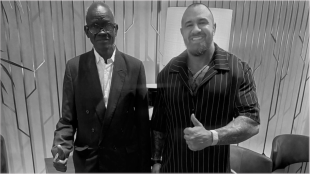
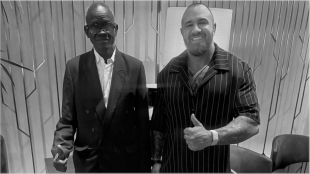 ALEX BODI AND AMBASSADOR GUM DOMINIC MATIOK OF THE REPUBLIC OF SOUTH SUDAN MEET IN BERLIN TO DISCUSS THE POSSIBILITY OF AN HONORARY CONSULATE IN BUCHAREST
 Lula, Bolsonaro wrap up campaigns ahead of Brazil's knife-edge vote
 Toulouse edge Castres in Top 14 derby
 Murakami homer propels White Sox to MLB playoff win over Guardians
 Israel targets top Hamas leader in deadly Gaza strike on anniversary
 Houthis say struck oil facility near Riyadh, as Saudis hit Sanaa
 AI needs safety layers like nuclear plants: ex-OpenAI engineer
 MVP Judge will miss Yankees' MLB playoff series against Rays
 New lizard species discovered in Peru

 Fernandes hails Portugal's 'greatest symbol' Ronaldo, calls for unity
The name resonates deeply among French minorities as a symbol of police violence, but it has taken 35 years for the death of Malik Oussekine to be recounted on-screen.
On the night of December 6, 1986, two police officers beat to death the 22-year-old French-Algerian on the sidelines of a student protest in Paris.
He had not been involved in the demonstration, and his killing became a turning point -- triggering weeks of unrest and leading to the unprecedented conviction of the officers.
While Oussekine's name has continued to reverberate among minorities, his story has never been adapted for the screen until now.
As if making up for lost time, two versions are being released this month: a film, "Our Brothers", premieres at the Cannes Film Festival, and a Disney+ mini-series, "Oussekine", is released worldwide on Wednesday.
"He was attacked because of the colour of his skin. He is France's Arab George Floyd," historian Pascal Blanchard told AFP, referring to the African-American whose death at the hands of police in 2020 sparked massive international protests.
He said much of French society had allowed Oussekine's story to be brushed under the carpet as with so much of its troubled history with immigrant populations.
"It's not a question of whether Malik Oussekine has been forgotten, but by who?" said Blanchard.
- 'Historical cancers' -
France is still wrestling with the trauma of its colonial period, particularly the bloody war of independence in Algeria from 1954 to 1962.
Among its darkest moments was the massacre of up to 200 Algerian protesters by police in Paris on October 17, 1961 -- many of them shot dead and their bodies thrown into the Seine.
The events of that day went officially unacknowledged for decades until President Emmanuel Macron finally described them as "inexcusable crimes" at the 60th anniversary last year -- though without apologising.
Oussekine's death was crucial in marking the end of total police impunity -- the first time that officers were convicted for this type of crime, according to the family's lawyer, Georges Kiejman.
It has taken until now, as the grandchildren of the original wave of North African immigrants comes of age, for there to be enough distance and confidence to address the past.
"For our generation, it is important to say that these individual stories form part of the French national story. They are not separate. These are French stories," said Faiza Guene, 36 and born to Algerian parents, who helped write the screenplay for "Oussekine".
Its director, Antoine Chevrollier, was part of the team behind hit spy series "The Bureau", and the lauded political saga "Baron Noir".
"The important thing is to make this name and this story resonate so that we never forget," he told AFP.
Chevrollier, who grew up in a small village in the Loire Valley, says he only became fully aware of the power of Oussekine's name when he moved to Paris and began to hang out with people from different backgrounds.
"I hope the series will help ease the tensions that are unsettling the country. It is time that we in France begin to treat these historical cancers."
J.Horn--BTB