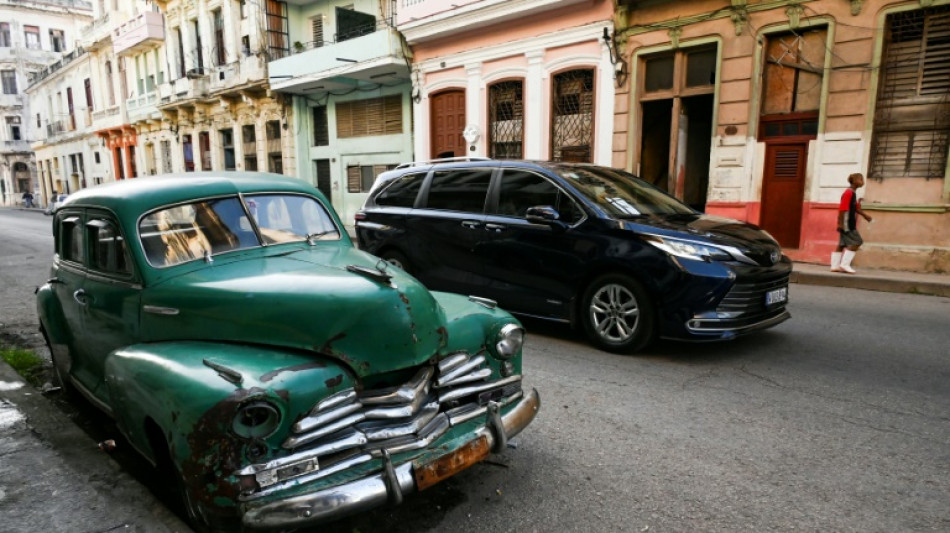
On Cuban streets, mid-century icons face challenge from new rides / Photo: © AFP

 South Africa arrests three more suspects, after nine women murdered

 Carse needs time away from England, says captain Brook

 NOWPayments Releases Cross-Chain Payout Data Revealing Key Performance Benchmarks Across TRON, BNB Chain, and Solana

 British Museum bans photos of Bayeux Tapestry as crowds linger

 COP31 host says AI climate footprint to be a summit priority

 Berlin's far-left vote winners reject anti-semitism charges

 Mancini eager for 'new adventure' on Italy return

 Mbappe says having Zidane as France coach 'like a film'

 Palmer, Rice out of England Nations League squad

 German auto workers stage mass protests in bid to save jobs
 Embattled Merz vows to keep ruling for 'democratic future' of Germany

 Merz vows to keep ruling coalition together for 'democratic future' of Germany

 Spain coach De la Fuente gets new deal after World Cup success

 Pressure grows on Germany's Merz after election defeats

 China's Zhang beats Japan rivals to Asian Games gymnastics gold

 Samlingen Haupt: Vad pengar avslöjar om oss människor

 Tens of thousands of German auto workers protest to save jobs

 हॉप्त् कलेक्शन: पैसा हमारे बारे में एक इंसान के रूप में क्या प्रकट करता है

 Συλλογή Haupt: Τι αποκαλύπτει το χρήμα για εμάς τους ανθρώπους

 TradersYard Shifts Focus to Futures Trading

 ハウプト・コレクション:お金が人間について明かすこと

 하우프트 컬렉션: 돈이 우리 인간에 대해 드러내는 것

 Indonesia doing 'everything' but struggling to curb fires

 Sbírka Haupt: Co o nás lidech prozrazují peníze
 North and South Korea fight out draw in niggly Asian Games clash

Brand new Mercedes, state-of-the-art 4x4s, even Teslas: high-end, modern cars have started appearing in Havana, a city whose image is intricately linked to the classic American sedans and Soviet-era Ladas that cruise its streets.
The influx has come despite a biting economic crisis on the communist island, where the average monthly wage is $42 and the vast majority of Cubans struggle to get from point A to B due to a public transport system crippled by shortages of parts and fuel.
Few can afford a car, never mind a new one.
But for private companies, authorized in Cuba only in 2021, the government last year eased restrictions on the importation of foreign vehicles previously subjected to exorbitant taxes and customs duties.
"Cuba needs new cars to achieve environmental goals. It must be done now," said 56-year-old Julio Alvarez, the owner of a tourist transport company who himself recently purchased a Chinese SUV of the Dongfeng brand.
The sleek new black machine has joined the 15 old but brightly-colored Chevrolets Alvarez has in his garage --- including a 1955 Bel Air and a 1938 van, treasured heirlooms which shine as if they had just left the factory.
According to the US-Cuba Trade and Economic Council, a New York-based chamber of commerce, $35 million worth of cars were imported from the United States in the first half of this year -- three times more than in 2023 as a whole.
The figure is expected to rise as the government in Havana is set to approve a law later this year making it easier for individuals to import foreign vehicles as well.
Tens of thousands of vintage cars -- gas-guzzlers older than the average inhabitant -- still circulate in Cuba, where many make a living as mechanics keeping the old engines running.
The American sedans, many of them Chevrolets, are most often used as taxis and for tourism -- a major part of the attraction for visitors who photograph them and buy postcards bearing their colorful image.
The most ubiquitous group of cars date from the Soviet era -- mainly of the Lada and Moskvitch brands.
But in the past 18 months, Cubans -- especially in Havana -- have seen a sudden influx of SUVs, 4x4s and pickup trucks from Japan, South Korea, China and the United States.
The country of 10 million people has a total car fleet of about 600,000.
- 'It's a lot of money' -
Transport Minister Eduardo Rodriguez explained on public TV recently that a Cuban who wants to import a car worth $10,000 has to pay $50,000 due to taxes and levies.
The new law, set to be passed in October, would reduce this cost to $15,900.
Cheaper, but still beyond the reach of most. A Cuban earning the median wage would have to save up for 31 years to buy a car at this price.
"I would like to" purchase a car, "but it is unlikely that this will happen to me," said 48-year-old Cesar Milera, who works as a driver --of someone else's car.
"It's a lot of money," he said, in a country where the most common private vehicles are electric scooters.
Cuban anesthesiologist William Flores, 25, told AFP while waiting for the bus that "no doctor, nor any professional in our country, can dream of... getting a car, even a motorcycle, with the salary" they earn.
In the first half of the 20th century, Cubans imported tens of thousands of American cars, then brand new.
But economic sanctions declared in 1962 against the government of Fidel Castro stopped the influx.
"It's a heritage that does not exist in other places and tourists come looking for these cars for that reason," said Milera.
Cuba's pending law will also regulate the type and number of cars that individuals will be allowed to import.
In an apparent rebuke of flashiness in a country that likes to think of itself as egalitarian, Prime Minister Manuel Marrero lamented in July that "certain cars entering" Cuba "are not compatible with our society."
G.Schulte--BTB