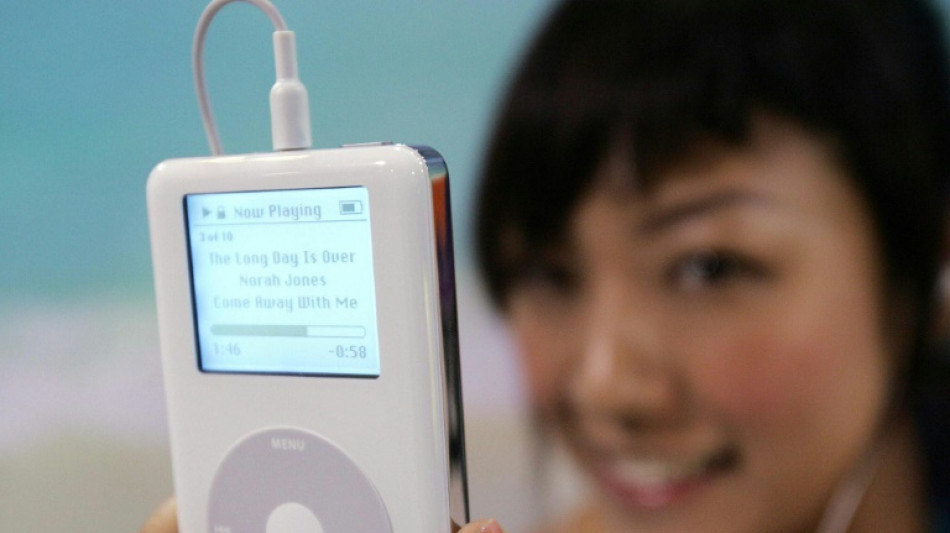
iPod RIP: How Apple's music player transformed an industry / Photo: © AFP/File

 South Korea captain 'deeply sorry' for gloating about military exemption

 Alcaraz through to Japan Open semis after Shapovalov injury

 Chanel: unpicking one year of 'Blazymania'

 Latvian pro-Europeans set for election win: partial results

 China swim sensation Yu Zidi, 13, says 'I'm no prodigy'

 Yu Zidi to Ohashi: Asian Games stars who can light up LA Olympics

 'Act before it's too late': Tokyo residents fight for more trees

 'Disappointing' as South Korea flag mishap sees Games end on sour note

 Pre-COP host Tuvalu at frontline of climate change

 Hungary's dwindling paprika producers battle to save signature spice

 Cornell president vows review in wake of alleged student gang rape

 Latvian partial election results suggest pro-European choice

 In Egypt's Sinai, Gazan builds school for children displaced by war

 Trump tariffs a mixed bag for US auto industry

 Yemen government forces say struck Houthi targets

 Music links past, present for Pedro Pascal's cellist in 'Behemoth!'

 ALEX BODI ȘI AMBASADORUL REPUBLICII SUDANUL DE SUD, GUM DOMINIC MATIOK, DISCUTĂ LA BERLIN DESPRE POSIBILITATEA ÎNFIINȚĂRII UNUI CONSULAT ONORIFIC LA BUCUREȘTI

 Dodgers step up World Series three-peat bid with 5-3 win over Braves

 Spain break down Czechs as England outclass Croatia in Nations League

 Yamal on target as Spain hold off Czech Republic

 Latvian exit polls suggest pro-European choice

 Lula, Bolsonaro wrap up campaigns ahead of knife-edge election

 Tuchel hails 'complete' England after Croatia demolition

 Fury to invite Trump to lead ring walk before Joshua showdown

 Fashion industry in 'precarious moment', says Vivienne Westwood supremo

At the height of its powers the pocket-sized music player known as the iPod shifted tens of millions of units each year, helping Apple to conquer the globe and transforming the music industry.
But that was the mid-2000s –- a lifetime ago in the tech industry. After years of declining sales, the US tech giant announced on Tuesday it was stopping production after 21 years.
"Clearly this was one of the products that Apple launched that completely changed our lives," Francisco Jeronimo of analysis firm IDC told AFP.
Social media was awash with emotional tributes under the banner "iPod RIP".
"Noooo, iPod touch, you were too pure for this world!" tweeted entrepreneur Anil Dash.
"Goodnight, sweet prince. You won't be forgotten," tweeted Apple enthusiast Federico Viticci.
The device began life in 2001 with the promise of "putting 1,000 songs in your pocket".
At $400 it was hardly cheap.
But its 5GB of storage outstripped the competition, its mechanical wheel was instantly iconic and it allowed a constant stream of music uncoupled from conventional albums.
In the following years, prices came down, storage space grew, colours and models proliferated and sales exploded.
- 'We folded' -
"It didn’t just change the way we all listen to music, it changed the entire music industry," Apple founder Steve Jobs said of the iPod in 2007.
Few would disagree.
Digital music was still in its infancy and closely associated with piracy.
File-sharing platform Napster had horrified the industry by dispensing with any idea of paying the record companies or musicians.
Against this background, Apple managed to persuade record company bosses to sanction the sale of individual tracks for 99 cents.
"We folded because we had no leverage," Albhy Galuten, an executive at Universal Music Group at the time, told the New York Times on Tuesday.
For years, bands from AC/DC to the Beatles and Metallica refused to allow Apple to sell their music.
But the industry has since found a way to stay hugely profitable and even embrace technology like streaming.
It was the first legal model for digital music, industry expert Marc Bourreau told AFP.
After the initial shock to the system, he said the industry has learnt to embrace -- and monetise -- technology.
"People are now spending money in ways they weren’t before," said Bourreau, highlighting money from streaming.
"By this logic, the music industry is doing just fine."
- Musical glasses -
But the writing was on the wall for the iPod as early as 2007 when Jobs launched the iPhone.
With theatrical flair, he told an expectant audience the new product was an "iPod, a phone and an internet communicator".
He was lighting a fire under his own product even though at the time it accounted for roughly 40 percent of Apple's revenue, according to analysis by Statista.
Five years later, the iPod's revenue share had plunged below 10 percent and it was being outsold by the iPhone.
People no longer needed both products in their lives, and Apple no longer needed both in its portfolio.
"I don't see why people would buy music players in the future," said Jeronimo.
"Music players are now a feature of other devices – in cars, smart speakers, watches, even in smart glasses."
The iPod and all its imitators seem likely to follow the Sony Walkman into a long twilight of nostalgic fandom and eBay listings of products from a bygone era.
M.Odermatt--BTB