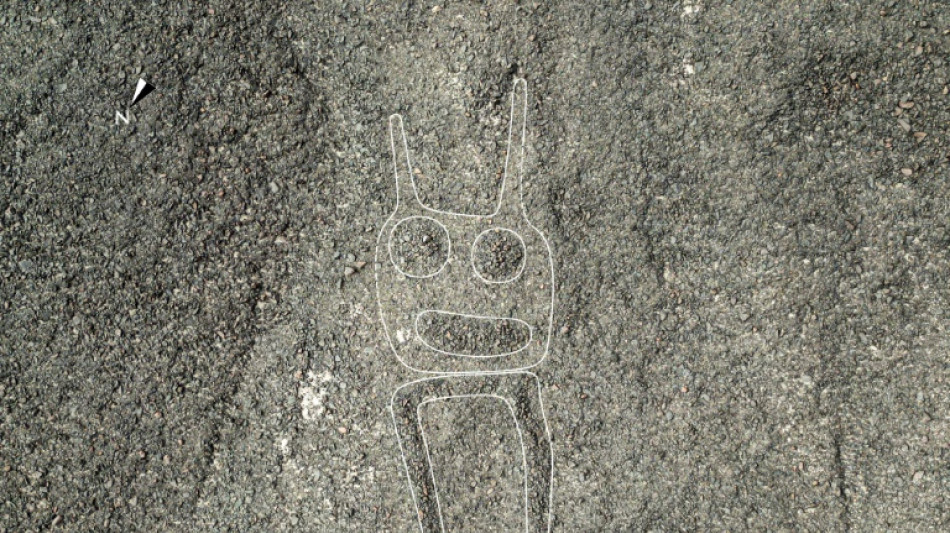
AI research uncovers 300 ancient etchings in Peru's Nazca desert / Photo: © Yamagata University Institute of Nasca/AFP

 Trump renames AI 'super intelligence' as leaders jostle over dangers

 Oil prices retreat as markets welcome US-Iran talks

 US refusing to give Sudan's de facto leader visa for UN: diplomatic sources, UN

 Macron urges world to choose UN over 'law of the jungle'

 All-rounder Jacks stars as England beat Sri Lanka in 1st ODI

 Man City peg back Bayern to start Women's Champions League

 Trump beats 'America first' drum at UN as allies tread carefully

 Snedeker backs Spaun for Ryder Cup after Presidents snub

 French prosecutors probe secret filming of women with smart glasses

 Trump renames AI "super intelligence," rejects international oversight

 Trump rejects international regulation of AI

 How is the EU approaching record fuel prices?

 Sri Lanka's Colombage strikes on debut as England dismissed for 265 in first ODI

 Hurricane Polo strengthens to top category 5 off Mexico

 11 hurt as teen opens fire outside school in western Turkey

 UN chief says 'Big Oil' treats atmosphere as open sewer

 Tunisia says 2026 summer hottest on record

 England's Rashid out of Sri Lanka ODIs with hand injury

 Houthis accuse Saudi Arabia of deadly strikes as thousands flee

 Stocks climb as oil slides, AI buzz returns

 India cricketers win in style as Afghan savours 'special' Games silver

 La Liga president hits out at Real Madrid refereeing 'conspiracy' claims

 MEXC Launches “Real Stocks, Real Friends” with Rewards for Bringing Friends to Wall Street

 Mbappe continues media push for Ballon d'Or recognition

 Stocks rise on AI buzz, oil prices cool

Japanese scientists have used artificial intelligence to uncover 303 new etchings in Peru's Nazca desert -- doubling the amount of known geoglyphs made some 2,000 years ago by a pre-Inca civilization.
The fabled Nazca lines, a series of massive incisions on the desert floor depicting animals, plants, imaginary beings and geometric figures, have fascinated scientists ever since they were first discovered around a century ago.
Best viewed from the air, the lines situated some 220 miles (350 kilometers) south of Lima are one of Peru's top tourist attractions.
Announcing the new discoveries in Lima on Monday, archaeologist Masato Sakai, from Yamagata University, said: "The use of AI in research has allowed us to map the distribution of geoglyphs in a faster and more precise way."
He said the findings were the fruit of collaboration between his university's Nazca Institute and the research division of the technology company IBM.
"The traditional method of study, which consisted of visually identifying the geoglyphs from high-resolution images of this vast area, was slow and carried the risk of overlooking some of them," he added.
The study was also published on Monday in the prestigious Proceedings of the National Academy of Sciences (PNAS) journal, describing how AI can be used to accelerate discoveries in archeology even in well-known sites.
The paper said it had taken nearly a century to discover 430 figurative Nazca geoglyphs.
Using AI, scientists found 303 more during only six months of field surveys.
The AI model was particularly good at picking up smaller relief-type geoglyphs which are harder to spot with the naked eye.
Among the new figures discovered were giant linear-type geoglyphs, mainly representing wild animals, but also smaller ones with motifs of abstract humanoids and domesticated camelids, a mammal from the camel family.
Scientists used AI to analyze a vast amount of geospatial data produced by aircraft to identify areas where they might find more geoglyphs.
The people that formed the Nazca civilization lived in the area of southwestern Peru from 200 BC to 700 AD.
What drove them to create the lines, designated a UNESCO World Heritage site, is a mystery.
Some scientists believe they have astrological and religious significance.
The first geoglyphs were discovered in 1927.
J.Fankhauser--BTB