US trade chief defends tariff hikes when paired with investment / Photo: © AFP

 Drone hits data centre of Russia's largest bank

 Bivial AG Brings Its Complete Dashboard to Mobile

 Mont Blanc nearly two metres taller than in 2023: French surveyors

 Pope recovering after lung cancer operation that rattles Church

 Indonesia haze spikes Singapore pollution, shuts East Timor schools
 Higher borrowing costs an 'alarm signal' for France: finance minister

 Zelensky accuses Putin of disrespecting Trump after latest attacks

 Japan PM says housework makes her busier than male predecessors

 Top Indian 'cockroach' leaders sent to jail after protest

 Ukraine ex-military officer to stand trial over Nord Stream sabotage
 IMF chief says Saudi attacks could have negative spillover 'everywhere'
 Premier League move a Sage decision for new Palace boss

 South Korean FA condemns 'personal attacks' as rift rumours grow

 Japan urges 'impartial treatment' of journalist arrested in Russia

 What we know about Pope Leo XIV's lung cancer operation

 Advanced economies must 'act now' to lower debt as bond yields spike: IMF

 Deluge by design: Thai villages flooded to protect capital

 Ivan Deforge, the French 'bison tamer' in Moscow

 Indonesians on fire-ravaged island sue state for clean air

 Trump, White House post video of UK man killed by tiger

 Saudi employee arrested for allegedly bugging OpenAI office

 Atletico sink Man Utd as Viking deny Bayern in Champions League

 Man United's Martinez blasts board's lack of investment

 Meet A7 International, an Innovative Global Platform Designed to Reinvent the International Payments Market

 Shakhtar hope London move a reminder of Ukraine conflict

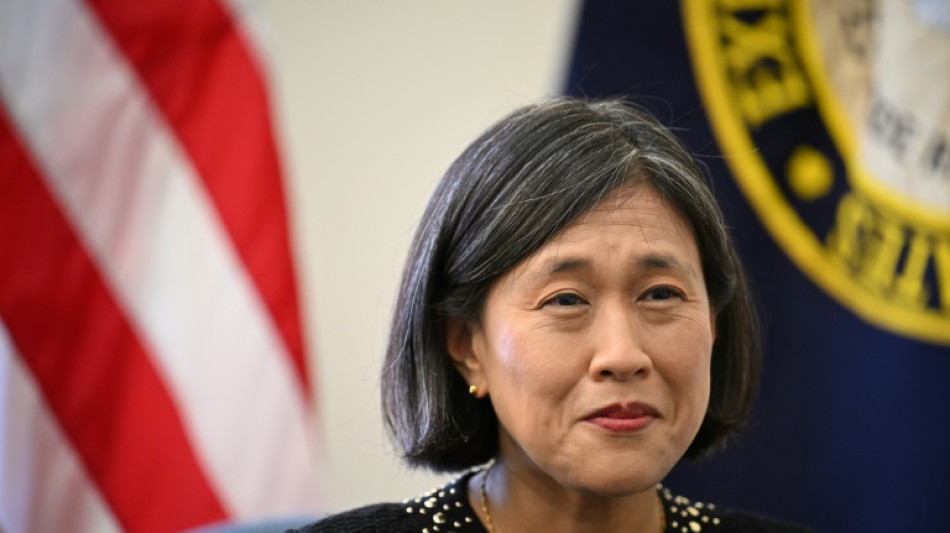
US Trade Representative Katherine Tai defended stiff tariff hikes against countries like China, arguing that paired with investment, they were a "legitimate and constructive" tool for re-invigorating domestic industries.
Tai's comments to AFP come a week after sharp tariff increases on Chinese electric vehicles, EV batteries and solar cells took effect -- with levies down the line on other products also recently finalized.
The latest moves targeting $18 billion in Chinese goods come weeks before November's US presidential election, with both Democrats and Republicans pushing a hard line on China as competition between Washington and Beijing intensifies.
In an interview Thursday looking back on her term, Tai defended the use of tariffs as a means "to counterbalance unfair trade" with China.
The latest hikes, she added, aim to help US clean energy investments "take root."
"We wanted to make sure that those increased areas are paired with the investments that we're making," Tai said, referring to efforts to build domestic industries like those for EVs, batteries and semiconductors.
"Once you've lost an industry, bringing it back from the brink is much, much harder," she said.
- Time needed -
The US manufacturing industry has declined in recent decades, a period that saw production shift offshore and heightened competition from China.
China's share of global manufacturing output has been around 30 percent, significantly above the United States and other developed countries.
Tai acknowledged that while the United States has seen new manufacturing investment, "in order to bring manufacturing back across the board, it is going to take more time."
She stressed however that Washington is not aiming to bring all production back on its shores, but to recover from earlier "levels of erosion."
President Joe Biden has largely maintained tariffs imposed by former president Donald Trump, which impacted some $300 billion in goods from China. The hikes this year affect earlier products and added ones.
An estimate by think tank the Tax Foundation in June noted the cumulative impact of tariffs would "reduce long-run GDP by 0.2 percent."
Further increases proposed by Trump as the Republican seeks another White House term could "shrink GDP by at least 0.8 percent," the foundation added.
- 'Very optimistic' -
Tai, who has held office for over three years, is also hopeful that Washington will reach new deals with European partners -- referring to ongoing talks on critical minerals.
A key factor in negotiations on a critical minerals deal has been labor standards and how these would be upheld.
"I remain very, very optimistic that we will be able to achieve these kinds of new agreements that put workers at their center," she said.
She sounded a positive note on talks on steel and aluminum as well.
Biden has paused Trump-era tariffs on most European steel and aluminum in favor of quotas allowing some imports without levies, but both sides face a complicated task in resolving an impasse.
This is because they are also pushing for the decarbonization of industries and to combat non-market practices from parties like China.
"We're not just trying to accomplish more trade. We're trying to accomplish better trade," Tai said.
She pointed to the US-Mexico-Canada Agreement, which allows enforcement actions against factories over labor violations, as an example of "worker-centered trade."
She added Washington wants to "expand the conversation beyond North America" and to Europe.
But the trade chief's term has seen challenges including a snag with the trade pillar of the Indo-Pacific Economic Framework for Prosperity -- a pact involving Asia-Pacific partners -- amid labor concerns.
Tai pushed back on the view that labor provisions alone have caused "insurmountable challenges," saying countries are still making progress this year.
She added that Washington remains present in the region: "We are there, we have been, we are engaging."
W.Lapointe--BTB