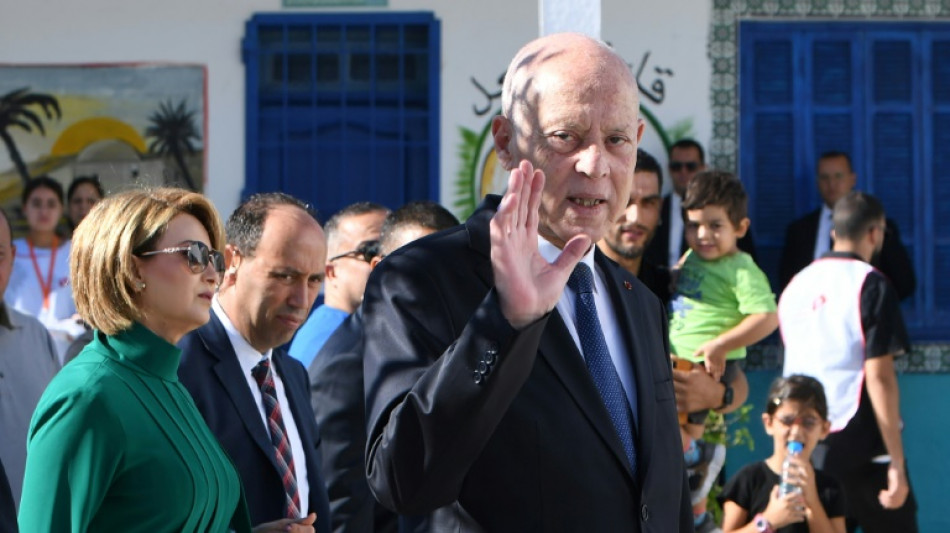
Tunisia voting ends as Saied eyes re-election with critics behind bars / Photo: © AFP

 Drone hits data centre of Russia's largest bank
 Bivial AG Brings Its Complete Dashboard to Mobile
 Mont Blanc nearly two metres taller than in 2023: French surveyors
 Pope recovering after lung cancer operation that rattles Church
 Indonesia haze spikes Singapore pollution, shuts East Timor schools
 Higher borrowing costs an 'alarm signal' for France: finance minister
 Zelensky accuses Putin of disrespecting Trump after latest attacks
 Japan PM says housework makes her busier than male predecessors

 Top Indian 'cockroach' leaders sent to jail after protest

 Ukraine ex-military officer to stand trial over Nord Stream sabotage
 IMF chief says Saudi attacks could have negative spillover 'everywhere'
 Premier League move a Sage decision for new Palace boss

 South Korean FA condemns 'personal attacks' as rift rumours grow
 Japan urges 'impartial treatment' of journalist arrested in Russia
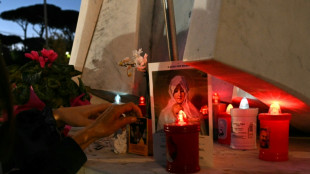 What we know about Pope Leo XIV's lung cancer operation
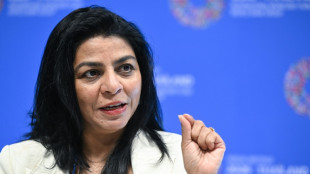 Advanced economies must 'act now' to lower debt as bond yields spike: IMF
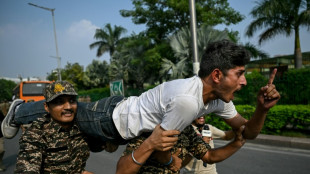
 Deluge by design: Thai villages flooded to protect capital
 Ivan Deforge, the French 'bison tamer' in Moscow

 Indonesians on fire-ravaged island sue state for clean air
 Trump, White House post video of UK man killed by tiger
 Saudi employee arrested for allegedly bugging OpenAI office
 Atletico sink Man Utd as Viking deny Bayern in Champions League
 Man United's Martinez blasts board's lack of investment

 Meet A7 International, an Innovative Global Platform Designed to Reinvent the International Payments Market

 Shakhtar hope London move a reminder of Ukraine conflict

Polls closed Sunday night in Tunisia after voting in a presidential election expected to see incumbent Kais Saied secure another five years in office while his main critics -- including one contender -- are behind bars.
Three years after Saied staged a sweeping power grab, rights group fear re-election will only further entrench his rule in the country which became the only democracy to emerge from the Arab Spring uprisings.
With the ouster of longtime dictator Zine El Abidine Ben Ali in 2011, Tunisia prided itself on being the birthplace of those regional revolts against authoritarianism.
But the north African country's path changed dramatically soon after Saied's democratic election in 2019.
The power grab by Saied, 66, saw him rewrite the constitution and crack down on dissent, sparking criticism at home and abroad.
In a speech on Thursday, Saied called for a "massive turnout to vote" and usher in what he called an era of "reconstruction".
The Tunisian electoral board, ISIE, has said about 9.7 million people were eligible to vote, in a country whose population is around 12 million.
By 1:00 pm -- five hours before the 5,000 polling station closed -- only 14 percent of voters had cast ballots, ISIE said.
The board's spokesman Mohamed Tlili Mansri later said it was expecting around 30 percent turnout. That is roughly the same proportion of people who turned out in 2022 for a widely boycotted referendum on the new constitution.
- 'Support Kais Saied' -
"I came to support Kais Saied," 69-year-old Nouri Masmoudi said in the morning. "My whole family is going to vote for him."
Hosni Abidi, 40, said he feared electoral fraud.
"I don't want people to choose for me," he said. "I want to check the box for my candidate myself."
Tunisia's electoral board said ahead of the ballot that it would not allow two local independent watchdogs to monitor the vote.
By midday in Bab Jedid, a working-class neighbourhood, there were few voters, and most were elderly men.
Saied cast his vote alongside his wife in the affluent Ennasr neighbourhood, north of Tunis, in the morning.
New York-based Human Rights Watch has said more than "170 people are detained in Tunisia on political grounds or for exercising their fundamental rights".
Jailed opposition figures include Rached Ghannouchi, head of the Islamist-inspired opposition party Ennahdha, which dominated political life after the revolution.
Also detained is Abir Moussi, head of the Free Destourian Party, which critics accuse of wanting to bring back the regime that was ousted in 2011.
- 'Least bad candidate' -
Heavily indebted Tunisia is grappling with weak economic growth, high inflation and unemployment that has led many Tunisians to join mostly sub-Saharan African migrants that use the country as a jumping-off point to Europe.
"Many fear that a new mandate for Saied will only deepen the country's socio-economic woes, as well as hasten the regime's authoritarian drift," the International Crisis Group think tank said.
Yet, voters were presented with almost no alternative to Saied. ISIE barred 14 hopefuls from standing in the race, citing technicalities.
Wajd Harrar, a 22-year-old student, said that in 2019, while she was too young to vote, "people had chosen a bad president".
This time, she said, "I have the right to vote and I will give my vote to the least bad candidate."
Mohamed Aziz, 21, said he was "motivated by the elections because choosing the right person for the next five years is important".
On Friday, hundreds of people protested in the capital, some holding signs denouncing Saied as a "Pharaoh manipulating the law".
Standing against him Sunday were former lawmaker Zouhair Maghzaoui, 59, who backed Saied's power grab in 2021, and Ayachi Zammel, 47, a little-known businessman who has been in jail since his bid was approved by ISIE last month.
Zammel currently faces more than 14 years in prison on accusations of having forged endorsement signatures to enable him to stand in the election.
Voting in Marsa, north of Tunis, Maghzaoui called on Tunisians to "vote in large numbers".
On Thursday Saied cited "a long war against conspiratorial forces linked to foreign circles", accusing them of "infiltrating many public services and disrupting hundreds of projects" under his tenure.
Crisis Group said that while Saied "enjoys significant support among the working classes, he has been criticised for failing to resolve the country's deep economic crisis".
The electoral board has said preliminary results should come no later than Wednesday.
F.Müller--BTB