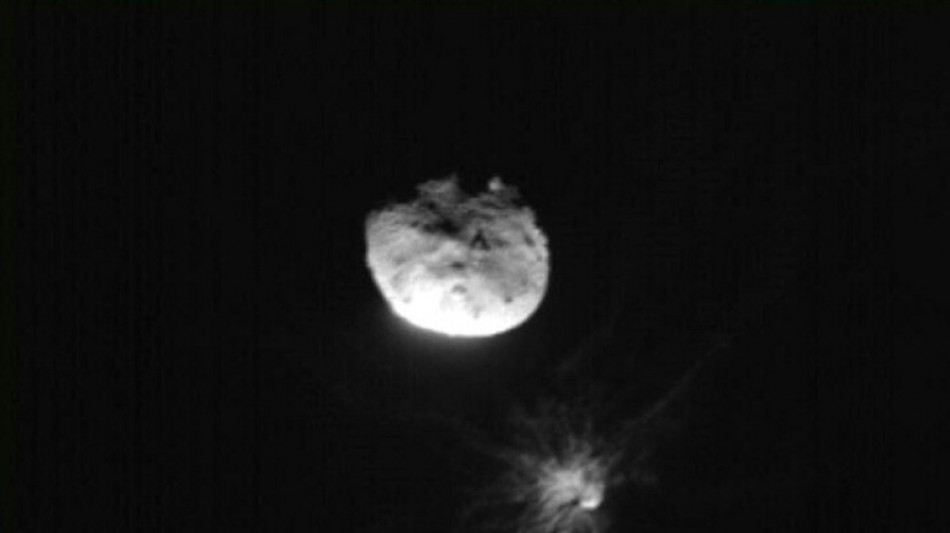
Europe's asteroid mission Hera launches despite hurricane / Photo: © ASI/NASA/AFP/File

 Drone hits data centre of Russia's largest bank

 Bivial AG Brings Its Complete Dashboard to Mobile

 Mont Blanc nearly two metres taller than in 2023: French surveyors

 Pope recovering after lung cancer operation that rattles Church

 Indonesia haze spikes Singapore pollution, shuts East Timor schools

 Higher borrowing costs an 'alarm signal' for France: finance minister

 Zelensky accuses Putin of disrespecting Trump after latest attacks

 Japan PM says housework makes her busier than male predecessors

 Top Indian 'cockroach' leaders sent to jail after protest

 Ukraine ex-military officer to stand trial over Nord Stream sabotage

 IMF chief says Saudi attacks could have negative spillover 'everywhere'

 Premier League move a Sage decision for new Palace boss

 South Korean FA condemns 'personal attacks' as rift rumours grow

 Japan urges 'impartial treatment' of journalist arrested in Russia

 What we know about Pope Leo XIV's lung cancer operation

 Advanced economies must 'act now' to lower debt as bond yields spike: IMF

 Deluge by design: Thai villages flooded to protect capital

 Ivan Deforge, the French 'bison tamer' in Moscow

 Indonesians on fire-ravaged island sue state for clean air

 Trump, White House post video of UK man killed by tiger

 Saudi employee arrested for allegedly bugging OpenAI office

 Atletico sink Man Utd as Viking deny Bayern in Champions League

 Man United's Martinez blasts board's lack of investment

 Meet A7 International, an Innovative Global Platform Designed to Reinvent the International Payments Market

 Shakhtar hope London move a reminder of Ukraine conflict

Europe's Hera probe launched Monday on a mission to inspect the damage done by a NASA spacecraft when it smashed into an asteroid during the first test of Earth's planetary defences.
Despite fears that an approaching hurricane could delay the launch, the probe blasted off on a SpaceX rocket into cloudy skies from Cape Canaveral in the US state of Florida just before 11:00 am local time (1500 GMT).
Hera's mission is to investigate the aftermath of NASA's Double Asteroid Redirection Test (DART), which deliberately crashed into the Dimorphos asteroid in 2022 roughly 11 million kilometres (6.8 million miles) from Earth.
The fridge-sized DART spacecraft successfully knocked the asteroid well off course, demonstrating that humanity may no longer be powerless against potentially planet-killing asteroids that could head our way.
The European Space Agency (ESA) said the Hera craft will investigate what it has called the "crime scene" in the hopes of learning how Earth can best fend off future space rocks.
The launch was met with applause from teams on the ground, according to an ESA broadcast.
Poor weather ahead of Hurricane Milton had put the launch into doubt, with SpaceX warning on Sunday that there was only a 15 percent chance of a launch.
Milton is the latest hurricane to hit the Gulf of Mexico after the deadly Hurricane Helene. It has been classified as "an extremely dangerous category 4 hurricane" and is expected to slam into Florida in the coming days.
- Green light after 'mishap' -
The launch had also faced a potential delay due to an anomaly involving a Falcon 9 rocket during the launch of SpaceX's Crew-9 astronaut mission late last month.
But on Sunday, the US Federal Aviation Administration gave the green light.
Hera is planned to fly past Mars next year and then arrive near Dimorphos in December 2026 to begin its six-month investigation.
Dimorphos, which is actually a moonlet orbiting its big brother Didymos, never posed a threat to Earth.
After DART's impact, Dimorphos shed material to the point where its orbit around Didymos was shortened by 33 minutes -- proof that it was successfully deflected.
But much about the impact remains unknown, including how much damage was done and exactly what the asteroid -- which is about the size of an Egyptian pyramid -- was like before it was hit.
Analysis of the DART mission has suggested that rather than being a single hard rock, Dimorphos was more a loose pile of rubble held together by gravity.
"The consequence of this is that, instead of making a crater" on Dimorphos, DART may have "completely deformed" the asteroid, the Hera mission's principal investigator Patrick Michel told a press conference.
But there are other possibilities, he said, adding that the behaviour of these low-gravity objects is little understood and "defies intuition".
- 'Able to protect ourselves' -
An asteroid wider than a kilometre (0.6 miles) -- which could trigger a global catastrophe on a scale that wiped out the dinosaurs -- is estimated to strike Earth every 500,000 years or so.
An asteroid around 140 metres (460 feet) wide -- which is a little smaller than Dimorphos but could still take out a major city -- hits our home planet around every 20,000 years.
Most of these celestial objects come from the asteroid belt between Mars and Jupiter. Almost all those bigger than a kilometre wide are known to scientists, and none are expected to threaten Earth in the next century.
There are also no known 140-metre asteroids on a collision course with Earth -- but only 40 percent of those space rocks are believed to have been identified.
Although asteroids are one of the least likely natural disasters to strike the planet, people now have the "advantage of being able to protect ourselves against them", the Hera mission's principal investigator Patrick Michel said.
The 363-million-euro ($400 million) mission will be equipped with 12 scientific instruments and two nanosatellites.
Once its job is done, the team on the ground hope that Hera can land gently on Dimorphos or Didymos, where it will spend the rest of its days.
F.Pavlenko--BTB