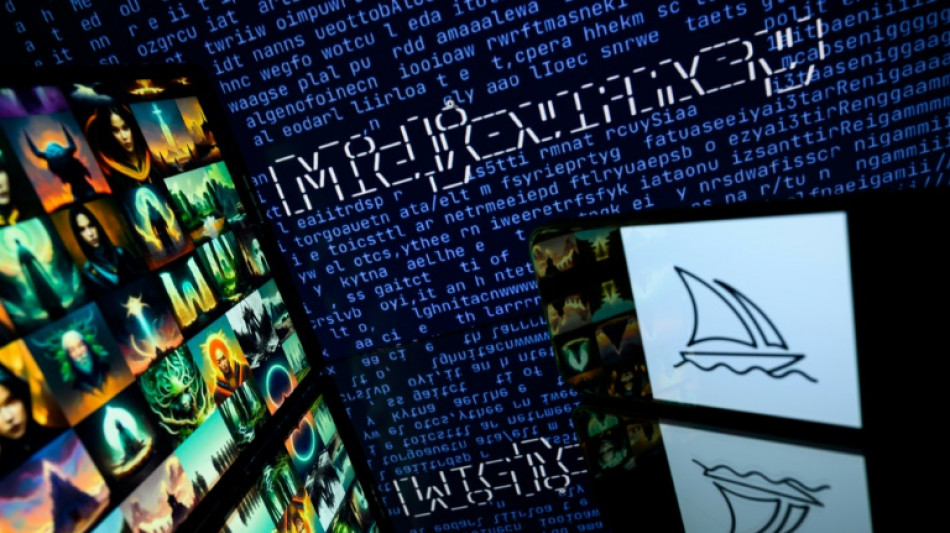
Fake AI history photos cloud the past / Photo: © AFP

 IMF chief says Saudi attacks could have negative spillover 'everywhere'
 Premier League move a Sage decision for new Palace boss

 South Korean FA condemns 'personal attacks' as rift rumours grow

 Japan urges 'impartial treatment' of journalist arrested in Russia

 What we know about Pope Leo XIV's lung cancer operation
 Advanced economies must 'act now' to lower debt as bond yields spike: IMF
 Deluge by design: Thai villages flooded to protect capital
 Ivan Deforge, the French 'bison tamer' in Moscow
 Indonesians on fire-ravaged island sue state for clean air
 Trump, White House post video of UK man killed by tiger

 Saudi employee arrested for allegedly bugging OpenAI office
 Atletico sink Man Utd as Viking deny Bayern in Champions League
 Man United's Martinez blasts board's lack of investment

 Meet A7 International, an Innovative Global Platform Designed to Reinvent the International Payments Market

 Shakhtar hope London move a reminder of Ukraine conflict

 Tresoldi hat-trick fires Brugge past Inter Milan

 Rams axe kicker Mevis after misses cost victory over Bills: reports
 Yamal stays cool at boiling Galatasaray to lift Barcelona to victory
 Arsenal cruise past Lille into share of Champions League lead
 Trump ousts Greece ambassador over ethics scandal

 Reese Witherspoon, France's Mediawan to buy Hello Sunshine

 Bipartisan US senators urge Trump to scrap Russian diesel deal

 Ex-gang leader sentenced to minimum 40 years for Tupac murder

 Cornell suspends frat parties after alleged gang rape

 Man City deserve to keep titles, says PSG's Luis Enrique

A wave of touching photos showing great moments in time is fascinating amateur historians online. The problem? They are not real -- and may be clouding our view of the past.
Widely shared on social media, the atmospheric black and white shots -- a mother and her child starving in the Great Depression; an exhausted soldier in the Vietnam war -- may look at first like real historic documents.
But they were created by artificial intelligence, and researchers fear they are muddying the waters of real history.
"AI has caused a tsunami of fake history, especially images," said Jo Hedwig Teeuwisse, a Dutch historian who debunks false claims online.
"In some cases, they even make an AI version of a real old photo. It is really weird, especially when the original is very famous."
One photo shared on Facebook shows a pair of fresh-faced young men posing in front of an antique biplane: purportedly Orville and Wilbur Wright at the time of their first powered flight.
But those are not the Wright Brothers.
Real archive shots from the time show mustachioed Orville and his taller brother Wilbur in flat caps, looking nothing like the blond pair in the sepia-hued AI image.
- Hiroshima reproduction -
Among the images created using Midjourney, a popular AI online image generator, is a series of fake reproductions portraying the moment when the suspected assassin of president John F. Kennedy, Lee Harvey Oswald, was himself shot dead by Jack Ruby in 1963.
Other images on Midjourney purport to show the explosion of the atom bomb over Hiroshima in 1945, the invasion of Prague by Soviet-allied troops in 1968 and even a vision of the Roman Coliseum in ancient times.
"They often focus on events from too long ago to have been photographed or on moments that are poorly documented," said Marina Amaral, an artist who specialises in adding colour to black and white photographs.
"This creates a risk of false visuals being accepted as fact, which could, over time, distort our understanding of history and weaken public trust in visual evidence as a reliable source for learning about the past."
- Spotting fake images -
For now, Amaral and Teeuwissen believe they can still tell fake historical images from real ones just by looking at them.
AI-generated photos often have tell-tale glitches: too many fingers on a hand, missing details -- such as the lack of a propeller on the Wright brothers' plane -- or, on the other hand, compositions that are too perfect.
"AI-generated pictures can recreate the look, but they miss the human element, the intent, the reason behind the photographer's choices," said Amaral.
"They may be visually convincing, but they're ultimately hollow."
For Teeuwissen, "real photos are made by real people and there's usually something that's out of focus, or someone looks silly by accident, the makeup looks bad, et cetera."
But she judges it is "only a matter of time" before the quality of the AI image makes fakes hard to detect with the naked eye -- a "dangerous" prospect, she says, which would amplify disinformation.
K.Thomson--BTB