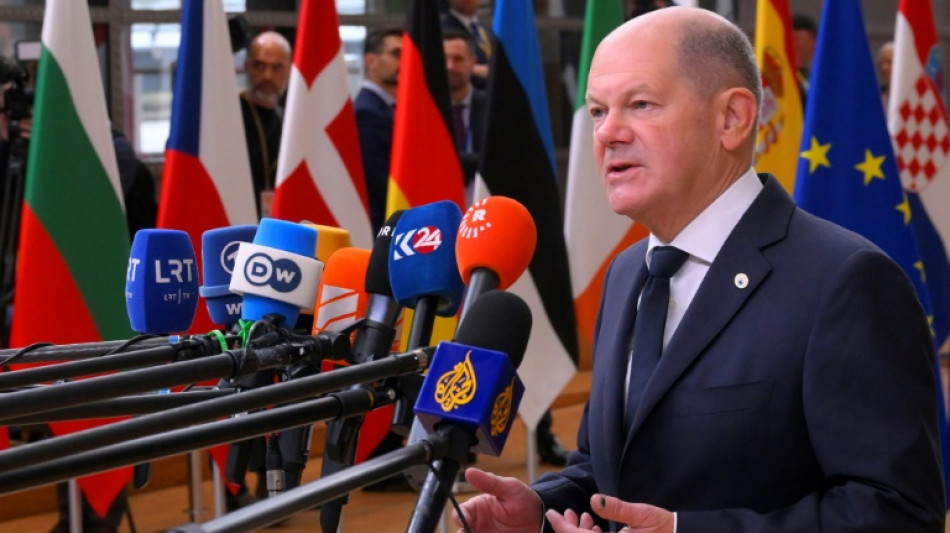
EU leaders talk tough on migration, but divided on action / Photo: © AFP

 IMF chief says Saudi attacks could have negative spillover 'everywhere'
 Premier League move a Sage decision for new Palace boss

 South Korean FA condemns 'personal attacks' as rift rumours grow

 Japan urges 'impartial treatment' of journalist arrested in Russia

 What we know about Pope Leo XIV's lung cancer operation

 Advanced economies must 'act now' to lower debt as bond yields spike: IMF
 Deluge by design: Thai villages flooded to protect capital

 Ivan Deforge, the French 'bison tamer' in Moscow

 Indonesians on fire-ravaged island sue state for clean air

 Trump, White House post video of UK man killed by tiger

 Saudi employee arrested for allegedly bugging OpenAI office
 Atletico sink Man Utd as Viking deny Bayern in Champions League

 Man United's Martinez blasts board's lack of investment

 Meet A7 International, an Innovative Global Platform Designed to Reinvent the International Payments Market

 Shakhtar hope London move a reminder of Ukraine conflict

 Tresoldi hat-trick fires Brugge past Inter Milan

 Rams axe kicker Mevis after misses cost victory over Bills: reports

 Yamal stays cool at boiling Galatasaray to lift Barcelona to victory

 Arsenal cruise past Lille into share of Champions League lead

 Trump ousts Greece ambassador over ethics scandal

 Reese Witherspoon, France's Mediawan to buy Hello Sunshine

 Bipartisan US senators urge Trump to scrap Russian diesel deal
 Ex-gang leader sentenced to minimum 40 years for Tupac murder
 Cornell suspends frat parties after alleged gang rape

 Man City deserve to keep titles, says PSG's Luis Enrique

Migration was at the top of the agenda as EU leaders met in Brussels on Thursday, with most governments keen to display a tough stance after hard-right gains in several countries, but little agreement on a course of action.
Talk of easing deportations, creating processing centres outside the European Union and speeding up implementation of a long-negotiated deal agreed on earlier this year have dominated the run-up to a summit that crystallised a rightward shift in the bloc's rhetoric.
Italy's hard-right Prime Minister Giorgia Meloni hosted a mini-summit in Brussels just ahead of the main event to discuss a common approach with 10 like-minded countries, including Denmark, the Netherlands and Hungary and Greece. EU chief Ursula von der Leyen was also present.
"We recognise that we need to think out of the box in order to address this pressing concern," Greek Prime Minister Kyriakos Mitsotakis told reporters.
But divisions remain among the bloc's 27 countries on the next steps, in particular a controversial idea of creating return "hubs" outside the EU.
German Chancellor Olaf Scholz dismissed the concept as representing "very few small drops" -- and not a viable answer to the migration challenges of a large country.
"If we all followed the rules we have together, we would already be much further ahead," he said.
Germany is among nations that want an early implementation of a landmark migration pact struck this year, which hardens border procedures and requires countries to take in asylum seekers from "frontline" states or provide money and resources.
But others say the package, set to come into force in June 2026, falls short.
A majority have backed a proposal to expedite deportations of irregular migrants and explore other "innovative solutions", as Meloni posted on X on Thursday.
Meloni showcased the deal Rome struck with Albania to send some migrants there, according to her office. Other EU capitals have shown keen interest in the scheme, and von der Leyen has said the bloc will draw lessons from it.
Finding "solutions" to possibly return some Syrian refugees to Syria was also talked about, according to a diplomatic source.
- 'New wind' -
Detected irregular border crossings into the European Union are down more than 40 percent this year after reaching the highest level in nearly a decade in 2023, according to EU border agency Frontex.
But migration remains "seen as a pressing and an urgent domestic issue" by many EU nations, a senior EU diplomat said.
Germany, which is part of the bloc's Schengen free movement area, tightened border controls in September in response to several suspected Islamist attacks.
And this month Poland said it would partially suspend asylum rights, accusing Russia and Belarus of pushing migrants over the border to destabilise the country.
"There is a new wind blowing in Europe," said Dutch politician Geert Wilders, whose nationalist populist party came top in general elections in the Netherlands last year.
Wilders was in Brussels to attend another event: a meeting of the far-right Patriots for Europe group in the European Parliament.
Hard-right parties often riding anti-immigrant sentiment performed strongly in European Parliament elections in June, and have topped recent national and regional votes in Austria and Germany.
France also tilted to the right after a snap parliamentary election this summer.
But whether the tough talk will result in concrete changes remains to be seen.
- 'Vague' ideas -
Von der Leyen kickstarted the process this week, promising changes to "streamline the process of returns".
In a letter to the bloc, she mentioned the option of developing deportation centres outside the European Union.
But an EU diplomat cautioned that the idea was "vague and preliminary", saying there was no real plan for it at this stage.
Disagreement over what remains a subject fraught with legal and ethical issues caused a similar immigration overhaul effort to fail in 2018.
"All these solutions of 'migration hubs', as they are called, have never shown in the past to be very effective, and they are always very expensive," Belgian Prime Minister Alexander De Croo told reporters.
"What works are agreements with third countries, agreements that are broader than only on migration," he said.
The EU has signed deals with Tunisia, Mauritania and others providing aid and investments in return for help curbing arrivals. They have been credited with reducing Mediterranean boat crossings but criticised for exposing asylum seekers to mistreatment.
Ukrainian President Volodymyr Zelensky also attended the meeting to present Kyiv's "victory plan" to defeat Russia, and EU leaders will discuss other topics, including Israel's conflicts in Gaza and Lebanon.
M.Odermatt--BTB