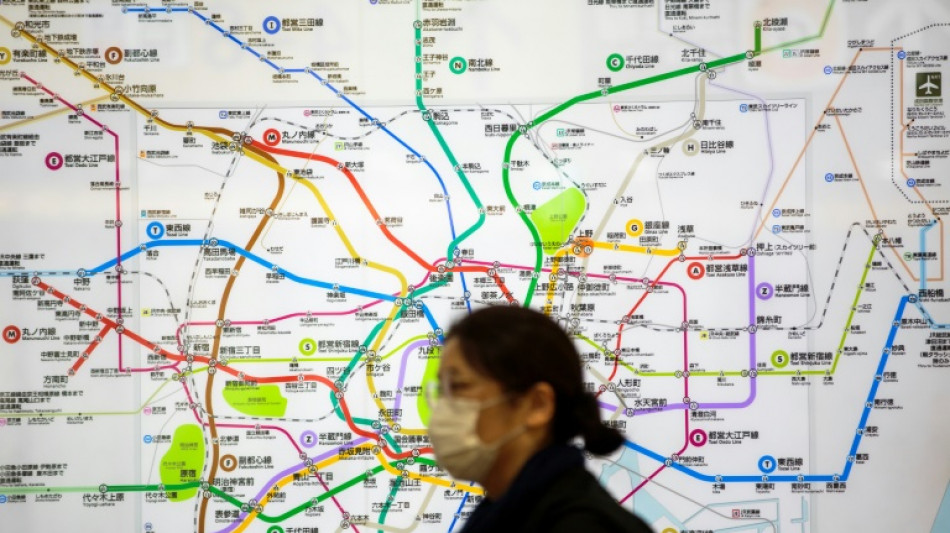
Tokyo Metro: Asia's oldest subway goes public / Photo: © AFP

 Seeing pivotal election, Israelis fly from around world to vote
 South Korea's Eom 'racially abused' in England's Championship: club
 Asian markets mixed as tech firms claw back some losses

 India shuts down iconic Delhi protest site after three decades
 Japan urges Russia for 'impartial treatment' of arrested journalist
 Lula, Bolsonaro ordered to call off attempts at online censorship
 EU takes a page from Ireland's AI playbook
 Global deforestation slowed in 2025 but surged in Congo basin: study

 Saudi says Houthi attacks sparked Aramco fire, wounded 4 in Riyadh

 Few buyers for starving cattle in El Nino parched El Salvador

 Bybit Expands Beyond Crypto as CEO Outlines Next Phase of Financial Platform
 Bayern held by Viking after 'super dumb' Olise red in Champions League
 Why AI makes computer worms harder to stop

 US fines Bank of America $1.2 bn for anti-money laundering violations

 Bayern held by Viking after Olise sees red in Champions League

 Atletico down Carrick's struggling Man United

 Croatia trials full driverless robotaxi service

 US stocks dip ahead of inflation data as tech sell-off hits Asia

 No lights, no friends: Cuban youth grapple with loneliness
 Saudi coalition strikes Yemen oil sites after Houthi attacks
 French economy minister denies country caught in debt 'snowball'
 Judge extends halt to Trump's golf course tree-cutting

 Milan's Saelemaekers set for lenghty spell out after ankle surgery
 Nvidia says to invest in French medical website
 Real Madrid's Mourinho has 'trust' in referees despite complaints

Every day six and a half million people ride Tokyo Metro's nine lines, part of a dizzyingly complex transport network serving the Japanese megacity and its sprawling suburbs.
Tokyo Metro shares rocketed more than 40 percent on their stock market debut Wednesday, raising $2.3 billion in Japan's biggest initial public offering (IPO) in six years.
Here are some facts about the company and its listing:
- Asia's first subway -
London built the first public underground railway, but in 1927 Tokyo became the first Asian city with a subway thanks to a 2.2-kilometre (1.4-mile) track from Ueno to Asakusa.
The trains ran every three minutes on what is now part of Tokyo Metro's modern-day Ginza Line but were crowded with passengers who previously overran the city's trams.
Having slowed during and after World War II, construction of public transport picked up pace as Japan rebuilt itself into a major economic power.
The company Tokyo Metro was incorporated in 2004, adopting its heart-shaped "M" logo in place of the network's previous one: a spiky, space-age "S" for subway.
- Complex map -
Tokyo Metro's nine lines -- named Ginza, Marunouchi, Hibiya, Tozai, Chiyoda, Yurakucho, Hanzomon, Namboku and Fukutoshin -- stretch for a total of 195 kilometres.
The spotless and punctual air-conditioned trains form only one part of a vast underground and overground rail system serving Greater Tokyo, often cited as the world's biggest urban area.
All but two of the nine Tokyo Metro routes connect to other train lines, allowing direct access to the capital for commuters in farther flung areas.
Four other subway lines are run separately by the Tokyo government, alongside private services and East Japan Railway's overground routes like the Yamanote Line, whose green trains carry millions in a loop around the city.
Unique jingles are played at each Tokyo Metro station when a train is at the platform.
For example, at Ginza Station, the Marunouchi line's tunes are called "Tomorrow's Door" and "The March of a Little Bird".
- IPO -
The IPO is Japan's largest since 2018 when tech and telecoms conglomerate SoftBank Group raised a national record of $23.5 billion by listing its mobile unit.
On Wednesday morning, Tokyo Metro shares traded at 1,745 yen, up 45 percent from their issue price of 1,200 yen, with reports saying the issue was 15 times oversubscribed among investors.
Before the IPO, the national government owned just over half of Tokyo Metro shares and the Tokyo city government owned the rest. The listing reduces total state ownership to around 50 percent.
The funds raised will be used to repay bonds issued to finance the reconstruction of northeastern Japan after the 2011 earthquake, tsunami and nuclear disaster that killed 18,000 people.
- Free tickets -
Tokyo Metro says investors who buy 200 shares or more will receive some free tickets to its museum and golf range, as well as free tempura toppings at its noodle stands.
The "low volatility" of a firm like Tokyo Metro makes their shares a safe investment prospect for Japanese households, said Hideaki Miyajima, a professor of commerce at Waseda University.
"And for institutional investors, the Japanese market is very favourable given the very low exchange rate" of the yen and recent corporate governance reforms, he told AFP.
- Going underground -
In earthquake-prone Japan, Tokyo Metro trains are set up to stop just before a powerful jolt hits, using real-time seismic data from monitoring stations.
Climate change is also bringing more frequent and intense flooding to the capital, with some Tokyo subway stations inundated in August by torrential rain.
Also buried beneath the Greater Tokyo area is the world's largest flood tank, a cavernous subterranean reservoir built to protect the metropolis from storms and typhoons.
O.Krause--BTB