
-
 Deluge by design: Thai villages flooded to protect capital
-
Japan urges Russia for 'impartial treatment' of arrested journalist
-
 Ivan Deforge, the French 'bison tamer' in Moscow
-
Lula, Bolsonaro ordered to call off attempts at online censorship

-
 Indonesians on fire-ravaged island sue state for clean air
-
EU takes a page from Ireland's AI playbook

-
 Trump, White House post video of UK man killed by tiger
-
Global deforestation slowed in 2025 but surged in Congo basin: study
-
 Saudi employee arrested for allegedly bugging OpenAI office
-
Saudi says Houthi attacks sparked Aramco fire, wounded 4 in Riyadh

-
 Atletico sink Man Utd as Viking deny Bayern in Champions League
-
Few buyers for starving cattle in El Nino parched El Salvador
-
 Man United's Martinez blasts board's lack of investment
-
Bybit Expands Beyond Crypto as CEO Outlines Next Phase of Financial Platform

-
 Meet A7 International, an Innovative Global Platform Designed to Reinvent the International Payments Market
-
Bayern held by Viking after 'super dumb' Olise red in Champions League

-
 Shakhtar hope London move a reminder of Ukraine conflict
-
Why AI makes computer worms harder to stop

-
 Tresoldi hat-trick fires Brugge past Inter Milan
-
US fines Bank of America $1.2 bn for anti-money laundering violations
-
 Rams axe kicker Mevis after misses cost victory over Bills: reports
-
Bayern held by Viking after Olise sees red in Champions League

-
 Yamal stays cool at boiling Galatasaray to lift Barcelona to victory
-
Atletico down Carrick's struggling Man United
-
 Arsenal cruise past Lille into share of Champions League lead
-
Croatia trials full driverless robotaxi service

-
 Trump ousts Greece ambassador over ethics scandal
-
US stocks dip ahead of inflation data as tech sell-off hits Asia

-
 Reese Witherspoon, France's Mediawan to buy Hello Sunshine
-
No lights, no friends: Cuban youth grapple with loneliness

-
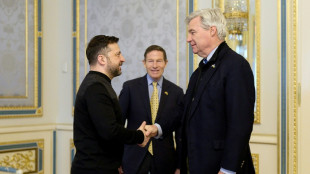 Bipartisan US senators urge Trump to scrap Russian diesel deal
-
Saudi coalition strikes Yemen oil sites after Houthi attacks

-
 Ex-gang leader sentenced to minimum 40 years for Tupac murder
-
French economy minister denies country caught in debt 'snowball'
-
 Cornell suspends frat parties after alleged gang rape
-
Judge extends halt to Trump's golf course tree-cutting

-
 Man City deserve to keep titles, says PSG's Luis Enrique
-
Milan's Saelemaekers set for lenghty spell out after ankle surgery

-
 Regulator 'will resign' if any political interference in Man City case
-
Nvidia says to invest in French medical website

-
 Microsoft's Brad Smith calls for 'real and effective' AI safety standards
-
Real Madrid's Mourinho has 'trust' in referees despite complaints
-
 Anthropic warns of AI 'worms' spreading across smart gadgets
-
Mendis, Shanaka star in Sri Lanka consolation T20I win
-
 Big US banks report strong earnings and stay bullish on AI
-
Demonstrations backing France's protesting students gather strength
-
 Iraola backs Barcola, Wirtz to come good for Liverpool
-
Trump says US Senate as hard to defend as House in midterms
-
 In a first, AI helps UK lawmaker find her voice in parliament
-
Suspected Russian drones hit two ships off Bulgaria, 11 missing
Russia hikes interest rates to 20-year high
Russia's central bank hiked interest rates to 21 percent on Friday, taking borrowing costs to their highest level in more than two decades as Moscow's Ukraine offensive has triggered rapid price rises at home.
The increase takes rates above an emergency level introduced in February 2022 -- just after Moscow ordered troops into Ukraine -- to their highest since 2003, with the regulator battling to stem the economic fallout of the conflict.
But despite the high inflation and Western hopes sanctions would cripple the Russian economy, the Kremlin is set to ramp up military spending yet again next year and analysts say Moscow has enough money to keep fighting in Ukraine for the foreseeable future.
Governor Elvira Nabiullina said the pace of price rises -- running at an annual rate of 8.6 percent in September -- was not slowing and that further rate rises may be necessary.
"Firstly, inflation. In general, we do not see any signs of it slowing down," she told reporters in Moscow.
"To contain accelerating price growth, we will need much tighter monetary policy over the next year," she added.
Without mentioning the Ukraine offensive, the bank directly blamed high government spending for pushing inflation higher.
"Additional fiscal spending and the related expansion of the federal budget deficit in 2024 have pro-inflationary effects," it said in a statement announcing the rate rise.
The bank also said it would not be able to bring inflation back to its 4.0-percent target until at least 2026.
- Growth boom, inflation woes -
Stubborn inflation, a volatile currency and historically high borrowing costs over the last two years have not deterred the Kremlin from ramping up spending on the military campaign.
Russia has more than $300 billion in reserves that have not been frozen by the West, a low debt-to-GDP ratio of around 15 percent and is pushing through major tax rises next year to help cover a deficit.
Lawmakers voted Thursday to increase military expenditure by almost 30 percent to around $145 billion in 2025.
Combined spending on defence and security is set to account for 40 percent of Russia's total budget.
The spending boom has powered the economy, with the International Monetary Fund this week raising its growth forecast for Russia in 2024 to 3.6 percent.
But it has also triggered domestic headwinds.
Hundreds of thousands of men have been called up to fight, fled the country or been recruited by the booming domestic arms industry -- leading to a cycle of spiralling wages and prices that the central bank has warned undermines stability.
Nabiullina acknowledged Friday that higher interest rates were having a less "pronounced" impact in cooling the "overheating" economy, in part due to the government's spending boom.
The Kremlin tasks the central bank with managing the domestic fallout of the Ukraine offensive, and permits it a degree of operational independence.
Nabiullina, a former Putin aide who is highly respected in Moscow and had won plaudits in the West before the conflict, has softly criticised the government's economic policies, while being cautious not to comment on the offensive itself.
- BRICS setback -
Russia's official borrowing costs have not been above 20 percent since 2003.
They regularly topped 100 percent throughout the 1990s, a decade of economic volatility and hardship following the collapse of the Soviet Union.
The first years of President Vladimir Putin's rule in the 2000s saw an oil-led boom and rising wealth.
But his conflict in Ukraine has threatened Moscow's future prosperity, cutting it off from lucrative Western export markets and much of the global financial system.
Putin had hoped to advance plans for alternative international payment systems at the BRICS summit in Kazan this week, the largest diplomatic gathering in Russia since the start of the offensive.
But speaking at the summit Thursday, he indicated international payments were one of the "key problems" Russia faced and said the group was not creating an alternative to the Belgium-based SWIFT financial messaging system.
The exclusion of some Russian banks from SWIFT due to Western sanctions has made it difficult for Russia to conduct trade.
E.Schubert--BTB