Myanmar's lost generation battles trauma, addiction at jungle rehab / Photo: © AFP

 Deluge by design: Thai villages flooded to protect capital
 Ivan Deforge, the French 'bison tamer' in Moscow

 Indonesians on fire-ravaged island sue state for clean air
 Trump, White House post video of UK man killed by tiger
 Saudi employee arrested for allegedly bugging OpenAI office
 Atletico sink Man Utd as Viking deny Bayern in Champions League
 Man United's Martinez blasts board's lack of investment

 Meet A7 International, an Innovative Global Platform Designed to Reinvent the International Payments Market

 Shakhtar hope London move a reminder of Ukraine conflict

 Tresoldi hat-trick fires Brugge past Inter Milan

 Rams axe kicker Mevis after misses cost victory over Bills: reports

 Yamal stays cool at boiling Galatasaray to lift Barcelona to victory

 Arsenal cruise past Lille into share of Champions League lead

 Trump ousts Greece ambassador over ethics scandal

 Reese Witherspoon, France's Mediawan to buy Hello Sunshine
 Bipartisan US senators urge Trump to scrap Russian diesel deal
 Ex-gang leader sentenced to minimum 40 years for Tupac murder

 Cornell suspends frat parties after alleged gang rape
 Man City deserve to keep titles, says PSG's Luis Enrique

 Regulator 'will resign' if any political interference in Man City case

 Microsoft's Brad Smith calls for 'real and effective' AI safety standards

 Anthropic warns of AI 'worms' spreading across smart gadgets

 Big US banks report strong earnings and stay bullish on AI
 Iraola backs Barcola, Wirtz to come good for Liverpool

 In a first, AI helps UK lawmaker find her voice in parliament
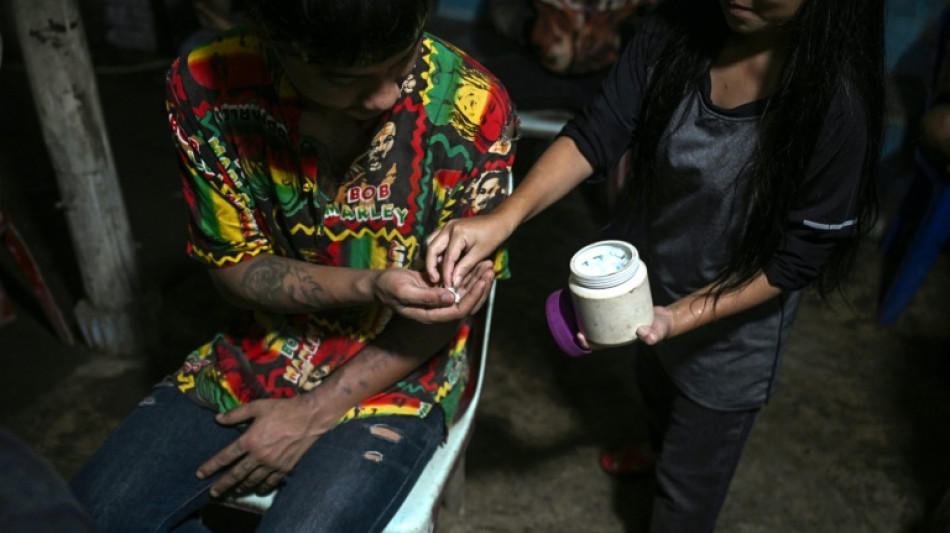
In a drug treatment centre in a wooden stilt house deep in the Thai jungle, young refugees from Myanmar wait patiently for the prick of an acupuncture needle.
They are among the thousands who have become addicted to methamphetamine and other synthetic drugs that have flooded camps housing those forced to flee their homes by Myanmar's civil war.
Myanmar's military ousted Aung San Suu Kyi's government in a February 2021 coup, igniting a conflict that has killed thousands, displaced nearly three million people and triggered a boom in drug production.
A rehabilitation programme across the border in Thailand, run by former addicts, is trying to help stem the rising tide of addiction among young people living in the camps.
"Youths from the camps are hopeless... they don't know what to do. They have no guarantee for jobs and no future," said Marip, a counsellor and former addict, using a pseudonym because of the stigma associated with addiction.
"They end up taking drugs. Drugs are easy to find in the camps," the 34-year-old told AFP at the camp in a remote forest location in Thailand's western province of Tak.
The Drug and Alcohol Recovery and Education (DARE) rehabilitation centre, funded by the UN and other aid agencies, uses acupuncture as part of its regimen along with massages to reduce drug cravings and yoga to help manage intense withdrawal pains.
The group operates in five refugee camps, as well as more than 40 villages in Myanmar's Karen state, and claims a 60 percent success rate for its 90-day treatment programme.
It did not allow AFP to speak to any of its patients or former cases, saying doing so would violate its treatment principles.
- 'Cheaper than beer' -
More than three years of conflict in Myanmar combined with the easy availability of drugs have created a "perfect storm", Edward Blakely, a director at DARE, told AFP.
"You have two large problems, trauma from people who fled their homes and saw their relatives killed and an abundant supply of drugs and a sense of hopelessness," he said.
The junta led by General Min Aung Hlaing is battling multiple armed groups opposed to its rule across the country.
As well as death and displacement, the conflict has also seen law enforcement wither, enabling drug gangs to ramp up production.
The "Golden Triangle" region where Myanmar, Thailand and Laos meet has long been a hub for the illegal drug trade.
But the UN Office on Drugs and Crime (UNODC) said in a report this year that methamphetamine production has "significantly increased", sending wholesale prices of the drug's crystal form crashing from over $10,000 a tonne in 2019 to $4,000 a tonne in 2023.
On the streets and in the camps, a tablet of "yaba" -- a potent mix of methamphetamine and caffeine -- can be bought for small change.
"They are so cheap at this point, it is really easy for people to buy drugs," Benedikt Hofmann, the UNODC's Southeast Asia and Pacific deputy representative, told AFP.
"Right now, in most parts of the Mekong, getting a tablet of yaba is cheaper than buying a beer."
- Drug-funded groups -
The displacement camps are in border regions of Myanmar mostly controlled by ethnic minority armed groups -- many of which fund their activities by making and trafficking drugs.
One senior anti-drugs police official in Myanmar told AFP that many new trafficking routes had opened up around the country due to the fighting.
"We face many difficulties in cracking down on the drug trade," the official who asked not to be named told AFP.
"The problem is severe, as many armed groups are involved."
The costs fall on those who have suffered most, and counsellor Marip told AFP: "There is no price that compares to the freedom from drugs."
J.Bergmann--BTB