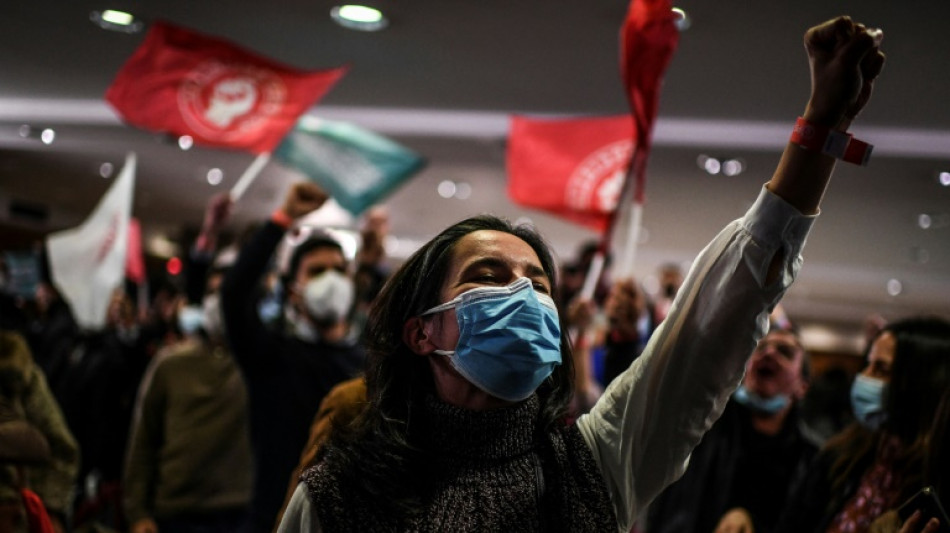
Portugal's Socialists win election marked by far right gains: exit polls / Photo: ©

 Prague’s Concert for the Future Kicks Off on Wenceslas Square

 Prince William and Princess of Wales to Announce Earthshot Prize Winners in Mumbai

 Indonesia Forest Fires: Health Crisis, Diplomatic Strains and the Search for Solutions

 BYD Dolphin G Leasing Deal: Plug-in Hybrid Supermini Available from £174 a Month

 JUEL Group Expands from Real Estate to Hospitality with Hyatt Centric Malta Opening

 French Economy Shrinks 0.1% as Consumer Confidence Slumps

 Wall Street Ends Turbulent Week Higher Despite Inflation and AI Jitters

 Kansas City Fed Chief Says Inflation Is Still Running Too Hot

Portugal's ruling Socialists won Sunday's early election by a wide margin but may still fall short of an outright majority while the far right made huge gains, exit polls showed.
Prime Minister Antonio Costa's party received between 37 percent and 42.5 percent of the vote, compared to between 27 percent to 35 percent for the main opposition centre-right PSD, according to the polls for TV stations RTP, SIC and TVI.
That would give the Socialists 100 to 118 seats in the 230-seat parliament, up from 108 in the outgoing assembly.
A party needs at least 116 seats to have an absolute majority.
A significant development was the rise of upstart far-right party Chega, which won up to 8.5 percent of the vote, which could make it the third-biggest party in the assembly with six to 14 seats.
The party has from just one lawmaker in the outgoing assembly and its rise mirrors gains for other populist far-right formations elsewhere in Europe.
The early election came as the nation of around 10 million people tries to boost its tourism-dependent economy which has been badly hit by the pandemic.
A stable government is needed for Portugal to make the most of a 16.6 billion euros ($18.7 billion) package of European Union recovery funds it is due to receive by 2026.
Costa, 60, had said during the campaign that he planned to govern alone if the Socialists failed to secure a majority, negotiating support from other parties for laws on a case-by-case basis.
- Skills and experience -
Costa has relied on two far-left parties -- the left Bloc and the Communist Party -- to underpin two minority Socialist governments since 2015.
But the two formations turned against him in October and joined forces with the right to vote down his draft 2022 budget, prompting Sunday's early election.
The Socialists had a comfortable lead when the election was called but the PSD managed to close the gap as the polls neared.
But while there is a "certain disenchantment" with the Socialists, most voters feel Costa has "more skills and experience to govern" than PSD leader Rui Rio, said University of Lisbon political scientist Marina Costa Lobo.
Under Costa's watch, Portugal has rolled back austerity measures, maintained fiscal discipline and slashed unemployment to pre-pandemic levels.
The country also achieved the highest immunisation rate against Covid-19 in Europe, with over 90 percent of its population fully vaccinated.
But the PSD's Rio argues the economy -- which the Bank of Portugal projects grew by 4.8 percent last year -- should expand faster.
He had called for lower corporate taxes and privatisations to boost Portugal's competitiveness and spur growth.
Portugal's Socialist party is faring better than its peers in many other European nations such as Greece and France where they have been virtually wiped off the map in recent years.
C.Kovalenko--BTB